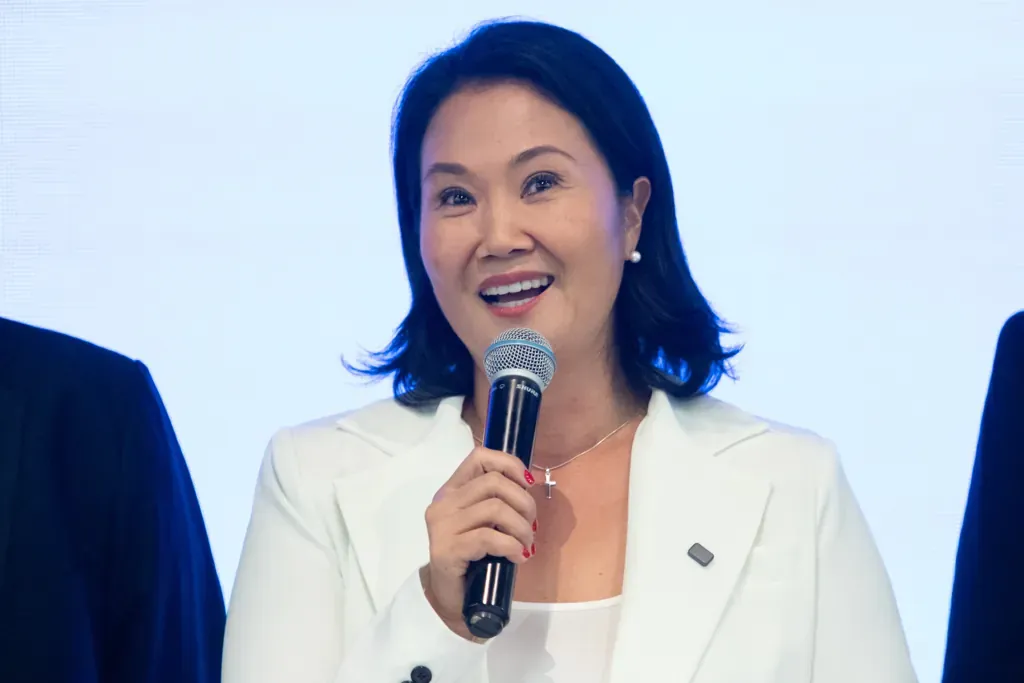
LIMA, Peru – Conservative leader Keiko Fujimori was sworn in as Peru’s president on Tuesday, beginning a five-year term with pledges to restore political stability and confront rising organized crime after more than a decade of political turbulence.
Fujimori, 51, returned to Peru’s presidential palace more than 25 years after serving as first lady following her parents’ divorce in 1994, during the presidency of her father, former President Alberto Fujimori.
She won the presidency in a closely contested June runoff against progressive candidate Roberto Sánchez, with overseas ballots proving decisive. The victory marked her fourth campaign for Peru’s highest office.

Organized Crime Emerges as Top Priority
Fujimori takes office as Peru faces growing concern over organized crime, particularly extortion, which has expanded sharply in recent years.
According to official figures cited by The Associated Press, reported extortion cases increased from 2,421 in 2019 to 26,734 in 2025.
Authorities say criminal groups have increasingly targeted small businesses through threats of bombings and arson while also extorting public transportation operators. Officials reported that 239 transport workers, most of them motorcycle taxi drivers serving lower-income communities, were killed in 2025.
During her election campaign, Fujimori pledged to combat organized crime with what she described as an “iron fist,” citing the security policies of Salvadoran President Nayib Bukele as a model.
She also proposed building a maximum-security prison modeled on El Salvador’s Terrorism Confinement Center and reintroducing masked judges, a judicial practice used during her father’s administration.
■ Related News



Opposition Calls for Legal Changes
Opposition parties have urged Fujimori’s administration to repeal several laws enacted by the previous Fujimori-led Congress that legal experts argue have weakened efforts to combat organized crime.
According to The Associated Press, critics say the legislation limits the use of preventive detention when suspects are not caught in the act, prevents prosecutors from classifying political parties as criminal organizations, raises the legal threshold for asset confiscation and makes effective collaboration agreements and law enforcement raids more difficult.
Fujimori has not publicly responded to those requests.
Human Rights Issues Continue to Loom
The new president also faces continuing pressure over the deaths of 50 civilians during anti-government protests in 2022 and 2023 following the removal of former President Pedro Castillo.
The demonstrations erupted after Castillo was dismissed from office, with then-President Dina Boluarte overseeing the government’s response.
Opposition groups have called for an independent commission to investigate the deaths.
Families of those killed said they do not recognize Fujimori’s presidency and planned demonstrations during her inauguration.
Milagros Samillán, whose brother was among those killed during the protests, accused Fujimori of protecting Boluarte and referred to her as the “daughter of a dictator” who violated human rights.
Castillo was later sentenced to 11 years in prison for conspiracy to commit rebellion. Some opposition leaders have urged Fujimori to release the former president.
Fujimori has not directly addressed those demands but said in mid-July that she “deeply believes in reconciliation.”
Political Stability Faces an Early Test
Beyond security concerns, Fujimori inherits a country seeking greater political stability after years of institutional upheaval.
Peru has had eight presidents over the past decade, reflecting persistent political instability despite an economy supported largely by the country’s mining sector.
Whether Fujimori can reduce political divisions while delivering on her promises to improve public security is expected to become one of the defining tests of her presidency.
This report is based on reporting by The Associated Press.