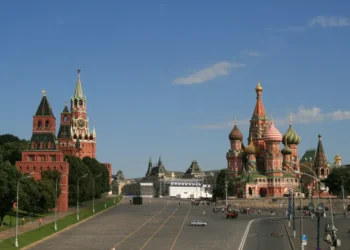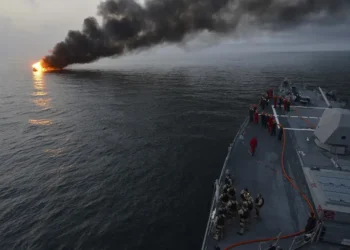
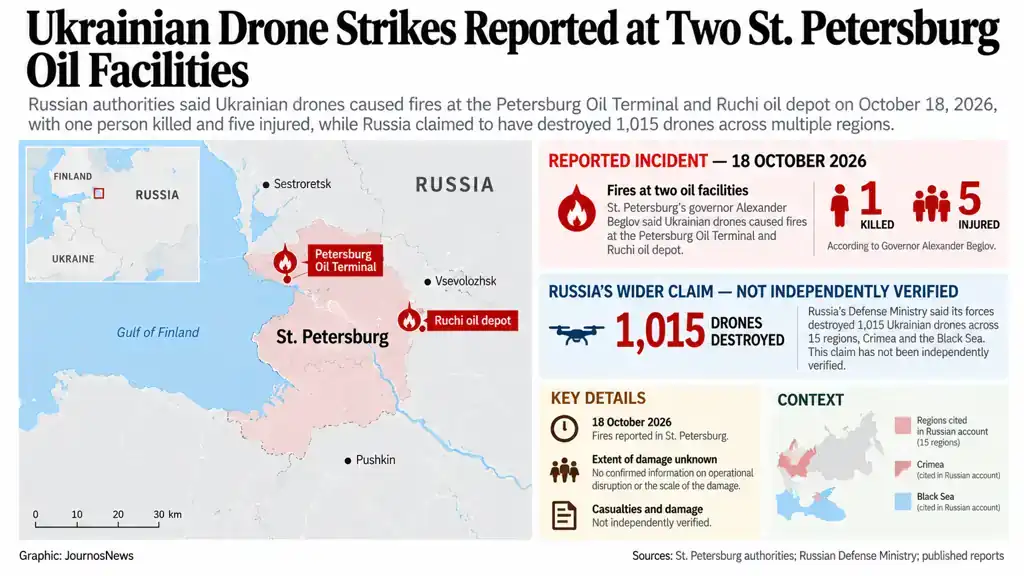
ST. PETERSBURG, Russia – Ukrainian drone strikes set fires at an oil export terminal and an oil depot in St. Petersburg on October 18, as Russia reported one of the largest Ukrainian aerial offensives of the war. Russian authorities said their forces destroyed 1,015 Ukrainian drones across multiple regions, Crimea and the Black Sea. The reported interception total has not been independently verified. Regional Governor Alexander Beglov said one person was killed and five were wounded in the St. Petersburg attack.
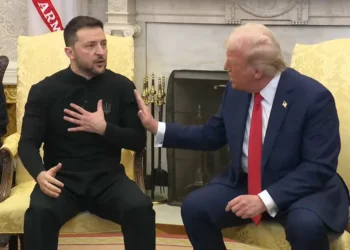
The offensive unfolded amid worsening public disagreements between U.S. President Donald Trump and Ukrainian President Volodymyr Zelenskyy over pressure on Russia, attacks against energy infrastructure and efforts to negotiate an end to the war. The political dispute forms part of the wider diplomatic context, but available evidence does not establish that it caused the Ukrainian operation.
Fires reported at St. Petersburg oil facilities
Beglov said Ukrainian strikes set fires at the Petersburg Oil Terminal and the Ruchi oil depot. The two sites handle oil-related operations, making the reported damage strategically significant. However, the available reporting does not establish the full extent of the damage, how long operations were disrupted or whether either facility was forced to suspend activity.

Russian companies also reported attacks on other infrastructure. Retailer Ozon said its logistics center was targeted, while technology company VK reported that its data center was also affected, according to AP. The extent of the damage at those sites has not been independently established.
The scale of the wider operation remains difficult to determine from the available public information. Russia’s Defense Ministry said it had destroyed 1,015 Ukrainian drones across 15 Russian regions, Crimea and the Black Sea. The figure is an official Russian military claim. The publicly available reporting reviewed for this draft does not provide independent confirmation of every interception or establish how many drones reached their intended targets.
The reported total should not be treated as proof that all 1,015 drones were part of one coordinated attack wave. A full assessment would require the original Defense Ministry statement, its reporting period and geographic breakdown, and corroborating evidence where available.
Casualties and damage remain under review
The reported toll in St. Petersburg stands at one person killed and five wounded, according to Beglov’s account cited by AP. The available material does not establish whether all casualties occurred at one facility or across multiple locations.
Further confirmation is needed from local emergency services and the companies operating the affected facilities. Independent imagery could help establish the locations of fires and visible damage, but images alone would not confirm casualties, operational disruption or the full extent of damage inside industrial sites.




The attacks occurred alongside continued Russian strikes against Ukraine. Ukrainian and regional officials reported damage to energy infrastructure and power outages in several areas. The Associated Press reported that Russian attacks on the southern Ukrainian city of Zaporizhzhia killed a woman and wounded at least two other people, including a six-year-old girl. Those incidents were separate from the Ukrainian offensive against Russia and should be assessed on their own evidence.
Trump defends sanctions decision as Zelenskyy objects
The military escalation came two days after Trump signed an executive order dated October 16 concerning the Lindsey O. Graham Sanctioning Russia and Iran Act of 2026.
The order invokes presidential waiver authority under the law and states that the administration had certified to Congress that the waiver was in the national interest. Its text specifically addresses duties under sections 112 and 113 of the act and duties provided for in the order. The legal effect should not be described as the removal of all U.S. sanctions against Russia. The precise scope of the waiver must be assessed against the full legislation and the administration’s accompanying certification.
Trump defended his decision by saying he did not want additional sanctions to undermine negotiations with Moscow. In comments reported by AP, he said he did not want to drive Russia away from the bargaining table and argued that he could impose sanctions later.
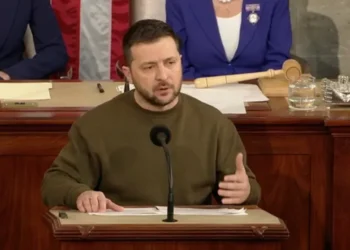
Zelenskyy took the opposite position. Speaking on NBC’s Meet the Press, he said waiving sanctions would strengthen Russia’s ability to continue its war. He also said U.S.-Ukraine intelligence sharing had resumed after being interrupted for a period.
The disagreement has not, however, amounted to a confirmed end to diplomatic contact. Zelenskyy said he had spoken with U.S. envoys Steve Witkoff and Jared Kushner about the results of an October 9 meeting between U.S. and Ukrainian negotiating teams and about next steps in diplomacy, AP reported.
The dispute also extends to attacks on Russian energy infrastructure. Trump has criticized Ukrainian strikes on Russian oil facilities, while Zelenskyy argues that Russia continues to attack Ukrainian energy sites. The leaders’ competing positions reflect a disagreement over how pressure on Moscow should be used in negotiations, but they do not by themselves establish that talks have collapsed.
The energy ceasefire remains unclear
On October 11, Trump announced that Russia and Ukraine had agreed to an “energy ceasefire.” He said it would take effect immediately but did not publicly provide detailed terms. The announcement therefore should not be treated as proof of a comprehensive ceasefire covering all military activity.
Zelenskyy initially said Ukraine supported the proposed arrangement and expected Russia to do the same. Ukrainian officials later reported continued Russian attacks on energy infrastructure. Ukraine also resumed strikes against Russian oil facilities after a three-day pause, according to AP.
On October 18, Zelenskyy said Russia had attacked Ukraine’s energy, oil and gas sectors 76 times in the week since Trump’s announcement. He also reported attacks on energy facilities in four Ukrainian regions overnight and said tens of thousands of families were without power.
The figure of 76 is Zelenskyy’s account and has not been independently verified in the material reviewed for this draft. A complete assessment would require the Ukrainian government’s incident list, definitions of what counted as an attack, and comparison with available Russian statements and independent reporting. The public record reviewed here also does not establish that Moscow and Kyiv agreed to the same written terms or that a formal bilateral agreement was signed.
Drone incursion raises separate concern for Lithuania
Ukraine’s Foreign Ministry apologized after a drone entered Lithuanian airspace on October 18. Ministry spokesperson Heorhii Tykhyi said the incident may have resulted from Russian electronic warfare diverting a drone during an operation against targets in Russia. He said Kyiv would share information with Lithuanian authorities to establish what happened, Reuters reported.
Lithuanian authorities reported an alert after an unidentified flying object entered the country’s airspace. AP, citing Lithuanian public broadcaster LRT, reported that a drone entered the northern Pasvalys region and damaged a moving car. No injuries were reported.
Ukraine’s explanation about electronic warfare remains an attributed possibility, not an established technical finding. The available reporting does not settle the drone’s precise route, the mechanism that brought it into Lithuanian airspace or the findings of any investigation. The incident should remain separate from the main offensive unless further evidence establishes a more direct operational connection.
What remains unknown
Several central questions remain unresolved. The available reporting does not independently establish Russia’s full interception tally, the number of drones that reached their targets or the complete extent of damage at the St. Petersburg facilities. Updated casualty figures and information about possible operational shutdowns also require confirmation.
The legal scope of Trump’s October 16 waiver needs to be assessed against the full text of the Graham Act and the administration’s certification to Congress. The October 11 energy-ceasefire announcement also lacks publicly established, mutually confirmed terms in the sources reviewed here.
The October 18 offensive and the dispute between Washington and Kyiv occurred at the same time, but the evidence does not show that one caused the other. The immediate reporting priority is to establish the attack’s verified effects, distinguish official claims from independently corroborated facts and determine whether subsequent diplomatic or military decisions change the situation.
Reporting Credit: Prepared by JournosNews through a review of publicly available reporting and official documents. Sources consulted for this draft include the White House executive order, Associated Press reporting, Reuters reporting on the Lithuanian airspace incident and reporting by The Guardian and The Washington Post. No direct interviews, independent on-the-ground observations or direct confirmations from the affected facilities have been completed for this draft. The Russian Defense Ministry’s original statement, the latest facility and emergency-service updates, the full sanctions certification and additional independent corroboration remain outstanding.