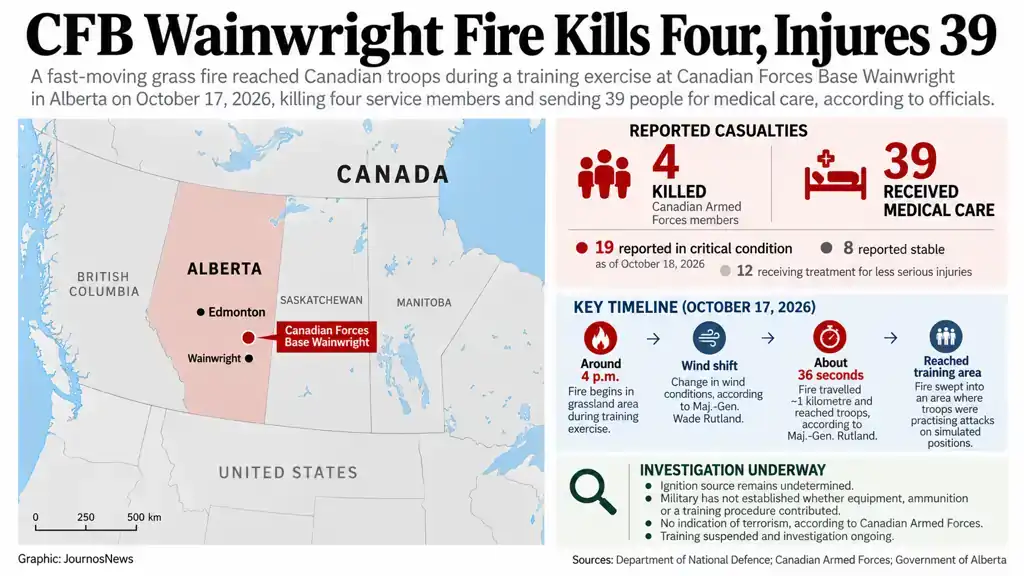
WAINWRIGHT, Canada – Four Canadian Armed Forces members died and 39 people required medical care after a fast-moving fire swept through a training area at Canadian Forces Base Wainwright in Alberta. Officials said 19 of the injured were in critical condition on October 18.
The fire began at about 4 p.m. local time on Saturday, October 17. It spread rapidly beyond the training area, catching soldiers during a live-fire exercise.
The military identified the dead as Sgt. Morgan Wong and Privates Shaun Farrell, Aidan Goulding and Hayden Lykkemark. Officials said their families had been notified.

The cause of the fire remains under investigation. Military officials have described a sudden change in wind conditions that drove the flames toward troops, but they have not established what first ignited the grass.
Four service members identified
The Canadian Armed Forces confirmed the four deaths on October 18. Sgt. Morgan Wong served with the Loyal Edmonton Regiment. Privates Shaun Farrell, Aidan Goulding and Hayden Lykkemark served with the 3rd Battalion, Princess Patricia’s Canadian Light Infantry.
The four were taking part in training at the base, east of Edmonton. Their deaths prompted condolences from military leaders and the federal government.
Prime Minister Mark Carney called the incident one of the worst peacetime tragedies for the Canadian Armed Forces on Canadian soil. He ordered flags on federal buildings lowered to half-staff to honour those who died.
Defence Minister David McGuinty and senior military officials also addressed the incident. The government said it would provide further updates as the investigation and emergency response continued.
■ Related News


A sudden wind shift drove the fire toward troops
Major-General Wade Rutland, commander of 1st Canadian Division, said the fire had been burning about one kilometre from the soldiers. Officials believed it was contained and that training could continue.
That changed when the wind shifted.
Rutland told reporters that the fire travelled the distance in about 36 seconds. A commander at the scene reported that soldiers went from seeing no immediate fire threat to facing flames in less than a minute.
About 84 soldiers were split between a grenade range and an area where they practised attacks on simulated enemy positions. The fire swept into the second training area.
Officials said strong winds had affected Alberta that day. Gusts reached about 100 kilometres per hour in parts of the region, although military officials said winds at the base had generally remained below 50 kilometres per hour earlier in the day.
The speed of the fire’s advance is now a central question for investigators. They will need to establish what warnings were available, how officials assessed the risk and how much time troops had to move away from the flames.
Hospitals treated 39 people
Alberta officials reported that 39 people received medical care after the fire. Nineteen were in critical condition, eight were stable and 12 were receiving treatment for less serious injuries, according to Acute Care Alberta chief executive Sayeh Zielke on October 18.
Some patients suffered severe burns and could require weeks or months of intensive treatment, Premier Danielle Smith said.
Emergency teams moved patients to hospitals in Edmonton, Calgary, Red Deer and Wainwright. The response involved ground ambulances, aircraft and helicopters, with support from neighbouring Saskatchewan.
Hospitals in Edmonton activated a Code Orange to manage the influx of casualties. That emergency measure helps hospitals prepare staff, beds and other resources for a mass-casualty event.
Officials said all patients had been accounted for by the October 18 briefing. Their medical conditions may change, so the figures should be treated as the latest confirmed public update available for this draft, not as a final casualty assessment.
Military investigation will examine the fire
The military has begun investigating the circumstances surrounding the fire. Officials have not confirmed what ignited it, and they have not announced a final finding about whether any equipment, ammunition or training procedure contributed to the incident.
The investigation is expected to examine the sequence of events, the conditions in the training area and the decisions made as the fire approached. Officials have also said they will consider whether safety procedures need to change.
Rutland said the military typically convenes a formal board of inquiry after incidents of this kind. He cautioned that determining what happened would take time.
The Canadian Armed Forces also said there was no indication of terrorism. That statement does not establish the cause of the fire; investigators still need to determine how it began and why it spread so quickly.
A preliminary report suggesting that a munition may have started a grass fire has not been confirmed as the final explanation. JournosNews has not independently verified that account. It should not be presented as fact without supporting evidence from the investigation.
Training suspended as questions remain
The military withdrew Charlie Company from the training area and suspended the battalion’s training on Sunday, October 18, according to the Associated Press’ account of the briefing.
Officials have not yet published a full timeline showing when personnel first detected the fire, when commanders received warnings and when they ordered troops to move. Those details will be important in assessing the response.
Investigators also need to establish which weather reports and fire warnings were available to range controllers. Military officials have said controllers use weather information to decide whether training can continue safely.
The fire crossed established firebreaks before crews brought it under control. It also moved beyond the base perimeter into nearby rural areas. Local officials said no evacuation order had been issued for residents of the nearby town of Wainwright.
The incident raises questions about how military training areas manage grass fires, sudden wind shifts and fast-changing hazards. Those questions do not, by themselves, establish negligence or a breach of safety rules.
What remains unknown
The confirmed toll is four dead and 39 people requiring medical care, including 19 in critical condition as of October 18. The military has identified the deceased and described how quickly the fire reached troops during training.
But key facts remain unresolved. Investigators have not established the source of ignition, the full sequence of events or whether any existing safety procedure needs revision.
The findings will also need to explain what commanders knew about the fire before the wind changed and how they assessed the risk to personnel. Updated medical information and any new restrictions on training should be confirmed before publication.
The investigation’s conclusions will determine whether the fire resulted from an unforeseeable change in conditions, a preventable hazard or a combination of factors. Until officials release more evidence, no single cause should be assumed.
The deaths have prompted national mourning and renewed attention to the risks faced by service members during training. Canadian military safety review will be important as investigators establish what happened and whether the Armed Forces should change its procedures.
Reporting Credit: The Department of National Defence’s October 18 incident statement and Prime Minister Mark Carney’s remarks were consulted for the confirmed deaths, incident chronology and official response. The Associated Press and Reuters reports were used for details from the October 18 military briefing, including the wind shift, training setup, medical response and investigation. The full briefing transcript, direct responses from investigators and updated medical information remain outstanding.