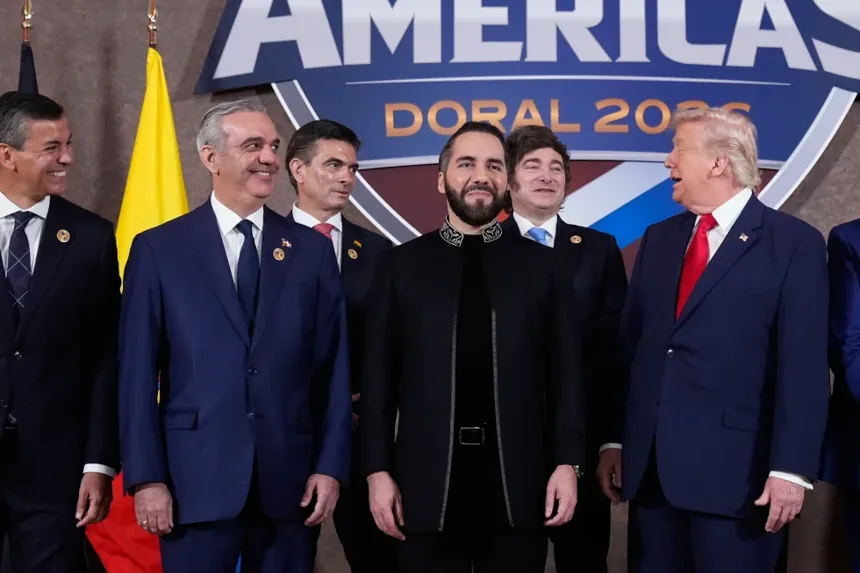
BOGOTA – A growing backlash against left-leaning governments is reshaping politics across Latin America, as concerns over crime, public security and migration drive support for conservative candidates promising tougher enforcement measures modeled in part on the policies of Salvadoran President Nayib Bukele.
The shift marks a significant political development in a region where progressive leaders gained power in several major countries earlier this decade amid public frustration over inequality and the economic fallout of the COVID-19 pandemic. Now, rising fears surrounding organized crime, extortion and cross-border criminal networks are increasingly influencing election campaigns and voter priorities.
Analysts and human rights advocates cited in public discussions say the trend reflects a broader regional debate over how governments should address persistent insecurity while balancing democratic institutions and civil liberties.

Security Becomes Dominant Electoral Issue
Crime has emerged as one of the most influential political issues in several Latin American countries, helping conservative and populist candidates build support through promises of rapid security improvements.
Enrique Roig, vice president of Human Rights First and a former U.S. State Department official, said an increasingly coordinated right-wing movement in the region has successfully used public concerns about crime as a political mobilizing tool.
Adam Isacson of the Washington Office on Latin America argued that voters frustrated by violence often favor policies that promise immediate results, even when long-term reforms may offer more sustainable solutions.
According to Isacson, proposals traditionally associated with the political left—such as community violence prevention programs, police reforms and judicial improvements—typically require years to show measurable outcomes, while hardline security campaigns offer voters a more immediate sense of action.
Organized Crime Continues to Shape Public Anxiety
Although regional homicide rates have generally declined over the past decade, several countries continue to experience significant violence linked to organized crime.
■ Related News


Data from InSight Crime indicated that Latin America and the Caribbean recorded a combined homicide rate decline of more than 5% last year compared with 2024, averaging roughly 17.6 killings per 100,000 residents. However, several countries have moved in the opposite direction.
Authorities in Peru recorded approximately 2,400 homicides last year, while Colombia reported 14,780 killings. Ecuador experienced a 31% increase in murders year over year, reaching 9,216 cases.
Officials and researchers have linked much of the violence to drug trafficking networks, prison gang conflicts and expanding criminal organizations operating across national borders.
Extortion has also become a growing concern. Ecuadorian authorities reported more than 16,000 extortion cases last year, though experts have suggested the true figure may be significantly higher because many incidents go unreported.
Bukele’s Model Gains Regional Influence
The security policies implemented by Bukele in El Salvador have become a frequent reference point for politicians seeking office elsewhere in the region.
Several candidates have promoted stricter border controls, expanded military involvement in public security and tougher prison conditions for gang members.
In Chile, concerns about crime and migration helped strengthen support for conservative leader José Antonio Kast, who campaigned on promises that included tougher immigration enforcement and stricter anti-gang measures. During his campaign, Kast visited El Salvador to observe Bukele’s prison system firsthand.
In Peru, presidential candidate Keiko Fujimori has centered much of her campaign on restoring public order amid rising concerns over extortion and organized crime. Her platform includes proposals to increase military involvement in prisons and border security.
Similar law-and-order themes have also played a significant role in recent elections in Costa Rica and Honduras.
Democracy Concerns Accompany Security Debate
The growing appeal of hardline security policies has sparked debate among academics, human rights advocates and political observers about the long-term implications for democratic governance.
Eduardo Moncada, director of the Institute of Latin American Studies at Columbia University, said declining public confidence in institutions has contributed to greater public openness toward more aggressive security approaches.
According to Moncada, some voters increasingly question whether democratic systems are capable of addressing crime effectively, creating space for leaders who promise stronger executive action.
The challenge has become particularly difficult for left-leaning governments that have struggled with sluggish economic growth, corruption controversies and unmet reform expectations in recent years.
Even some progressive leaders have adopted tougher rhetoric or security measures in response to public concerns. Examples cited in recent political debates include emergency anti-gang measures in Guatemala and statements from regional leaders suggesting elements of Bukele’s approach deserve examination.
Campaign Promises Face Governing Constraints
Despite their electoral appeal, security-focused campaign pledges have often encountered obstacles once candidates take office.
In Ecuador, President Daniel Noboa entered office promising major anti-crime initiatives, including large prison projects and other aggressive security measures. Some proposals were later scaled back or delayed as his administration confronted financial limitations and institutional challenges.
Chile has faced similar difficulties. Efforts to rapidly implement large-scale deportations and other security promises have proven more complicated than campaign rhetoric suggested.
Political analysts note that governing larger and more complex democracies presents challenges that differ significantly from conditions in El Salvador, where Bukele’s party maintains overwhelming legislative control.
As crime continues to dominate political discourse across Latin America, governments throughout the region are confronting the challenge of balancing demands for stronger security with legal, financial and democratic constraints. Whether voters remain supportive of hardline approaches may depend on whether those policies deliver measurable improvements in public safety.
Tags: Latin America, Nayib Bukele, Crime, Organized Crime, Elections, Migration, Security Policy, Democracy