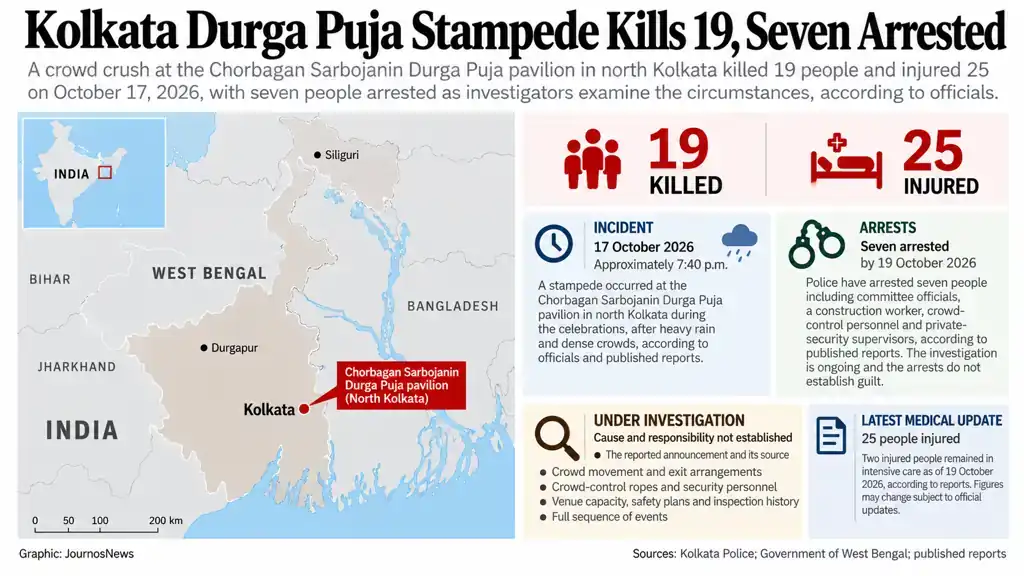
KOLKATA, India – Nineteen people died and 25 were injured in a stampede at the Chorbagan Durga Puja pavilion in Kolkata on October 17, as heavy rain and a surge of people near the venue preceded the deadly crowd crush. By October 19, seven people had been arrested in connection with the incident, while investigators examined possible failures in crowd control, access arrangements and emergency communication. The precise sequence of events and the contribution of individual actions remain under investigation.
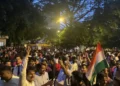
The incident occurred at the Chorbagan Sarbojanin Durga Puja pavilion in north Kolkata during Maha Saptami, an important day of the annual Hindu festival. Police said the stampede occurred at about 7:40 p.m. amid heavy crowds and rain. Early reports said visitors rushed toward the pavilion or sought shelter from the downpour, causing people to fall near an exit.
The death toll rose from the initial reports of 17 fatalities to 19 as authorities updated the casualty count. West Bengal Chief Minister Suvendu Adhikari said 19 people had died and 25 were receiving treatment. The latest reporting available on October 19 said two of the injured remained in intensive care.

What happened before the stampede
The available accounts point to a crowd surge during heavy rain, but they do not yet provide a complete, independently corroborated minute-by-minute timeline.
A Kolkata Police statement reported by The New Indian Express said the stampede occurred at the pavilion’s exit gate at about 7:40 p.m. because of heavy crowds during rain. Police said injured people were rescued and taken to hospital, with personnel from the police, fire brigade, disaster-management teams and medical services deployed to the scene.
Other reporting described people gathering in narrow lanes near the venue and rushing for cover when the rain intensified. The Indian Express reported on October 19 that the venue had one exit and that crowd-control ropes were dropped during the incident. It also reported that investigators were examining the role of announcements made by the organizers. These details raise questions about how the crowd was managed, but they do not, on their own, establish which decisions directly caused the deaths.
The authorities have not publicly established a verified crowd count at the moment of the crush or disclosed a documented maximum capacity for the pavilion. Without those figures and the relevant venue plan, it is not possible to quantify how far attendance exceeded any approved limit.
The reported announcement remains a key question
Chief Minister Adhikari said an announcement by the organizers contributed to the rush that preceded the stampede, according to reporting by The New Indian Express. Subsequent reports said an announcement warning that the pavilion might collapse may have caused alarm among visitors.


The original recording of the announcement, its exact wording and the identity of the person who made it have not been independently established in the material reviewed for this draft. Nor has a publicly available engineering assessment confirmed whether the pavilion was in danger of structural failure when the announcement was made.
Those distinctions matter. An announcement could have been inaccurate, misunderstood or based on information available to the speaker at the time. Without the recording, witness accounts that can be independently checked and the findings of investigators, it would be premature to describe the warning as the definitive cause of the stampede.
The investigation needs to establish what was said, why it was said, how the crowd responded and whether organizers or officials had grounds to believe the structure was unsafe.
Questions about crowd control and exits
The Indian Express reported that investigators were examining the number and experience of volunteers, the availability of exits and the handling of ropes used to control the crowd. Its October 19 report said police were looking into claims that security arrangements were inadequate and that home guards had dropped their ropes and moved away during the rain. The account raises questions about staffing and the maintenance of crowd-control barriers, but the details remain subject to investigation.
The public information reviewed for this draft does not establish the pavilion’s approved capacity, the width and number of its exits, the contents of its emergency plan or whether a pre-event inspection identified specific deficiencies. It also does not establish whether any applicable safety requirement was formally found to have been breached.
A reliable assessment will require the venue’s plans and permissions, inspection records, the crowd-management arrangements agreed with authorities and evidence from people responsible for security on the night. Until those records are available, reported shortcomings should be treated as investigative questions rather than settled findings.
Seven people arrested as investigation continues
By October 19, seven people had been arrested in connection with the stampede. The Indian Express reported that the accused included Chorbagan Sarbojanin Durga Puja committee secretary Raj Kumar Sewda, vice-president Santanu Dubey, pandal construction worker Biplab Mukherjee, crowd-control personnel Koushik Saha and Pintu Dey, and private-security in-charges Suman Chakraborty and Rajesh Pal.
The Indian Express reported that the case had been registered under Sections 105, 110 and 3(5) of India’s Bharatiya Nyaya Sanhita. The provisions cited in reporting concern culpable homicide, attempt to commit culpable homicide and common intention. The exact application of each provision to each accused should be checked against the formal police case record and court documents before publication.
NDTV reported on October 18 that a local court remanded the seven accused to 10 days of police custody. That is a procedural step that allows the investigation to continue; it is not a finding that the accused are guilty.
Authorities have said they are investigating potential crowd-control and safety failures. The available reports do not establish that a court has determined the cause of the stampede or assigned final legal responsibility. The evidence disclosed publicly so far does not answer whether the main failures involved planning, staffing, the announcement, access restrictions or a combination of factors.
Victims, medical care and government response
The latest reported toll remains 19 dead and 25 injured. Chief Minister Adhikari visited Kolkata Medical College and Hospital, where victims were taken, and said an investigation would be conducted. The Indian Express reported on October 19 that two injured people remained in intensive care. A fresh hospital or state health department update is needed to establish whether that number has changed.
The authorities have not provided a complete, independently verified public list of victims and their ages in the sources reviewed for this draft. Names should be added only after confirmation through reliable official records and, where appropriate, family members.
Prime Minister Narendra Modi’s office announced compensation of ₹200,000 for the family of each person who died and ₹50,000 for each injured person, according to Reuters reporting. The announcement establishes the stated assistance amounts; the sources reviewed do not establish how many payments had been completed by October 19.
The pavilion was closed after the incident. The Associated Press reported that authorities advised several of Kolkata’s busiest Durga Puja venues to temporarily suspend public entry. That was a precautionary response, but the reporting reviewed does not establish that every affected venue had closed or that a uniform citywide inspection programmed had been completed.
Why crowd safety matters during Durga Puja
Durga Puja is one of West Bengal’s major annual religious and cultural celebrations. Organizers build temporary or specially constructed pavilions, known as pandals, to display images of the goddess Durga and welcome worshippers and visitors. The festival attracts large crowds to venues across Kolkata.
The Associated Press reported that about 3,500 pandals had been set up across the city for the festival. Large attendance makes safe entry and exit routes, clear public announcements, trained crowd-control staff and workable emergency plans important parts of event management.
Fatal crowd crushes have occurred at other religious gatherings in India, but those incidents should not be treated as having the same cause as the Chorbagan disaster. The relevant question here is whether the arrangements at this particular venue were adequate for the crowd, the weather and the emergency that unfolded on October 17.
The incident also highlights the need to distinguish a rapid crowd surge from a proven breach of safety regulations. That determination depends on the applicable rules, the venue’s approved arrangements and the evidence collected during the investigation.
What remains unknown
As of October 19, the central questions remain unresolved. The available reporting does not establish the exact wording or source of the announcement, whether there was a genuine structural risk, how many people were inside or immediately outside the pavilion, or whether the venue complied with all applicable safety requirements.
The public evidence also does not yet provide a complete reconstruction of the crowd’s movement, the response of individual security personnel or the precise sequence in which people fell. The arrests indicate that investigators are pursuing potential criminal responsibility, but they do not establish guilt.
The next important evidence will include the original announcement recording, CCTV footage, witness accounts, the venue’s capacity and exit plans, inspection records, and the formal police and court documents. Until those materials are assessed, the cause of the stampede should be described as under investigation.
Durga Puja crowd safety is an appropriate internal link for related Journos News reporting on festival crowd management and public-event safety.
Prepared by Journos News using reporting from The Associated Press, The Indian Express, The New Indian Express, NDTV and Reuters. The reporting completed for this draft includes comparison of the published casualty updates, reported arrests, legal provisions and preliminary accounts of the crowd surge. Direct interviews with Kolkata Police, the organizers, survivors, victims’ families, treating hospitals or venue-safety officials have not been conducted for this draft. The original announcement recording, complete police case file, court documents, venue capacity and safety plans, inspection records and final inquiry findings remain outstanding.