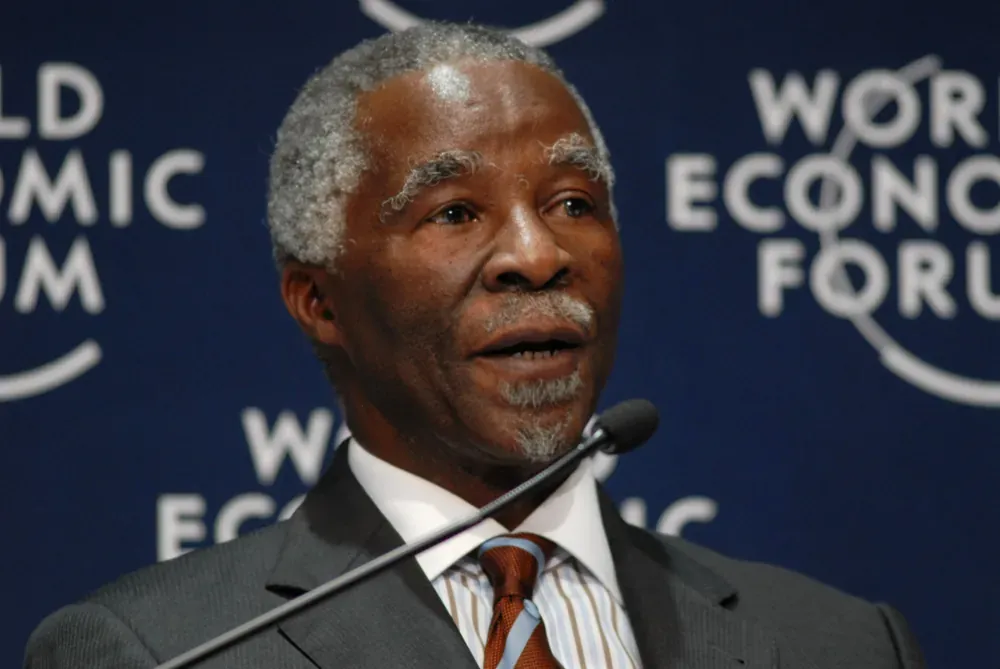
JOHANNESBURG, South Africa – Former president Thabo Mbeki on October 19 denied ordering prosecutors to halt cases involving apartheid-era crimes or making secret agreements to shield former security officials from prosecution, testifying before a judicial inquiry examining allegations of political interference in investigations and prosecutions referred by the Truth and Reconciliation Commission (TRC).
“It’s a complete fabrication. There was no such thing,” Mbeki told the Khampepe Commission of Inquiry, according to The Associated Press. He argued that the National Prosecuting Authority (NPA), rather than the president or Cabinet, was responsible for deciding whether cases should be prosecuted.
The inquiry is examining whether efforts were made to influence or pressure investigators and prosecutors to stop pursuing TRC-related cases. Mbeki’s testimony addresses a central question in the inquiry: whether decisions and discussions within successive administrations contributed to the failure to bring more perpetrators of apartheid-era abuses before the courts.

Inquiry examines decades of stalled prosecutions
President Cyril Ramaphosa announced the commission in May 2025 following litigation by families of victims of apartheid-era crimes. It is chaired by retired Constitutional Court Justice Sisi Khampepe, with retired judge Frans Diale Kgomo and Advocate Andrea Gabriel SC serving alongside her. Its mandate includes examining alleged attempts to stop investigations or prosecutions and identifying who may have been responsible.
The TRC, which operated during South Africa’s transition from apartheid, offered amnesty to people who met its requirements for full disclosure of politically motivated crimes. Those who were refused amnesty or did not apply could remain liable to prosecution.
The commission referred approximately 300 cases to the NPA for further investigation and possible prosecution. That figure describes referrals, not criminal charges or convictions. Only a small number of the referred cases resulted in successful prosecutions, according to reporting on the inquiry and reviews of the post-TRC prosecution process.
The reasons for the limited progress are among the matters requiring scrutiny. Allegations of political interference sit alongside documented practical obstacles, including missing evidence and the deaths of witnesses or suspects. Some cases have been closed because accused people died or were found medically unfit to stand trial, according to material published by the inquiry.
The NPA’s handling of the referrals has also faced criticism. An inquiry-related review said the authority had not provided a clear account of each of the approximately 300 cases. The review noted that the NPA’s dedicated TRC component initially handled 114 matters, a figure that increased to 134 following an audit. Those numbers refer to matters within the component’s work at that stage, not to the total number of prosecutions or convictions.
■ Related News

Mbeki’s 2003 address is central to the dispute
The controversy partly concerns Mbeki’s April 15, 2003, parliamentary address responding to the TRC’s final report. In that speech, he rejected the creation of a general amnesty for people who had not applied to the TRC, saying such an approach would undermine accountability and the rights of victims.
Mbeki said the matter had been left to the National Directorate of Public Prosecutions to pursue cases it believed deserved prosecution and could be prosecuted. He also said prosecutors, working with intelligence agencies, would remain open to lawful arrangements with people willing to disclose information and cooperate in uncovering the truth. The address said victims’ involvement would be crucial in any such arrangements.
Critics have argued that the proposed arrangements created scope for political interference or protection for former security officials. Mbeki has denied that his speech authorized blanket immunity or an agreement to stop prosecutions.
In his testimony, Mbeki acknowledged meeting former military and police officers but denied agreeing to shield them from prosecution. According to AP, he said those discussions were intended to encourage their participation in the truth and reconciliation process. He also maintained that the 2003 address concerned people who had not participated in the TRC’s amnesty process, rather than cases the commission had referred for prosecution.
The speech’s wording is relevant to the inquiry, but its meaning must be assessed alongside testimony, documents and evidence about what happened after 2003. The public record reviewed for this draft does not establish a final commission finding that Mbeki personally obstructed prosecutions.
Prosecutorial independence and executive responsibility
South Africa’s NPA is responsible for decisions about criminal prosecutions. Mbeki has argued that neither he as president nor his Cabinet had the authority to direct prosecutors to pursue or abandon individual cases. He has said the NPA should explain why cases referred by the TRC were not pursued.
The commission’s task is broader than determining how prosecutorial powers are formally allocated. Its terms include examining whether officials or others tried to influence or pressure members of the South African Police Service or the head of the NPA to stop TRC cases, who may have made such attempts, and whether officials improperly colluded with them.
Establishing whether improper interference occurred requires evidence about specific decisions, communications and conduct. The existence of prosecutorial independence does not, by itself, resolve whether individuals attempted to influence investigators or prosecutors; equally, the failure of cases to progress does not by itself prove that Mbeki directed or caused that outcome.
Mbeki and former president Jacob Zuma previously challenged Khampepe’s participation in the inquiry, arguing that her earlier roles in the TRC and NPA created concerns about impartiality. The Constitutional Court considered those challenges in a judgment delivered on August 31, 2026, and did not grant the relief sought. The case concerned the recusal challenge, rather than a final determination of whether the alleged interference in TRC cases occurred.
Victims’ families continue to seek answers
The inquiry followed legal action by victims’ families and survivors seeking progress on cases that have remained unresolved for decades. Ahead of Mbeki’s testimony, the Foundation for Human Rights and 25 families of victims and survivors called for an explanation of why the cases had not been prosecuted.
Foundation executive director Zaid Kimmie told AP that families wanted a candid account of why they had been denied justice after years of waiting.
The delays have had consequences beyond the legal process. As time passes, evidence can become harder to obtain, witnesses and suspects may die, and families can lose the opportunity to see cases brought to court. The inquiry is examining the reasons for the stalled cases, including allegations of interference and the practical obstacles to prosecution.
The commission’s findings may help establish responsibility for decisions or conduct that impeded investigations, but its conclusions remain pending. The inquiry must assess the evidence presented rather than treat either the allegations or Mbeki’s denial as a final determination.
Commission faces December reporting deadline
Ramaphosa extended the commission’s term in May 2026 to allow it to complete its work and submit a final report by December 18, 2026. The extension followed a request from the commission and consideration of submissions both supporting and opposing it.
AP reported that Mbeki’s testimony was continuing on October 20, with three former Cabinet ministers expected to appear later in the week. Zuma’s appearance, initially scheduled for October 22, had been postponed to a date yet to be confirmed. Those hearing arrangements may change as proceedings continue.
The inquiry’s outstanding task is to determine whether attempts were made to obstruct TRC-related investigations or prosecutions, who was responsible if they occurred, and what institutional failures allowed cases to remain unresolved. Until the commission reports its conclusions, Mbeki’s denial remains his account of the events, while allegations of interference remain matters for the inquiry to assess.
TRC Case Accountability is a suitable internal-link marker for a related Journos News article, if one exists.
Reporting Credit: The Associated Press and Eyewitness News for reporting on Mbeki’s testimony; the South African Presidency’s commission announcements; the TRC Cases Inquiry’s published materials; the Constitutional Court’s judgment and media summary; the published text of Mbeki’s April 15, 2003, parliamentary address; and inquiry-related reviews of TRC prosecutions.