Journos News - Breaking News, World News, Top Stories, Todays Headlines and Flash Reports
Thursday, September 24, 2026
  • Login
  • Home
  • World
    • Africa
    • Americas
    • Asia
    • Europe
    • Middle East
    • Oceania
  • Politics
  • Business
  • Technology
  • Health
  • Science
  • Sports
  • Entertainment
  • Culture
No Result
View All Result
  • Home
  • World
    • Africa
    • Americas
    • Asia
    • Europe
    • Middle East
    • Oceania
  • Politics
  • Business
  • Technology
  • Health
  • Science
  • Sports
  • Entertainment
  • Culture
No Result
View All Result
Journos News - Breaking News, World News, Top Stories, Todays Headlines and Flash Reports
No Result
View All Result
Home World News Middle East

Iraq Struggles to Balance U.S. and Iran as Regional War Intensifies

Baghdad faces pressure to disarm Iran-aligned militias while avoiding a wider confrontation that could destabilize Iraq.

The Daily Desk by The Daily Desk
August 10, 2026
in Middle East, World News
0
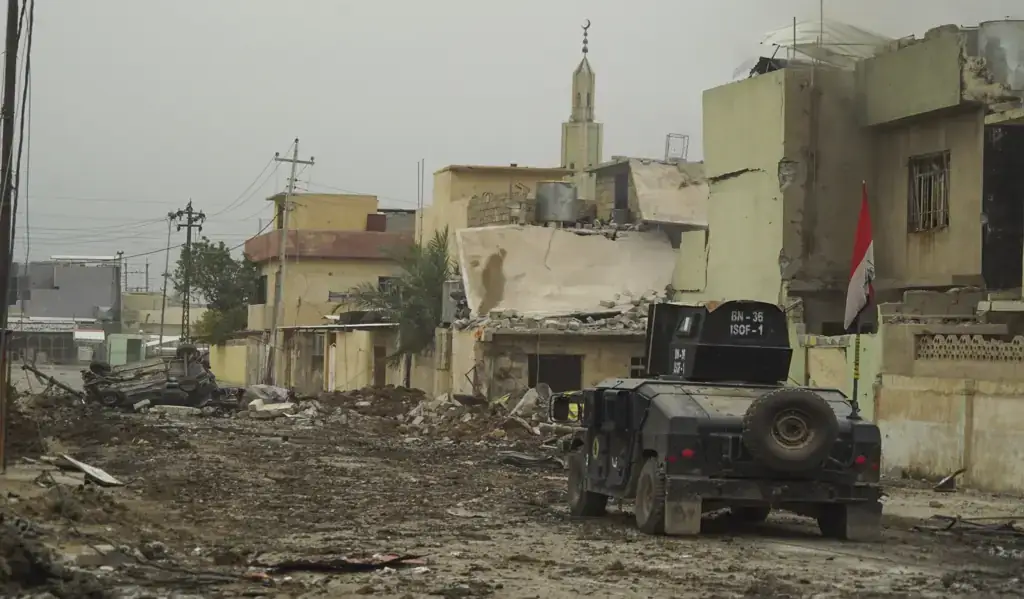
An Iraqi Special Operations Forces armored personnel carrier drives along a street in Mosul during the battle against Islamic State forces.

An Iraqi Special Operations Forces armored personnel carrier moves through a street in Mosul, Iraq, during the battle against Islamic State forces on Nov. 16, 2016. — Photo by Mstyslav Chernov.

BEIRUT, Lebanon – Iraq is facing increasing pressure to confront Iran-aligned armed groups as the widening U.S.-Iran conflict threatens to draw the country deeper into the regional war.

Prime Minister Ali al-Zaidi’s government has spent years trying to maintain working relationships with both Washington and Tehran while preventing Iraq from becoming a battleground between competing powers. That strategy is becoming more difficult as Iran-aligned Iraqi militias attack U.S. interests and regional targets, prompting retaliatory strikes.

The dispute is also intensifying a longstanding debate over whether Baghdad can bring powerful armed factions fully under state control without triggering an internal confrontation.

Strikes expose Iraq’s security dilemma

Saudi Arabia accused Iran-backed Iraqi armed groups of using drones to attack petroleum facilities on Monday and Tuesday. The groups denied involvement, with the Islamic Resistance in Iraq describing the accusations as fabrications and suggesting that Iran-backed Houthi forces in Yemen were responsible.

Saudi and U.S. retaliatory strikes subsequently hit bases belonging to the Popular Mobilization Forces, or PMF, a coalition of predominantly Shiite armed groups with close ties to Iran.

The PMF said the strikes killed at least 20 of its members and wounded 32 others.

Iraq’s National Security Council condemned the attacks, saying they caused civilian casualties and undermined the authority of the Iraqi state. The council said the government had been investigating concerns raised by Saudi Arabia and the United States and remained committed to bringing weapons under state control.

The escalation also disrupted planned diplomacy. Al-Zaidi had been scheduled to travel to Saudi Arabia on Thursday, but the visit was postponed indefinitely after the latest hostilities.

■ Related News

Brazilian President Luiz Inácio Lula da Silva at the Palácio da Alvorada in Brasília on July 9, 2026.

Lula Warns Against Foreign Interference in Brazil’s Election

September 23, 2026
Leaders from the United States, Denmark, and Greenland attend a security agreement signing ceremony on September 22, 2026.

Trump Signs U.S.-Denmark-Greenland Deal to Expand Arctic Security Presence

September 23, 2026
Courtroom hearing shows judges seated at the bench, defendants facing forward, lawyers and police officers present during proceedings.

Sri Lankan Court Gives 15 Men Effectively Life Sentences for Easter Bombings

September 23, 2026
U.S. President Donald J. Trump addresses the United Nations General Assembly in New York on September 25, 2018.

Trump Says U.S. and Iranian Officials Held Talks After UN Threat

September 23, 2026

PMF factions maintain ties to Iran

The PMF became a major military force after Islamic State militants captured large areas of Iraq in 2014. Predominantly Shiite and Iran-backed factions joined the fight against Islamic State alongside the U.S.-led international coalition.

Iraq formally recognized the PMF as an independent military formation within the country’s armed forces in 2016. Several of its constituent factions, however, have retained significant operational and command autonomy.

Lahib Higel of the International Crisis Group said that while the PMF formally reports to Iraq’s military command, many brigades have continued to operate through command structures developed when they functioned as separate armed groups.

That autonomy has become more consequential during the current regional conflict. Since the United States and Israel went to war with Iran on Feb. 28, Iran-aligned Iraqi militias have repeatedly targeted U.S. military bases and diplomatic facilities, as well as energy infrastructure.

Disarmament puts Baghdad under pressure

Al-Zaidi’s government has committed to disarming armed groups operating outside direct state control. The government has set Sept. 30 as the deadline for non-state factions to surrender their weapons, coinciding with the deadline for U.S. troops stationed in Iraq to complete their withdrawal.

The policy puts Baghdad under competing pressures.

Washington is likely to seek stronger action against Iran-aligned militias, while confronting the most powerful factions directly could risk armed conflict inside Iraq. Delaying disarmament, meanwhile, could increase tensions with the United States.

Al-Zaidi came to power earlier this year as a consensus candidate following months of political deadlock after parliamentary elections. He was backed by a coalition of Shiite parties aligned with Iran but has also received support from U.S. President Donald Trump, who welcomed him at the White House this month.

The competing relationships leave the Iraqi government with limited room to maneuver as it attempts to preserve relations with both Washington and Tehran.

Some factions reject disarmament

Some PMF factions could potentially be incorporated more fully into Iraq’s armed forces and placed under centralized military command. Others, including the powerful Kataib Hezbollah, which maintains particularly close ties to Iran, have rejected disarmament.

Higel said the process could take months or years and that only a small number of factions had agreed to surrender their weapons. Groups that identify themselves as part of the regional “resistance” have rejected the government’s approach.

She said continued fighting between the United States and Iran could make disarmament more difficult because factions that identify with Iran’s regional network may view the conflict as an opportunity to continue armed operations.

Iraq seeks to preserve state authority

For Baghdad, the challenge extends beyond whether individual militias will surrender their weapons. The government must attempt to consolidate control over armed forces while avoiding a domestic confrontation with groups that possess military capabilities, political influence and ties to Iran.

The Sept. 30 disarmament deadline could therefore become an important test of the government’s ability to strengthen state authority while managing pressure from both Washington and Tehran.

As the U.S.-Iran conflict continues, Iraq’s longstanding effort to balance its relationships with the two powers faces increasing strain. Baghdad’s ability to maintain that position will depend in part on whether it can address militia activity without opening another front inside the country.

This report is based on reporting by The Associated Press.

Tags: #Iran#IranAlignedMilitias#Iraq#MiddleEastConflict#NationalSecurity#PopularMobilizationForces#UnitedStates#USIranConflict
The Daily Desk

The Daily Desk

The Daily Desk is the editorial byline of Journos News, representing reporting produced by the newsroom across world news, politics, business, technology, disasters, and other areas of public interest. Stories published under this byline are independently researched, verified, and edited in accordance with Journos News’ editorial standards, with an emphasis on accuracy, transparent sourcing, attribution, context, and editorial independence.

Related Posts

Empty United Nations General Assembly Hall in New York City, photographed on August 8, 2024, with no session in progress.

Middle East Wars Dominate UN Assembly as Iran Diplomacy Faces New Test

September 23, 2026
Iranian and Azerbaijani troops participate in the Aras-2025 joint military exercise in the Karabakh region in May 2025.

Iran Guards Warn of Wider War if U.S. Escalates Conflict

September 21, 2026
Asian markets rise as U.S.-China trade talks support sentiment, with semiconductor stocks and oil prices featured in the market overview.

Asian Stocks Rise as U.S.-China Talks Set Stage for Trump-Xi Summit

September 21, 2026
Yemeni military spokesperson Yahya Saree photographed in 2026 in an image sourced from Tasnim News Agency.

Saudi Arabia Says Houthis Targeted Riyadh With Ballistic Missile

September 21, 2026
Houthi supporters protest Saudi-led coalition airstrikes in Sana'a, Yemen, on September 4, 2015.

How the Houthis Are Turning Yemen Into a New Front in the Iran War

September 21, 2026
U.S. Navy guided-missile destroyer USS Carney engages missiles and unmanned aerial vehicles over the Red Sea on October 19, 2023.

How the Houthis Opened a Volatile New Front in the Iran War

September 19, 2026
U.S. Coast Guard fast response cutter USCGC Glen Harris sails through the Strait of Hormuz on August 22, 2022.

US Iran War Costs Reach $43.6 Billion as Military Spending Surges

September 19, 2026
Iranian girls participate in the 22 Bahman rally marking the anniversary of Iran’s Islamic Revolution in Tehran on February 10, 2017.

Hundreds of Thousands Rally in Tehran as Iran Mobilizes New Volunteer Force

September 19, 2026
Load More
Next Post
Diorama at Hiroshima Peace Memorial Museum showing the city after the atomic bomb blast, with a red marker indicating the blast location.

Nagasaki Anniversary Highlights Japan’s Nuclear Policy Dilemma

Myanmar Prime Minister Min Aung Hlaing meets Russian Federation Council Chairperson Valentina Matviyenko in Moscow on March 4, 2025.

Myanmar Rejects ASEAN Pressure Over Suu Kyi as Peace Effort Falters

JournosNews logo

Journos News delivers globally neutral, fact-based journalism that meets international media standards — clear, credible, and made for a connected world.

  • Categories
  • World News
  • Politics
  • Business & Markets
  • Technology
  • Health
  • Science
  • Sports
  • Arts & Culture
  • Resources
  • Editorial Standards
  • Submit a Story
  • Advertise with Us
  • Syndication & Partnerships
  • Site Map
  • Press & Media Kit
  • Editorial Team
  • Careers

Join thousands of readers receiving the latest updates, tips, and exclusive insights straight to their inbox. Never miss an important story again.

  • About Us
  • Editorial & Trust Center
  • Contact Us
  • Privacy Policy
  • Terms of Use & Copyright Notice

© JournosNews.com All rights reserved.

Welcome Back!

Login to your account below

Forgotten Password?

Retrieve your password

Please enter your username or email address to reset your password.

Log In
JournosNews

Independent Journalism.
Verified Facts.

You're about to read a professionally edited article from JournosNews.com.

Every article is produced in accordance with our editorial standards, emphasizing factual accuracy, transparent attribution, fairness, editorial independence, and meaningful context.

Editorial Standards
No Result
View All Result
  • Home
  • World
    • Africa
    • Americas
    • Asia
    • Europe
    • Middle East
    • Oceania
  • Politics
  • Business
  • Technology
  • Health
  • Science
  • Sports
  • Entertainment
  • Culture

© JournosNews.com All rights reserved.

This website uses cookies. By continuing to use this website you are giving consent to cookies being used. Visit our Privacy and Cookie Policy.