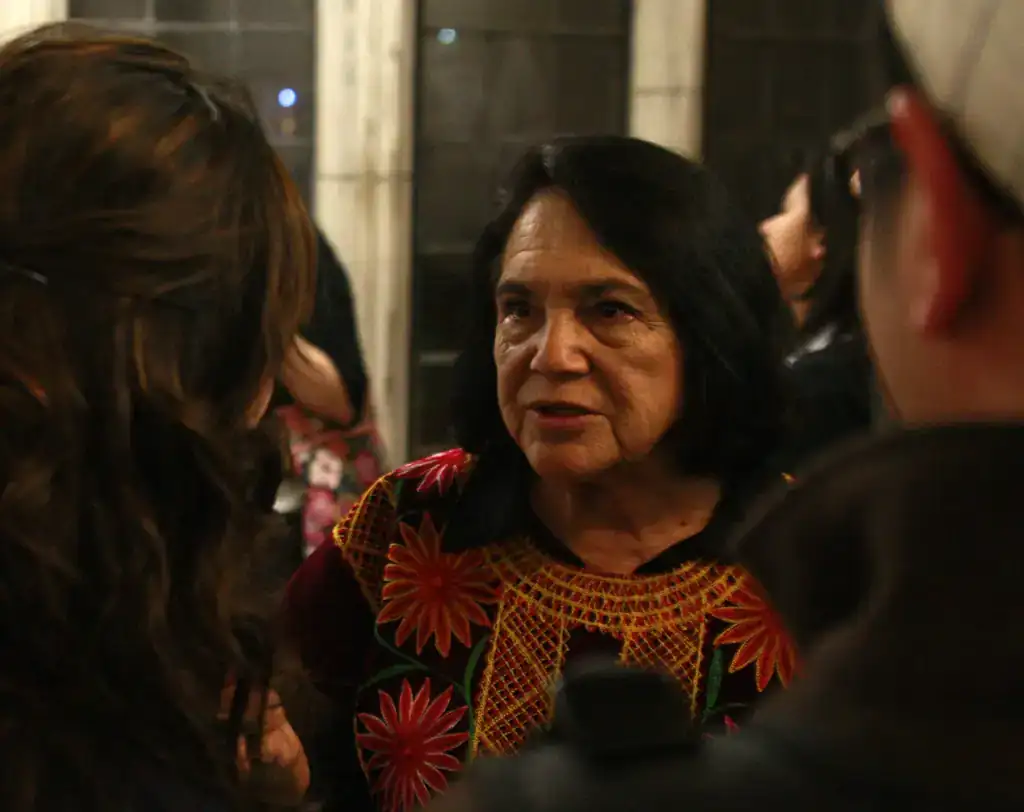
BAKERSFIELD, United States – Dolores Huerta, the labor organizer who helped transform the fight for farmworkers’ rights in the United States, died at home in Bakersfield, California, on October 28, 2026. She was 96. Her family announced her death through the Dolores Huerta Foundation. A family spokesperson attributed her death to cancer.
For more than six decades, Huerta organized workers, lobbied lawmakers, registered voters and challenged discrimination. She helped build the organization that became the United Farm Workers (UFW), fought for stronger labor protections and pushed for greater political representation for women and Latino communities.
Her work reached beyond the fields. She advocated for immigrant rights, reproductive freedom, voting rights and community-led change. In 2002, she established the Dolores Huerta Foundation to train new organizers and help communities influence the decisions affecting their lives.

Huerta’s legacy also reflects the complicated history of the movement she helped lead. In 2026, she publicly described sexual abuse by César Chávez, her longtime organizing partner and fellow UFW co-founder. Her account brought new attention to the personal costs and power imbalances that existed within a movement remembered for its fight against exploitation.
From the classroom to community organizing
Huerta was born Dolores Clara Fernández on April 10, 1930, in Dawson, New Mexico. She spent much of her childhood in Stockton, California, where her mother, Alicia, raised her and her siblings after her parents separated.
Her family’s experience exposed her to a diverse agricultural community that included Mexican, Filipino, African American, Japanese and Chinese working families. Her mother also took part in community affairs and helped people who struggled financially. Those experiences shaped Huerta’s understanding of poverty, discrimination and collective action.
Huerta studied at Stockton College, now part of San Joaquin Delta College, and earned a provisional teaching credential. She became a teacher, but the hardship facing some of her pupils troubled her. Children arrived at school hungry or without adequate clothing because their families earned too little working in the fields.
She came to believe that organizing their parents could address the problems she saw in the classroom. Instead of remaining in teaching, she turned to community activism.
■ Related News




Through the Community Service Organization, Huerta helped register voters, challenge discrimination and press local officials for improvements in working-class neighborhoods. She also developed the political and organizing skills that would shape her work with farmworkers.
Building a farmworker movement
In 1962, Huerta joined César Chávez in establishing the National Farm Workers Association (NFWA). The organization sought to give agricultural workers greater power over their wages and working conditions.
Huerta became one of its key organizers and negotiators. She also helped secure early legislative gains in California, including disability insurance protections for farmworkers and assistance for low-income families. Her work brought labor concerns into state politics at a time when agricultural workers had limited power to challenge employers.
The union’s development involved many organizers, workers and families. It was not the work of Huerta and Chávez alone.
Filipino farmworkers played a decisive role in the movement’s turning point. In September 1965, members of the Agricultural Workers Organizing Committee (AWOC), a union led by Filipino American labor organizer Larry Itliong, began a grape strike in Delano, California. They asked the predominantly Mexican American NFWA to join them.
The NFWA joined the strike, bringing together workers from different backgrounds in a common campaign against growers. In 1966, the NFWA and AWOC merged. Their combined organization developed into the United Farm Workers of America.
The Filipino organizers’ role matters to the history of the movement. Their strike helped set the events in motion, while cooperation between Filipino and Mexican American workers gave the campaign a broader base.
The grape boycott and labor protections
Huerta became a central strategist in the campaign to win better conditions for agricultural workers. She helped coordinate the national grape boycott, which asked consumers to stop buying California table grapes to pressure growers into negotiating with the union.
The campaign extended the struggle beyond California’s fields. Consumers, labor supporters and community groups elsewhere could help workers by withholding purchases. The boycott contributed to a 1970 agreement under which California table-grape growers signed contracts with the union, improving wages, benefits and workplace protections.
Huerta also worked to secure changes in state law. California’s Agricultural Labor Relations Act of 1975 established a framework for agricultural workers to organize and bargain collectively. Huerta served as a leading legislative advocate, but the law resulted from a wider campaign involving farmworkers, organizers, lawmakers and supporters.
The measure was significant because agricultural workers had long faced barriers to collective bargaining. It gave them a legal route to organize and negotiate with employers, although the existence of legal rights did not eliminate disputes over enforcement or working conditions.
Huerta’s influence came from linking different forms of pressure: workers could strike, consumers could boycott products, and organizers could lobby elected officials. That combination helped the movement gain leverage beyond the workplace.
A woman challenging barriers in labor and politics
Huerta worked in a labor movement where women often had less authority than men, even when they carried major organizing responsibilities. She negotiated with employers, spoke publicly and helped shape strategy while raising a large family.
Her activism also developed into a wider commitment to women’s political participation. She encouraged women, particularly Latinas and other women of color, to run for office and take leadership roles. Her work connected labor rights with questions of representation, economic opportunity and gender equality.
She did not confine her advocacy to one political cause. Huerta supported immigrant rights, voting access, reproductive freedom and racial equality. She also challenged sexism within institutions and communities to which she was deeply connected.
In 2012, President Barack Obama awarded her the Presidential Medal of Freedom, the highest civilian honor in the United States. The White House recognized her decades of work for labor rights and civil rights, as well as her continued efforts to train and mentor community organizers.
The work continued through her foundation
Huerta founded the Dolores Huerta Foundation in the early 2000s, using prize money she received in 2002 as seed funding. The organization’s work focuses on helping communities organize around issues such as education, civic participation, health, safety and equality.
The foundation’s approach reflects a principle that guided Huerta throughout her career: people affected by a problem should have a meaningful role in deciding how to address it.
Its organizers help residents register voters, engage with local government and build community groups. The aim is not simply to advocate on behalf of people but to give them the skills and networks to represent themselves.
Huerta continued public advocacy into her 90s. Her later work emphasized younger organizers and the importance of maintaining civic participation beyond election campaigns or major protests. Her legacy, in this sense, rests partly on whether the people she helped train can sustain that work after her death. <
A difficult disclosure about Chávez
Huerta’s historical role cannot be separated from the complicated record of the organization she helped build. In 2026, she publicly disclosed that Chávez had sexually abused her during the early years of the movement.
Huerta described experiences involving pressure and coercion by a man who was both her boss and a central figure in the cause to which she had devoted herself. She said she had remained silent for years partly because she did not want to harm the movement. Her account also addressed pregnancies that resulted from the encounters and the arrangements she made for the children to be raised by other families.
The disclosure added a painful dimension to the movement’s history. It highlighted the risks of concentrated authority within organizations, particularly when a leader holds substantial influence over colleagues who depend on the movement for their work and identity.
Recognizing this history does not erase Huerta’s documented work for farmworkers and civil rights. Nor should her public achievements be used to dismiss her account of abuse. Both belong in an honest assessment of the people and institutions that shaped the movement.
A legacy built through collective action
Huerta helped change how farmworkers organized, how consumers could support labor campaigns and how communities could use political pressure to seek change. Her work contributed to labor agreements and legislation that expanded protections for agricultural workers.
But the movement’s achievements came through collective effort. Filipino organizers helped launch the Delano strike; farmworkers took risks by walking off the job; families sustained campaigns; and supporters helped turn labor disputes into national issues.
Huerta’s own contribution was to connect those efforts through organizing, negotiation, public advocacy and political action. She also carried those methods into campaigns for women’s rights, immigrant rights and stronger local communities.
Her death closes a long chapter in the history of American labor activism. The organizations she helped build and the people she trained will now face the task of carrying that work forward.
Reporting Credit: Dolores Huerta Foundation — memorial statement and official biographical material published October 28, 2026, documenting Huerta’s death, organizing career and later community work. Dolores Huerta Foundation — historical account of the National Farm Workers Association, the 1965 Delano grape strike, the 1970 grape contracts, the Agricultural Labor Relations Act of 1975 and Huerta’s civic and feminist advocacy. The White House archives — official record of Huerta’s 2012 Presidential Medal of Freedom. United Farm Workers — historical material documenting the role of Filipino organizers and the Agricultural Workers Organizing Committee in initiating the Delano strike. The cause of death is attributed separately to a family spokesperson’s statement as reported publicly.