TEHRAN, Iran – Iran’s Islamic Revolutionary Guard Corps Navy says four oil tankers caught fire after striking naval mines in the Strait of Hormuz. The claim has not been independently verified, and the vessels have not been publicly identified in the material reviewed.
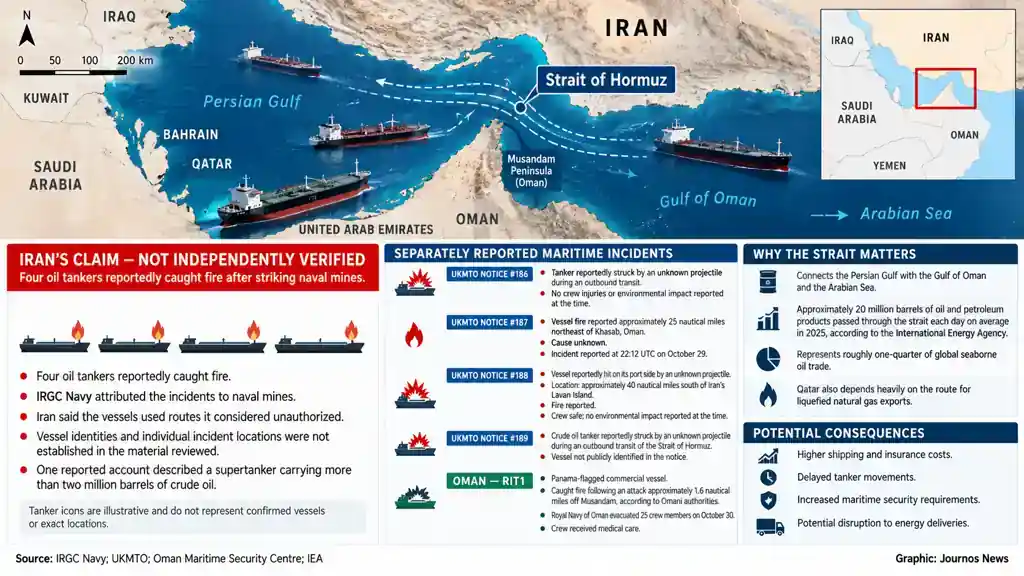
The IRGC Navy said the ships had attempted to use routes it considered unauthorized. Iranian accounts included a supertanker carrying more than two million barrels of crude oil. The military also said the vessels had ignored warnings.
The reports emerged as maritime authorities recorded separate attacks, fires and crew evacuations around the strait. Those incidents raise serious concerns for commercial shipping. However, no available vessel-level evidence establishes that they involved the four tankers described by Iran.

Separate Maritime Alerts Reported by UKMTO
The United Kingdom Maritime Trade Operations agency issued several notices on October 29 and 30.
UKMTO’s notice #186 said a company security officer reported that a tanker had been struck by an unknown projectile during an outbound transit of the strait. The agency reported no crew injuries or environmental impact at the time.
Notice #187 described a vessel on fire about 25 nautical miles northeast of Khasab, Oman. The incident occurred at 22:12 UTC on October 29. A third party reported the fire, but the cause was unknown. UKMTO initially had no confirmed information about the crew’s condition, damage or environmental impact.
On October 30, notice #188 reported that a vessel had been hit on its port side by an unknown projectile about 40 nautical miles south of Iran’s Lavan Island. The strike caused a fire. UKMTO said the crew were safe and reported no environmental impact at that time.
Notice #189 concerned a crude oil tanker reportedly struck by an unknown projectile while completing an outbound transit of the Strait of Hormuz. UKMTO said the information came from a verified source, but its public notice did not identify the vessel.
■ Related News



These notices describe separate reports. They do not establish that naval mines caused the damage. An unknown projectile is not evidence of a mine strike, and a reported fire does not establish the weapon or cause.
Oman Evacuates 25 Crew From RIT1
Oman’s Maritime Security Centre said the Royal Navy of Oman evacuated 25 crew members from the Panama-flagged commercial vessel RIT1 on October 30.
The vessel caught fire after an attack about 1.6 nautical miles off the coast of Musandam, according to the Omani account. The crew received medical care. Authorities did not specify whether anyone had been injured.
Oman did not identify the attacker or the weapon used. Its public account also did not establish the full extent of the vessel’s damage or whether the fire had been extinguished.
The available information does not prove that RIT1 was one of the four tankers claimed by Iran. Nor does it establish that the evacuation involved any vessel in UKMTO’s notices. Those links require confirmation through vessel names, identification numbers, positions and incident times.
Vessel Identities and Damage Remain Unclear
The public information reviewed does not provide a verified list of the four tankers named in Iran’s claim. Their flags, owners, cargoes and precise locations also remain unclear.
No shipowner or flag-state confirmation has been established for the four alleged mine strikes. The available maritime notices provide some crew and environmental information for individual incidents, but not a complete account of all the reported vessels.
The International Maritime Organization maintains a list of confirmed attacks on commercial ships in the Persian Gulf, Strait of Hormuz and Gulf of Oman. Its incident data undergo validation using information from flag states, coastal states and credible third-party sources. The list was updated on October 30. Its existence provides an important independent reference, but it does not turn Iran’s separate four-tanker claim into a confirmed incident.
There is also no verified evidence in the material reviewed of an oil spill caused by the four alleged mine strikes. UKMTO’s notice #188 reported no environmental impact at the time of its update. That statement applies to that report and should not be extended to other vessels.
Why the Strait of Hormuz Matters
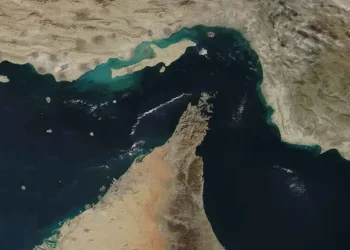
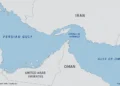
The Strait of Hormuz connects the Persian Gulf with the Gulf of Oman and the Arabian Sea. It is one of the world’s most important routes for oil and liquefied natural gas shipments.
The International Energy Agency estimated that an average of about 20 million barrels of oil and petroleum products passed through the strait each day in 2025. That represented roughly one-quarter of global seaborne oil trade. Qatar also depends heavily on the route for its liquefied natural gas exports.
A sustained disruption could force ships to delay voyages, change routes or wait for security assessments. Those decisions can increase transport costs and complicate delivery schedules.
Insurers may also reassess the risks of entering the area. Higher war-risk premiums and additional security requirements could raise costs for shipowners and energy traders.
However, the reported incidents do not yet establish a sustained closure or a measurable loss of oil deliveries. The scale of any market impact will depend on confirmed damage, the safety of the shipping lanes and whether attacks continue.
Yemen: Airport and Government Sites Reported Targeted
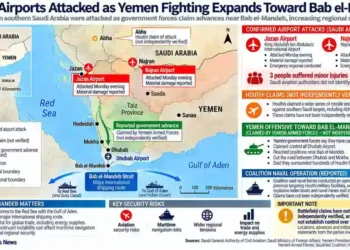
Yemeni authorities accused Houthi forces of launching missiles at Aden International Airport and the government palace in Aden. The allegations came amid renewed fighting and attacks involving Yemen’s internationally recognized government and the Houthi movement.
The airport had already faced disruption after reported missile attacks. Yemen’s Transport Ministry said operations resumed after repairs following an earlier closure. The latest allegations concerning the airport and government palace must be treated separately from those earlier incidents.
The Houthis have not been independently shown to be responsible for every reported attack. Their public statements have described some cross-border operations as targeting Saudi military and energy infrastructure. A specific response to the latest Aden allegations remains necessary.
The United Nations has reported that more than 280,000 people have been displaced in Yemen since the beginning of August. UNHCR’s country data dashboard recorded 278,443 newly displaced people since August 1, using data updated on October 25. The figures describe displacement across Yemen, not only in Aden or one battle area.
The difference reflects separate reporting updates and counting dates. The figures should not be treated as a precise count of people displaced by the latest attacks.
Saudi Arabia Reports Missile and Drone Interceptions
The Saudi-led coalition said its air defenses intercepted and destroyed a drone launched toward the Mecca Region on October 30.
Saudi Arabia’s official news agency published the coalition spokesperson’s statement. The Houthis denied targeting Mecca and said their operations focused on Saudi energy facilities and military sites.
The competing accounts remain important. The Saudi statement identifies the drone as Houthi-launched, while the Houthi denial disputes that attribution. Neither account, by itself, provides independent evidence identifying the launch site or the intended target.
Saudi claims of other missile and drone interceptions have also circulated during the escalation. Each interception should be assessed by its date, weapon type and reported target rather than combined into one incident.
Qatar Continues Mediation Between Washington and Tehran
Qatar said its delegation’s visit to Tehran formed part of consultations with regional and international partners. Qatar’s Foreign Ministry described the effort as an attempt to sustain mediation, reduce tensions and prevent further escalation.
A Qatari delegation returned to Tehran on October 30 as part of efforts to reach an agreement between the United States and Iran, according to an official briefed on the talks.
The diplomatic effort faces substantial differences. Washington wants nuclear issues included from the beginning of negotiations. Tehran has demanded that the United States first end its port blockade and lift restrictions affecting Iranian oil exports.
The United States and Iran have not publicly disclosed a final agreement or confirmed that formal negotiations have resumed.
Vance Letter Adds Another Diplomatic Channel
US Vice President JD Vance reportedly sent a letter to Iranian security official Mohsen Rezaei through Qatari intermediaries.
The letter has not been made public. US officials described it as an effort to reopen discussions, including the nuclear issue. President Donald Trump publicly characterized the communication as concerning the delivery of medical supplies.
Those descriptions leave important questions unanswered. The full text, precise terms and Iranian response have not been independently established through a published document.
Qatar’s mediation continues to provide a channel for messages between Washington and Tehran. But the return of mediators to Tehran does not mean that the two governments have reached agreement.
Israeli Forces Demolish Two Homes in Hebron
Israeli forces demolished two homes in the occupied West Bank city of Hebron on October 30. Israeli authorities said the homes belonged to the Palestinian men accused of killing two Israeli soldiers at a checkpoint on October 23.
The demolitions took place during a wider Israeli military operation in the area. Israeli officials described the operation as a security response to the attack.
The homes had been occupied by family members, including wives and children of the accused men, according to local accounts. The wider operation has also involved movement restrictions, arrests and the displacement of Palestinian residents.
UN human rights chief Volker Türk warned that the operation had raised serious concerns over the use of force and the displacement of residents. The United Nations said more than 3,000 people had been forced from their homes during the operation by October 27.
The Israeli military’s stated security rationale and the humanitarian impact on residents are separate issues. The demolitions and displacement require scrutiny under international law, including the protections afforded to civilians and family members.
Verification Will Determine the Scale of the Maritime Crisis
The four-tanker claim remains the central unresolved issue. Iran has not yet provided independently corroborated vessel identities and incident records in the material reviewed.
UKMTO’s notices and Oman’s evacuation show that separate maritime incidents were reported around the Strait of Hormuz. They do not establish that four ships struck mines or that all the reported fires share one cause.
Shipowners, flag states and maritime authorities will be essential to resolving the uncertainty. Vessel tracking records may help establish movements and positions, but gaps or interruptions in AIS signals must be considered before drawing conclusions.
For now, the evidence supports reporting a series of serious maritime-security alerts and an Iranian military claim. It does not support presenting four confirmed mine strikes as established fact.
The distinction matters well beyond the vessels involved. The Strait of Hormuz carries a significant share of global energy shipments. Verified attacks could affect crew safety, shipping costs and energy deliveries. Until the vessels and causes are established, the scale of the threat remains uncertain.
Reporting Credit: Journos News reviewed public statements and incident notices from the United Kingdom Maritime Trade Operations, Oman’s Maritime Security Centre as reported from its official statement, the International Maritime Organization, Qatar’s Ministry of Foreign Affairs, Saudi Press Agency, UNHCR and United Nations human rights reporting. The report also examined publicly reported accounts of Iran’s IRGC Navy claim and the diplomatic communication involving US Vice President JD Vance. The four-tanker mine claim, vessel identities and links between the separate maritime incidents remain unverified. No direct interviews with vessel operators, flag-state authorities or the parties to the reported diplomatic communication were obtained for this report.