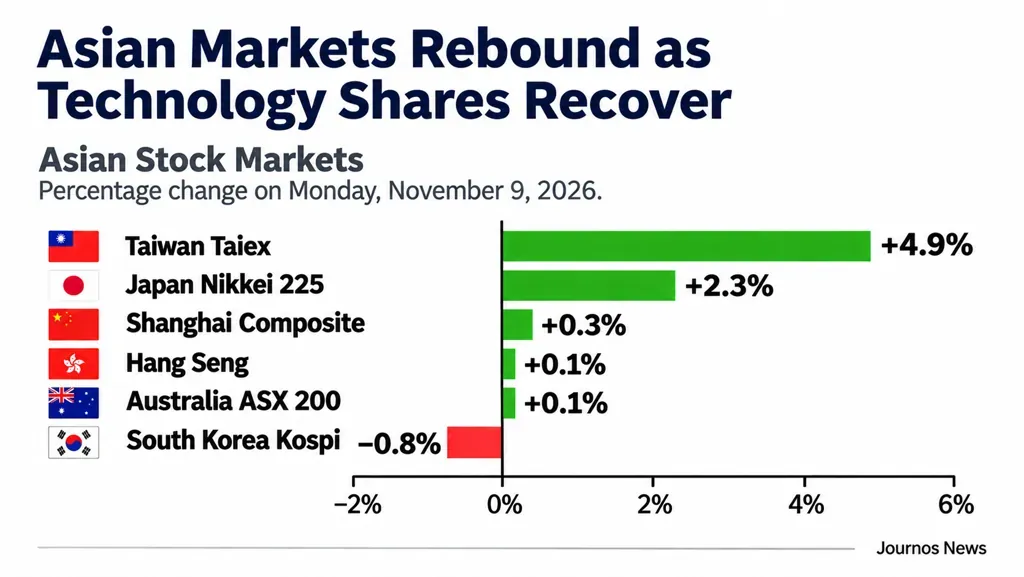
TOKYO, Japan – Asian stock markets rebounded on Monday, November 9, as semiconductor and technology shares recovered following a late-week rally on Wall Street, offering some relief after sharp losses driven by concerns over artificial intelligence investments and future demand for computer chips.
Taiwan’s benchmark Taiex led regional gains, rising 4.9% as shares of Taiwan Semiconductor Manufacturing Company (TSMC) climbed 4.7%. Japan’s Nikkei 225 advanced 2.3% to close at 58,775.50, while technology-related companies also recorded gains in other regional markets.
The recovery followed Friday’s improvement in US technology shares, which helped ease concerns after a turbulent week for companies associated with artificial intelligence infrastructure and semiconductor manufacturing.

However, the rebound was uneven. South Korea’s Kospi reversed earlier gains to finish 0.8% lower at 5,018.85, while Hong Kong, mainland China and Australia recorded comparatively modest movements.
Taiwan leads regional semiconductor recovery
Taiwan’s strong performance reflected renewed buying in semiconductor companies following a particularly difficult week for technology stocks.
TSMC, the world’s largest contract chipmaker, gained 4.7%, helping lift the Taiex by 4.9%.
Japan’s semiconductor equipment manufacturers also advanced. Tokyo Electron rose 2.8%, while Advantest gained 1.3%, reflecting improved sentiment toward companies supplying equipment and testing technologies used in chip production.
In South Korea, Samsung Electronics gained 0.6% and SK Hynix advanced 0.4%, despite the broader Kospi index closing lower.
■ Related News



The relatively modest gains in these companies followed several weeks of sharp fluctuations as investors reassessed the valuations of businesses benefiting from the artificial intelligence investment boom.
Wall Street recovery helps restore investor confidence
The regional recovery followed Friday’s gains on US stock markets after technology shares recovered some of their earlier losses.
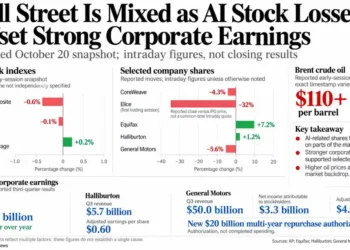
The S&P 500 rose 0.3% on Friday, November 6, reducing its weekly decline to 2.7%. The Nasdaq Composite gained 1.1%, while the Dow Jones Industrial Average fell 0.5%.
Nvidia contributed significantly to the S&P 500’s advance, with its shares rising 2.8% after falling 9.3% and 3.2% during the preceding sessions.
The recovery interrupted a broader international sell-off that had pushed major Asian indexes sharply lower, with Tokyo and Seoul experiencing particularly substantial declines following Wall Street’s earlier losses.
Political concerns add uncertainty to AI investment outlook
The recovery followed concerns that the results of the US midterm elections could affect the pace of artificial intelligence infrastructure development.
Democratic victories raised questions about whether increased political scrutiny could slow the construction of AI data centres, particularly in Texas, where electricity consumption and rising power bills have become contentious issues.
Investors are also assessing whether the enormous investments required to build and operate AI infrastructure will generate sufficient financial returns.
These concerns have contributed to volatility in semiconductor and technology shares, particularly companies supplying processors, memory chips and equipment for data centres.
Regional markets deliver mixed performances
Despite the strong gains in Taiwan and Japan, other Asian markets recorded smaller movements or declined.
Hong Kong’s Hang Seng Index edged up 0.1% to 24,507.83, while the Shanghai Composite added 0.3% to 3,660.79.
Australia’s S&P/ASX 200 increased 0.1% to 9,029.70.
South Korea’s Kospi was among the weaker performers, falling 0.8% to 5,018.85 despite gains in Samsung Electronics and SK Hynix.
The mixed performance indicated that the recovery was concentrated in selected technology and semiconductor shares rather than representing a uniform advance across Asian markets.
Investors await technology earnings and economic signals
Market participants are now looking towards upcoming earnings announcements from major technology companies, including CoreWeave, Applied Materials and Cisco Systems.
Their results could provide further information about demand for artificial intelligence infrastructure, corporate investment plans and the profitability of the semiconductor supply chain.
Investors are also monitoring US inflation and employment figures for indications of the Federal Reserve’s next interest-rate decision.
Stronger-than-expected US employment data has increased expectations of a possible interest-rate increase in December, adding another consideration for investors assessing technology valuations and borrowing costs.
Monday’s rebound provided relief following last week’s technology-led losses, but the uneven performance across Asian markets showed that concerns about AI investment, regulation and economic conditions remained unresolved.
Primary Sources: Tokyo Stock Exchange / Japan Exchange Group (JPX), Institutional source for Japanese listed-market information and trading data. Taiwan Stock Exchange (TWSE), Official exchange information for Taiwan’s equity market, Korea Exchange (KRX) Institutional source for South Korean equity-market information. Hong Kong Exchanges and Clearing (HKEX) Official market information for Hong Kong-listed securities.