NEW YORK, United States — US stocks fell sharply on Thursday as investors reconsidered the cost of the artificial intelligence boom. Concerns about rising technology spending, weaker cash flow at Meta Platforms and a jump in oil prices combined to unsettle markets.
The Nasdaq Composite suffered its steepest daily percentage decline since early June. The S&P 500 recorded its biggest one-day drop since July, while the Dow Jones Industrial Average finished nearly unchanged.
The sell-off followed quarterly results from Meta and Tesla. Both companies reported results that offered some positive news, but investors focused on spending plans and the uncertain returns from large investments in AI infrastructure.

How Wall Street opened and closed
The following figures distinguish Thursday’s completed session from Friday’s opening. Friday’s closing levels were not yet available when this report was prepared.
Thursday, October 22
| Index | Close | Daily change |
|---|---|---|
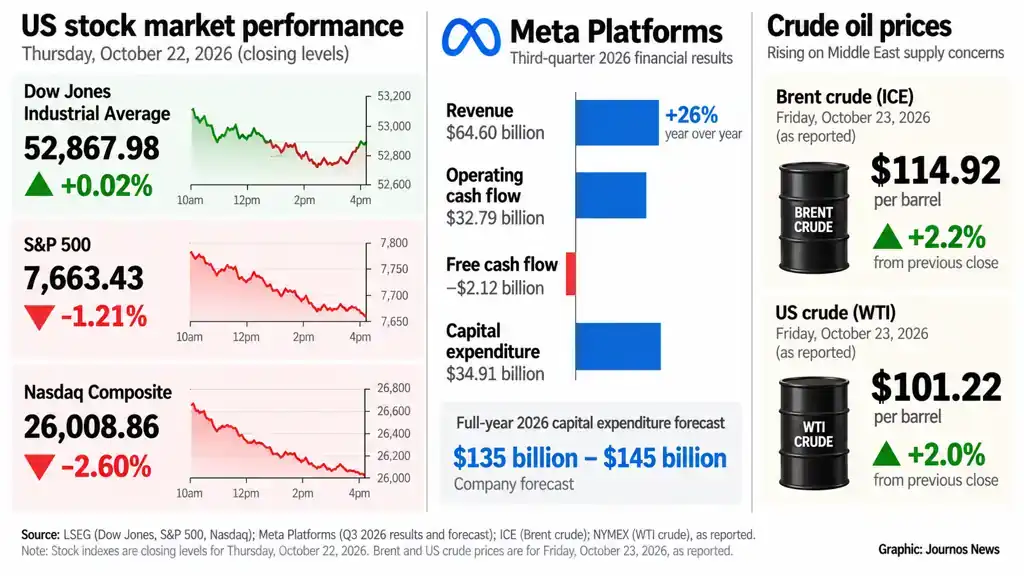
| Dow Jones Industrial Average | 52,867.98 | +0.02% |
| S&P 500 | 7,663.43 | −1.21% |
| Nasdaq Composite | 26,008.86 | −2.60% |
Friday, October 23 — opening levels
| Index | Open | Change from previous close |
|---|---|---|
| Dow Jones Industrial Average | 52,696.70 | −0.32% |
| S&P 500 | 7,637.18 | −0.34% |
| Nasdaq Composite | 25,893.953 | −0.44% |
Friday’s opening declines showed that investors remained cautious after Thursday’s technology sell-off. They do not establish how the market performed over the full Friday session.
Why Meta’s strong revenue failed to reassure investors
Meta reported third-quarter revenue of $64.60 billion, up 26% from a year earlier. Its operating cash flow reached $32.79 billion.
■ Related News



But the company also reported negative free cash flow of $2.12 billion. It spent $34.91 billion on capital expenditure, including principal payments on finance leases.
Meta also raised the lower end of its full-year 2026 capital expenditure forecast. It now expects to spend between $135 billion and $145 billion, compared with its previous range of $130 billion to $145 billion.
The company says its AI investments are improving advertising performance and supporting new products. Chief Executive Mark Zuckerberg has argued that the spending will help Meta build future revenue opportunities. The company also expects to continue investing heavily in AI infrastructure beyond 2026.
Investors, however, must weigh those expected benefits against the immediate costs. Meta’s total expenses rose 68% from a year earlier, partly because the company recorded a $9.89 billion legal charge. That charge reduced reported operating income, making it important to distinguish the underlying business performance from the effect of the one-off expense.
Meta’s plan to establish a new class of non-voting shares added another concern. The company said the shares could help fund investment, employee compensation, acquisitions and other corporate needs. Investors may see the move as a way to preserve financing flexibility, but it also highlights the scale of the company’s future capital requirements.
Meta’s shares fell about 7% on Thursday. The decline shows that beating revenue expectations does not guarantee a higher share price. Investors also judge costs, future cash generation, financing needs and whether expected growth already reflects a high stock valuation.
AI spending is putting cash flow under scrutiny
Meta’s results have become part of a wider debate over the cost of building AI systems.
Large technology companies are spending heavily on data centers, advanced chips, power supplies, networking equipment and computing capacity. These projects require substantial upfront investment. The revenue they generate may arrive over several years, and returns can vary widely between companies.
A July analysis of Microsoft, Alphabet, Amazon, Meta and Oracle found that their combined capital spending could exceed their free cash flow by 2027 if current spending and earnings trends continue. The analysis relied on market estimates, not guaranteed future outcomes.
A September analysis by Barclays Private Bank also found that four major technology companies—Microsoft, Alphabet, Amazon and Meta—spent a combined $165 billion in cash capital expenditure during the second quarter of 2026. Their combined free cash flow after capital spending was much smaller.
These figures help explain the market’s reaction. Investors are no longer looking only at how quickly AI-related revenue grows. They are also asking whether companies can turn that growth into enough cash to cover infrastructure costs, support other business activities and reward shareholders.
Heavy spending does not automatically mean an investment will fail. Data centers and computing equipment may support future revenue for years. But investors need evidence that demand, pricing and profit margins will justify the cost.
Semiconductor shares take a harder hit
The damage extended beyond Meta. Semiconductor companies and other businesses tied to AI infrastructure also suffered steep losses.
The Philadelphia Semiconductor Index fell 6.7% on Thursday. Lam Research dropped sharply after its latest results, while Nvidia lost about 4.4%. Shares in AI cloud provider CoreWeave also fell.
Chipmakers have benefited from demand for processors used to train and run AI models. But their shares also depend on expectations for future orders, investment by large customers and the pace at which new computing capacity comes online.
When investors question the return on AI infrastructure spending, they may reassess the suppliers that depend on that investment. Even a company with strong current demand can see its shares fall if investors believe its future growth will be weaker than expected.
The weakness was not evenly spread across the whole market. On Thursday, roughly two-thirds of S&P 500 stocks advanced even as the index fell. The Russell 2000, which tracks smaller US companies, also edged higher.
That pattern suggests the biggest pressure came from large technology and semiconductor shares, which carry substantial weight in major market indexes. The broader market still faced risks, but Thursday’s decline was not a uniform retreat by every sector.
Oil prices add another source of uncertainty
Crude oil rose sharply as concerns grew over renewed conflict involving Iran and threats to energy supplies in the Middle East.
Brent crude reached its highest level in five months. Reports of attacks on Saudi Arabian facilities and uncertainty about US-Iran negotiations raised concerns about possible disruption to oil production and transport. On Friday, Brent rose to around $114.92 a barrel, while US crude reached approximately $101.22.
Higher oil prices can raise costs for transport, manufacturing and households. If energy costs remain high, inflation may prove harder to bring down. That could complicate the outlook for interest rates and increase the financing costs faced by businesses investing in data centres and other infrastructure.
The connection is not automatic. One increase in oil prices does not guarantee higher inflation or a change in Federal Reserve policy. The effect depends on how long prices remain elevated, whether supply disruptions persist and how businesses and consumers respond.
On Thursday, the US 10-year Treasury yield fell as investors moved toward government bonds. That move showed demand for safer assets during the sell-off, even as higher oil prices raised concerns about inflation.
Strong earnings can still lead to falling shares
Stock prices reflect expectations about future performance, not just the latest quarterly results.
A company may report revenue above analysts’ forecasts but still fall short of what investors had hoped for. Its shares may also have risen ahead of the announcement, leaving less room for positive news to push the price higher.
Spending plans matter because they affect how much cash a company can retain after investing in growth. If expenses rise faster than revenue, investors may question when the investment will pay off. A company may also need to borrow money or issue shares to finance expansion, creating additional costs or potential dilution for existing shareholders.
Meta’s results illustrate these competing factors. Its revenue grew strongly, but its free cash flow turned negative and its capital spending outlook remained high. Investors had to weigh the strength of its advertising business against the cost and timing of its AI plans. <Cite refs={[“turn260497view0″,”turn811440news60”]}/>
Tesla also reported quarterly results that included better-than-expected profit, but its shares fell on Thursday. That reaction underlined the market’s broader concern about the cost of future AI and robotics ambitions, alongside the company’s core vehicle business.
The market reaction does not prove that AI investment is a bubble. It shows that investors are scrutinizing spending, financing and expected returns more closely.
One session does not establish a lasting trend
Thursday’s declines were significant, but they do not by themselves establish a long-term market reversal.
The S&P 500 fell 1.21% and the Nasdaq dropped 2.60%. The S&P 500’s decline was its largest daily fall since July, while the Nasdaq’s was its steepest since early June. Yet both indexes remained up for the year as of Thursday’s close.
Investors will be watching future earnings reports, capital-spending forecasts and evidence of demand for AI services. They will also track oil prices, inflation data and Federal Reserve communications for signs that borrowing costs may remain restrictive.
For technology companies, the key question is whether AI revenue can grow fast enough to support the infrastructure being built. For the broader market, the issue is whether pressure on large technology stocks spreads to companies with different business models and earnings drivers.
Neither outcome is certain. The latest decline shows that investors have become more sensitive to the cost of AI expansion and the risks surrounding energy supplies. It does not yet settle whether current AI spending will deliver the returns companies expect.
Reporting Credit: Meta Platforms — October 21, 2026, third-quarter earnings release, capital expenditure outlook, cash-flow disclosures and new Class C share announcement. Tesla — October 21, 2026, third-quarter financial results and management outlook. US market index data — October 22 closing levels and October 23 opening levels for the Dow Jones Industrial Average, S&P 500 and Nasdaq Composite. US Treasury market data — October 22 movement in the 10-year Treasury yield. Crude oil market data — October 22–23 price movements amid Middle East supply concerns. Barclays Private Bank — September 2026 analysis of AI infrastructure spending and free cash flow. Reuters analysis — July 2026 estimates of capital spending and free cash flow among major technology companies.