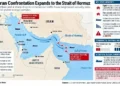
Iran said negotiations with Oman over reopening the Strait of Hormuz have entered their final drafting stage, raising hopes that commercial shipping through one of the world’s most important energy corridors could resume more normally even as conflicts across the Middle East continue to fuel regional instability.
Iranian Foreign Ministry spokesperson Esmail Baghaei said Wednesday that Tehran and Muscat are in the “final stage” of preparing an agreement and that a joint statement would be issued “if certain parties do not obstruct this process,” in an apparent reference to the United States.
According to The Associated Press, any agreement is expected to depend on the United States lifting its blockade on Iranian ports.

U.S. President Donald Trump declined Thursday to confirm whether an agreement had been finalized, telling reporters at the White House that the waterway “has been sort of open right now.”
A U.S. official, speaking on condition of anonymity because they were not authorized to discuss the negotiations publicly, said any temporary shipping arrangements would not require vessels to obtain approvals or pay transit fees.
Strait of Hormuz Remains Critical to Global Energy Trade
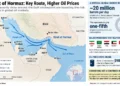
The Strait of Hormuz remains one of the world’s most strategically important maritime chokepoints, carrying a significant share of global seaborne oil and liquefied natural gas exports.
Before the conflict involving Iran began in February, roughly one-fifth of globally traded oil and natural gas transited the narrow waterway linking the Persian Gulf with international shipping routes.
Despite diplomatic progress, security concerns remain.
■ Related News

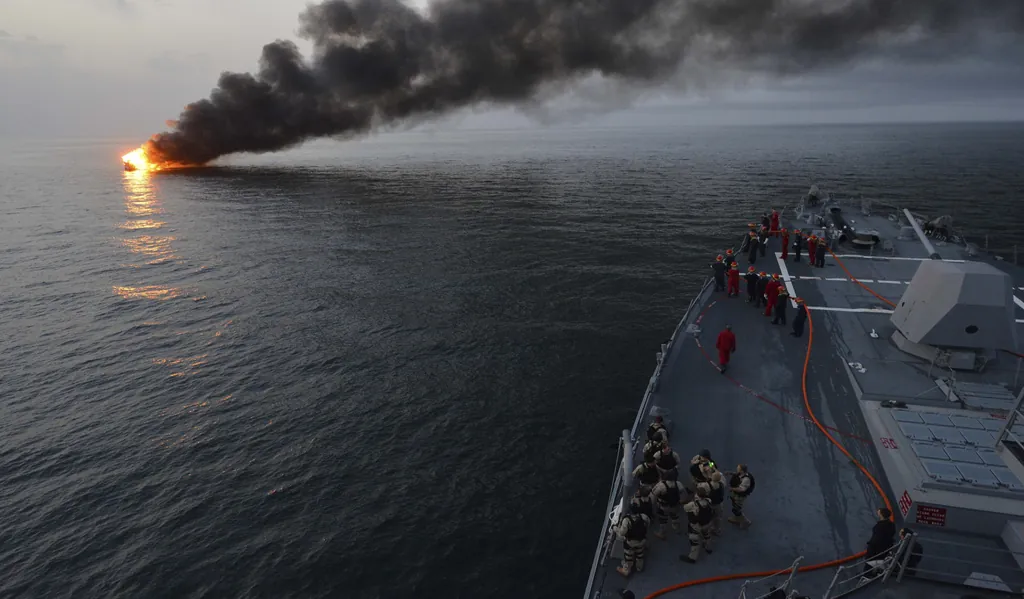
According to maritime intelligence firm Lloyd’s List Intelligence, at least two commercial vessels were struck in the Strait of Hormuz during the past week, while several others reported near misses or radio warnings from individuals claiming to represent Iran’s Islamic Revolutionary Guard Corps. Those claims could not be independently verified.
The company reported that weekly commercial traffic increased to 84 vessel transits during the week of July 27 through Aug. 2, up from 45 the previous week, though still well below the more than 700 weekly transits typically recorded before the crisis.
Fighting Intensifies in Yemen
Violence also escalated in Yemen, where Iran-backed Houthi forces launched attacks that killed at least 30 troops aligned with the internationally recognized government and wounded at least 50 others, according to Yemeni officials.
The strikes targeted military positions in Marib and Hadramout provinces.
A Houthi official claimed Saudi-backed forces suffered “hundreds” of casualties, although those assertions could not be independently verified.
Hours later, Saudi Arabia said Houthi attacks struck the southern border region of Najran, injuring more than 10 civilians.
Saudi military spokesperson Turki al-Malki said those wounded included seven Saudi citizens, one Yemeni national, two Egyptian nationals and one Pakistani expatriate.
The attacks marked one of the most significant escalations since a 2022 truce substantially reduced fighting in Yemen’s long-running civil war.
Lebanon Ceasefire Under Renewed Pressure
Israel’s military said Thursday that two soldiers were killed and four others seriously wounded in an explosion in southern Lebanon, marking Israel’s first military fatalities since a ceasefire with Hezbollah took effect in June.
The Israeli military also carried out strikes in southern Lebanon on Wednesday, saying Hezbollah had violated the ceasefire agreement. It additionally issued evacuation warnings for residents of another village, the first such warning in several weeks.
The renewed fighting coincided with negotiations in Rome between Lebanese and Israeli representatives seeking to implement the June ceasefire agreement, which calls for Israeli forces to withdraw from occupied areas of southern Lebanon in exchange for Hezbollah’s disarmament.
Political and Security Challenges Continue Across the Region
Elsewhere in the region, Uganda’s parliament approved the deployment of troops to a proposed International Stabilization Force for Gaza, although the multinational mission has not yet been established.
Several countries have pledged personnel, while Indonesia has suspended its earlier commitment.
Efforts to secure a Gaza ceasefire also remain stalled after Israeli Prime Minister Benjamin Netanyahu said Israeli forces would not withdraw from current positions until Hamas is fully disarmed.
In the occupied West Bank, Israeli prosecutors charged settler Yinon Levi with reckless manslaughter in the July 2025 killing of Palestinian activist Awdah Hathaleen. Prosecutors also filed charges of armed trespassing and malicious property damage.
Israeli human rights organization B’Tselem said it is the first indictment involving the killing of a Palestinian by an Israeli since Hamas’ Oct. 7, 2023, attack.
In Iraq, authorities announced that armed activity outside state control after Sept. 30 will be prosecuted under the country’s Anti-Terrorism Law as the government seeks to consolidate authority over weapons held by non-state armed groups.
Several Iran-backed factions have rejected calls to disarm, saying they remain committed to what they describe as the “option of resistance.”
The latest developments illustrate the complex security landscape across the Middle East, where diplomatic efforts to restore maritime trade through the Strait of Hormuz continue alongside persistent conflicts and political tensions stretching from the Persian Gulf to the eastern Mediterranean.
This report is based on reporting by The Associated Press.