
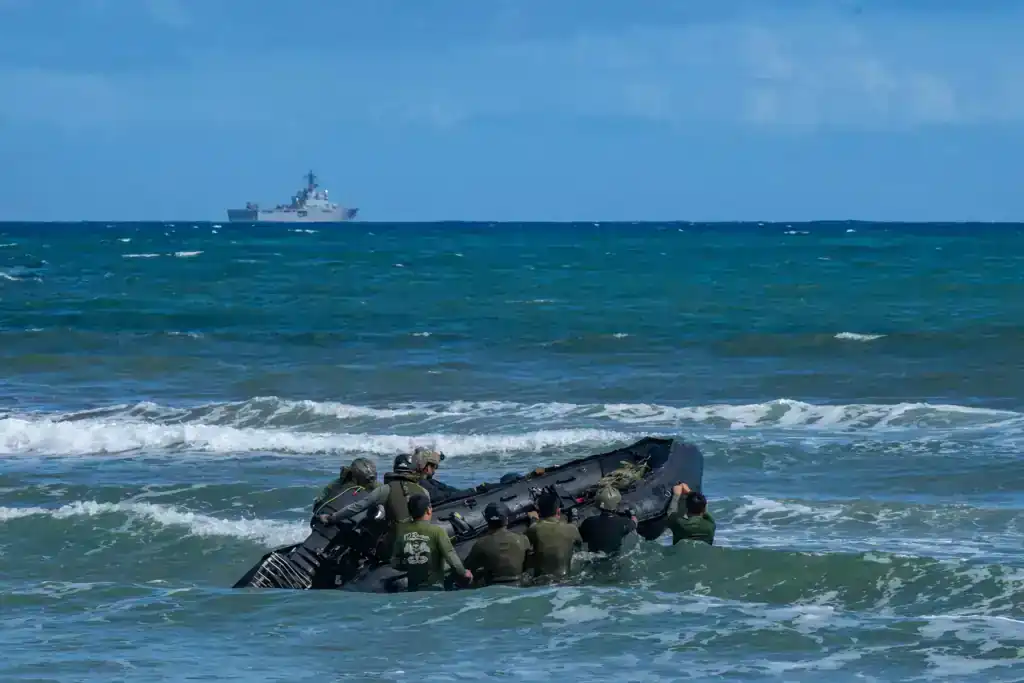
TOKYO, Japan – Japan and the United States began Keen Sword 27 on October 19, launching one of their largest joint military exercises with training focused on defending Japan’s southwestern islands and improving coordination across air, maritime, land, space, cyber and electromagnetic operations. The exercise runs through October 29 and includes forces from seven additional countries in selected activities.
Japan’s Joint Staff announced that approximately 45,000 Self-Defense Force personnel would take part, alongside about 6,100 vehicles, 40 vessels and 260 aircraft. Estimates of U.S. participation differ: the Associated Press reported about 12,000 American service members, while a U.S. Forces Japan release put the figure at approximately 11,000. The discrepancy was not reconciled in the material reviewed.
The exercise comes as Japan strengthens its defense posture in the southwest, where its island chain lies near Taiwan and key sea routes. Japanese officials describe the drills as preparation for responding jointly to a range of contingencies. The exercise’s location and weapons deployments have also drawn attention because of tensions involving China and the wider regional security environment. The drills themselves do not establish that a conflict is imminent.

Seven partner countries join selected activities
Australia, Canada, France, Germany, the Netherlands, New Zealand and the Philippines are participating in some parts of Keen Sword 27, according to Japan’s Joint Staff and U.S. Forces Japan. France, Germany, the Netherlands, New Zealand and the Philippines are participating for the first time, AP reported. South Korea and the United Kingdom are attending as observers, according to the U.S. military release.
The presence of these countries does not mean every contingent will take part in every exercise. The public material reviewed does not provide a complete activity-by-activity breakdown of each partner’s role, including the specific tasks assigned to the Philippine contingent.
The exercise’s stated purpose is to strengthen readiness and interoperability between the Japanese and U.S. forces, while improving the ability to operate together with partners. Japan’s Joint Staff has said the training is intended to maintain and improve joint responses to contingencies and the integrated operation of the Self-Defense Forces.
Training spans island defense and joint operations
The exercise includes amphibious operations, air and missile defense, maritime activities, mine sweeping, intelligence gathering, logistics and resupply, casualty evacuation, and the protection and repair of facilities. Some training also covers operations in space, cyberspace and the electromagnetic spectrum.
The activities are distributed across Japanese military facilities, U.S. bases and other locations in Japan, as well as surrounding sea and airspace. The opening ceremony was held on Ishigaki Island, part of Okinawa Prefecture’s Yaeyama island group.
■ Related News




Tanegashima is among the locations identified for exercise activities. The uninhabited island of Oki-Daito, about 500 kilometers southeast of Okinawa, was scheduled for live-fire training by Japan’s Self-Defense Forces on October 19–20, according to U.S. Naval Institute reporting. That activity is distinct from the planned presence of missile systems on Yonaguni.
Missile systems deployed close to Taiwan
One of the exercise’s most closely watched elements is the deployment of Japan’s Type-25 land-to-ship missile system to Yonaguni, Japan’s westernmost inhabited island. AP reported that this was the system’s first deployment to the island during an exercise and that no test-firing was planned. The reported range is approximately 1,000 kilometers, but that published capability does not establish that the missile will be fired or directed toward any particular location during Keen Sword 27.
The U.S. Marine Corps also deployed its Navy-Marine Expeditionary Ship Interdiction System, known as NMESIS, and its Marine Air Defense Integrated System, or MADIS, to Yonaguni. NMESIS is a mobile, ground-based anti-ship missile system designed to threaten vessels at sea. MADIS is intended to provide short-range air defense against aerial threats. The systems’ deployment gives participating forces an opportunity to practice moving and operating capabilities on a remote island, although the material reviewed does not establish that either system will conduct live firing there.
The U.S. Army’s High Mobility Artillery Rocket System, or HIMARS, was also reported on nearby Ishigaki. Its presence adds another mobile fires capability to the exercise, but no specific target or planned firing activity should be inferred from the deployment alone.
Yonaguni lies approximately 110 kilometers east of Taiwan. Its proximity makes it geographically relevant to scenarios involving Japan’s southwestern islands and surrounding waters. However, geography alone does not establish the operational target or intended use of any individual weapons system.
Japan says the exercise is not aimed at a specific country
Japan’s Joint Staff chief, Gen. Hiroaki Uchikura, denied that Keen Sword 27 was directed at a specific country, AP reported. At the opening ceremony on Ishigaki, Japan Maritime Self-Defense Force Adm. Tateki Tawara said that protecting territory also meant protecting residents’ peaceful lives, and that cooperation with allies and partners was essential to preventing a crisis.
The exercise takes place amid Japanese concerns about military activity by China, North Korea and Russia. Japan has expanded defense capabilities in its southwestern region in recent years, including longer-range missiles and interceptors. These developments form part of the wider security context, but they do not override the Japanese military leadership’s stated position that the exercise is not aimed at a particular country.
China’s military activity around Japan’s surrounding waters and islands has been a recurring subject of Japanese defense statements. The materials reviewed for this article did not establish a specific Chinese government response to the start of Keen Sword 27 on October 19. The absence of a verified response should not be interpreted as evidence of China’s position.
Local concerns remain part of the security picture
Military exercises and deployments take place alongside civilian communities, ports and transport networks. In Yokosuka, where the aircraft carrier USS Theodore Roosevelt arrived before participating in Keen Sword, the city’s mayor asked Japan’s Foreign Ministry to convey to the U.S. military the importance of crew members complying with Japanese rules. U.S. Naval Institute reporting said the carrier strike group was expected to participate in the exercise.
Okinawa has a long history of public concern about the effects of U.S. military bases, including noise, pollution and crime. AP reported renewed anti-base sentiment after the arrest of a U.S. Marine in connection with the alleged robbery and murder of a Japanese woman. The arrest is a separate matter from the exercise, and the allegation should not be treated as a conviction.
The Japanese Joint Staff has said the exercise will be conducted with safety management and explanations to relevant local governments and residents. The public sources reviewed did not provide a comprehensive record of local complaints specifically concerning Keen Sword 27’s missile movements, road transport, noise or access restrictions on each participating island.
Exercise continues through October 29
Keen Sword 27 is the 18th iteration of the field-training exercise in a series that began in 1985, according to U.S. Forces Japan. Japan’s Joint Staff has described the event as part of a recurring programmed intended to strengthen joint operational capabilities.
The exercise is scheduled to continue through October 29. Its outcomes will depend on the training conducted and the capabilities tested; the start of the drills alone does not establish how effective the participating forces will be in a real contingency.
For now, the verified developments are the launch of the exercise, the published Japanese participation figures, the participation of seven partner nations in selected activities, and the reported deployment of missile and air-defense systems to southwestern islands. The exact roles of every foreign contingent and the full details of each weapons system’s training remain incompletely documented in the public material reviewed.
Southwestern Island Defense is a suitable internal-link marker for a related JournosNews article, if one exists.
Reporting Credit: Japan’s Joint Staff and U.S. Forces Japan for official exercise announcements; the Associated Press for the October 19 launch, locations, weapons deployments and Japanese military leadership’s comments; Stars and Stripes for reporting on U.S. Marine Corps missile-system deployments; and U.S. Naval Institute News for details on naval participation and the Oki-Daito live-fire schedule.