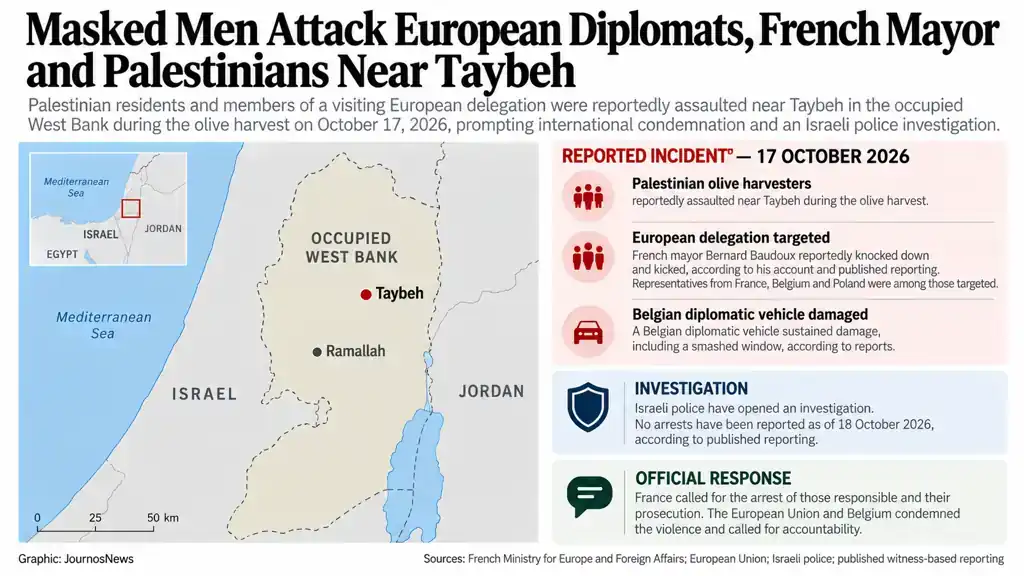
TAYBEH, Occupied West Bank – Masked men attacked European diplomatic representatives, Palestinian civilians and a visiting French mayor near the Palestinian village of Taybeh on October 17, prompting condemnation from European governments and renewed demands for action against settler violence.
The delegation included representatives from Belgium, France and Poland, along with Catholic officials. Bernard Baudoux, mayor of the French town of Aulnoye-Aymeries, said the attackers knocked him to the ground and kicked him. A Belgian diplomatic vehicle also sustained damage.
Belgian Foreign Minister Maxime Prévot condemned the assault and called for action against those responsible. France’s Foreign Ministry also demanded that Israeli authorities arrest the perpetrators and bring them to justice.

The Israeli military condemned the violence and said police investigators would collect evidence and take witness statements. It also said the diplomatic visit had not been coordinated with the military. Israeli police opened an investigation, but reporting published on October 18 said authorities had announced no arrests.
The attack has raised questions about the protection of Palestinian residents, foreign representatives and journalists in the occupied West Bank. It also came amid reports of violence against Palestinian olive harvesters during the annual harvest.
What happened near Taybeh
The delegation visited Taybeh, a predominantly Christian Palestinian village northeast of Ramallah, during the olive harvest. The visit included diplomats from Belgium, France and Poland, Catholic representatives and Baudoux, who had travelled to the area for ties between his French town and the Palestinian community.
According to reporting by The Guardian, the group had joined Palestinian residents harvesting olives when masked men approached. Some of the attackers carried clubs, the newspaper reported.
The newspaper said the men first assaulted Palestinian residents working on nearby slopes. They reportedly kicked and abused a Palestinian woman in her seventies and beat a man so badly that he needed six stitches for a head injury.


The attackers then approached the delegation. Baudoux said the men knocked him down, kicked him and struck him. The group also threatened his wife and Vincent Dollmann, the archbishop of Cambrai, according to the newspaper’s account.
A Belgian diplomatic vehicle had its window smashed during the incident. The Guardian reported that its correspondent witnessed the assault and documented damage to the vehicle.
The accounts establish a reported sequence of violence against Palestinian residents and members of the visiting delegation. Investigators still need to establish the identities of individual attackers and determine whether any specific person or group was deliberately targeted.
European governments demand accountability
Prévot said the attack affected Palestinian civilians, diplomatic representatives and a French mayor. He condemned the violence and said Belgium would continue to press for European Union sanctions against settlers.
France’s Foreign Ministry issued a statement on October 18 condemning the assault on Baudoux and the confrontation involving diplomatic representatives. It called on Israeli authorities to arrest those responsible and bring them to justice.
The French statement also urged Israel to take measures to stop further violence and protect civilians and diplomatic missions. It linked those responsibilities to Israel’s obligations under international law.
The European Union issued its own condemnation on October 18. Its diplomatic service said it expected “full accountability” and effective measures to prevent further violence and harassment against Palestinians and journalists, including during the olive harvest.
The EU also urged Israel to comply fully with international humanitarian and human rights law and to stop settlement expansion.
These statements set out diplomatic demands. They do not establish that the EU has imposed new sanctions in response to the Taybeh incident or that any individual attacker has been charged.
Israel condemns the violence as police investigate
Israel’s military condemned what it called a serious act of violence against diplomatic representatives. It said Israeli police and forensic investigators would enter the area under military protection to gather evidence and interview witnesses.
The military also said the consular visit had not been coordinated with it. It described coordination as important for preventing incidents of this kind.
That statement does not establish who was responsible for the assault or whether coordination would have prevented it. The investigation must determine what happened and whether authorities took appropriate steps to protect those present.
Israeli Foreign Minister Gideon Sa’ar also condemned the violence. Prime Minister Benjamin Netanyahu’s office urged caution before drawing conclusions about the incident.
The official responses have not resolved the central questions. Authorities had not announced arrests by October 18, according to Reuters reporting. No public charging decision or completed investigation finding was identified in the material reviewed for this draft.
The status of the investigation should be checked again before publication. Any later arrests, charges or formal findings would materially change the account.
The attack came during a tense olive harvest
The Taybeh assault occurred during the annual olive harvest, a crucial period for many Palestinian communities that depend on olive trees for income and cultural traditions.
Palestinian residents and rights groups have reported attacks, intimidation, damage to trees and obstruction of access to agricultural land during the harvest. These incidents can affect both a family’s immediate income and its ability to work land over the longer term.
The attack on the delegation followed another incident on October 16 involving Heidi Levine, a photojournalist for The Washington Post. Levine was injured during an assault while covering Palestinian olive harvesting in the West Bank and was hospitalized, according to Reuters and other published reports.
The two incidents occurred on consecutive days, but the available evidence does not establish that they involved the same attackers or a coordinated operation. They should therefore be treated as separate cases within the wider context of reported violence during the harvest.
The presence of diplomats and a journalist has drawn additional international attention to the violence. However, the underlying protection concerns extend to Palestinian residents who face threats while harvesting their own land.
What remains unknown
The available reporting identifies the delegation’s national representation, describes the assault and documents damage to a Belgian diplomatic vehicle. The French mayor has also publicly described being attacked.
Important questions remain. Investigators have not publicly identified the individuals responsible, and the material reviewed for this draft does not establish whether suspects have since been arrested or charged.
It also remains unclear whether the attackers specifically targeted the diplomats because of their official roles or encountered the delegation while attacking Palestinians nearby. The sequence reported by witnesses may help investigators answer that question, but motive should not be assumed from the incident alone.
The police investigation must establish individual responsibility through evidence, including witness accounts, recordings and forensic findings. Diplomatic condemnation and demands for accountability do not replace that process.
The European Union has called for both accountability and effective measures to prevent further violence. Whether those demands lead to arrests, prosecutions or concrete protective measures remains to be seen.
The assault has brought international attention to the dangers facing Palestinians, foreign representatives and journalists in the occupied West Bank. West Bank settler violence remains a central concern as authorities investigate the Taybeh attack and the olive harvest continues.
Reporting Credit: The European External Action Service statement of October 18, 2026, and the French Foreign Ministry’s statement on the Taybeh assault were consulted for the official European response. The Israeli military’s public account was used for its condemnation, the coordination issue and the investigation process. Reuters and The Guardian were consulted for the reported sequence of events, the accounts of the mayor and Palestinian residents, and the damage to the Belgian vehicle. Direct interviews by JournosNews with the delegation, affected residents, police investigators and Israeli officials remain outstanding.