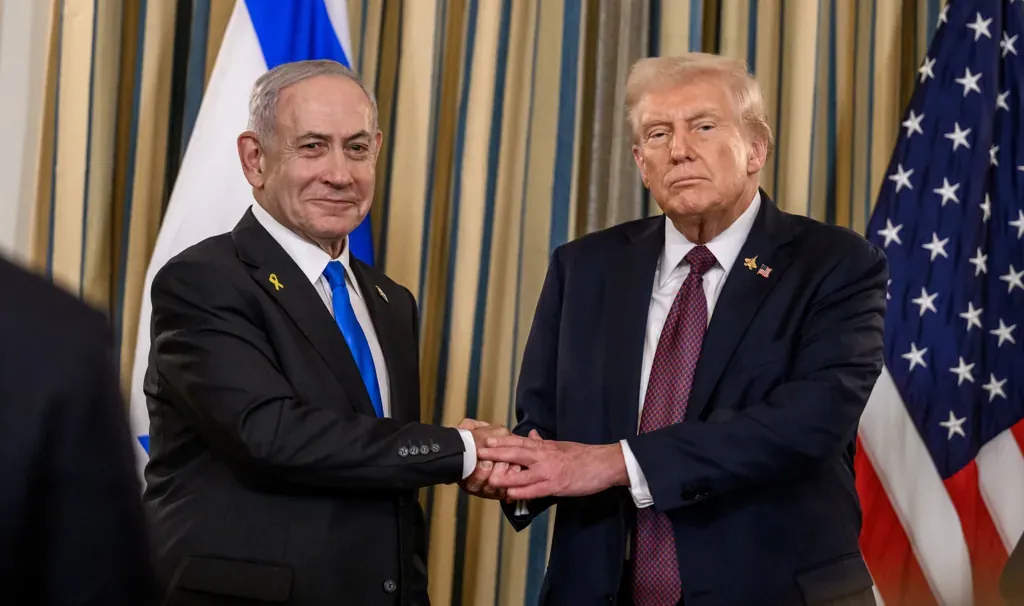
JERUSALEM, Israel – U.S. President Donald Trump endorsed Israeli Prime Minister Benjamin Netanyahu for reelection on October 18, nine days before Israel’s October 27 parliamentary election. Trump praised Netanyahu’s leadership against Iran and warned that the United States might have to continue the conflict without the same Israeli partnership if Netanyahu lost.
Trump announced his support in a post on Truth Social addressed to the people of Israel. He described Netanyahu as a “Great Warrior Prime Minister” and a partner for peace in confronting Iran. He also called the Israeli leader strong, brave and brilliant despite opposition at home and abroad.
Netanyahu thanked Trump publicly later that day. The endorsement came after months in which Trump had withheld a clear public commitment to Netanyahu, as the two leaders’ approaches to the Middle East sometimes diverged.

The announcement makes their relationship a visible part of the final stretch of Israel’s campaign. However, its effect on voters remains uncertain, and the endorsement does not determine which parties can form the next government.
Trump ties his endorsement to Iran
Trump’s message went beyond praise for Netanyahu’s leadership. He argued that the Israeli prime minister had been an important partner in confronting Iran and warned that a different leader in Jerusalem could leave Washington to handle the conflict without the same support.
“If Israel has the wrong Leader, which would be anyone other than Bibi, America will have to do this work ourselves, and I am not inclined to do so,” Trump wrote.
He also said the United States and Israel would soon finish their campaign against Iran unless Tehran changed course. Those remarks framed the election as relevant to the future of the two countries’ military cooperation.
Trump’s endorsement reflects his stated view of Netanyahu as a valuable partner. It does not establish that Israeli voters share that view or that the statement will change the election result.


Netanyahu thanks Trump
Netanyahu responded on X, thanking Trump for his “tremendous support and the joint work.” He added: “Together we will complete the mission!”
Netanyahu also released a video message praising Trump’s leadership and describing him as an exceptionally strong friend of Israel. In the video, he addressed Americans concerned about fuel prices and argued that Iran acquiring nuclear weapons would pose a wider threat.
The response echoed Trump’s focus on Iran. Both leaders presented their cooperation as central to the campaign against Tehran, although the endorsement itself does not settle how their governments will approach the conflict after the election.
The endorsement comes after months of uncertainty
Trump had not publicly endorsed Netanyahu in the months leading up to the announcement. Their relationship remained close, but their governments faced differences over the course of the Iran conflict and wider regional policy.
Reuters reported that the two leaders had experienced friction over Iran, Gaza and Lebanon. Trump had also publicly criticized Netanyahu at points during their relationship. The disagreements complicated the picture of an alliance that has included close military cooperation.
The timing of the endorsement is clear, but its private motivation is not. Analysts cited by Reuters suggested that Trump may have weighed his influence over regional issues before deciding to back Netanyahu. That is analysis, not a confirmed account of Trump’s internal reasoning.
The public record supports a narrower conclusion: Trump chose to endorse Netanyahu shortly before the vote and made Iran a central part of his explanation.
Israel’s election depends on parliament
Israelis are scheduled to vote on October 27 to elect members of the Knesset, the country’s parliament. Voters do not directly elect the prime minister.
After the vote, party representation and coalition negotiations determine who can command a parliamentary majority and form a government. Netanyahu’s Likud party is seeking to remain in power, while opposition parties are trying to assemble an alternative.
Reuters reported that polling pointed to a difficult path for Netanyahu’s religious-nationalist coalition to retain its governing majority. The opposition, however, could also struggle to assemble enough support for a stable government.
That uncertainty limits what can be concluded from the endorsement. Trump’s support may matter to some voters, but the election’s outcome will depend on party support, coalition negotiations and the parliamentary arithmetic after ballots are counted.
The endorsement also does not guarantee that Netanyahu will remain prime minister, even if Likud performs strongly. Coalition partners and their willingness to join a government will remain central to the result.
The effect on voters remains uncertain
Trump has broken with longstanding U.S. practice by publicly endorsing candidates in other countries’ elections. His backing of Netanyahu is notable because the U.S. president has a prominent public profile in Israel and has played a central role in the conflict with Iran.
But public support for Trump in Israel has faced pressure amid disagreements over the war and diplomatic proposals. Reuters cited analysts who said the endorsement could help Netanyahu regain support from some wavering voters, while cautioning that it might not attract a wider group.
Those assessments remain predictions, not established outcomes. No evidence currently shows how many voters, if any, will change their choices because of Trump’s message.
The endorsement also does not resolve the policy questions that have strained the relationship. The future of the Iran conflict, the situation in Gaza and Lebanon, and the next government’s approach to Washington will depend on decisions beyond the campaign statement.
What happens after October 27
The immediate test will be the election itself. Israeli voters will choose the next Knesset, after which party leaders will negotiate over the formation of a government.
If Netanyahu’s bloc cannot assemble a majority, he could face difficulty remaining in office. The opposition could also struggle to form a viable coalition, leaving the political situation unresolved.
Trump’s endorsement has made his support for Netanyahu explicit. It has also tied the Israeli election more directly to the two leaders’ shared position on Iran. But neither the statement nor Netanyahu’s response can predict the election result.
The central question is whether Netanyahu’s political support and potential coalition partners will be sufficient to keep him in office. Israeli coalition formation will ultimately determine who leads the next government, regardless of the endorsement from Washington.
Reporting Credit: Donald Trump’s October 18 Truth Social post was accessed through the link carried by CBS News, although the platform’s page did not expose its full text in the browser. Netanyahu’s response on X was identified through the linked post and corroborated by contemporaneous reporting from CBS/AP and The Times of Israel. Reuters reporting was consulted for the endorsement’s timing, the leaders’ documented disagreements and the coalition context. The official Israeli election timetable was checked against the Central Elections Committee’s published schedule. Direct interviews with the leaders’ offices and independent analysis of the latest polling remain outstanding.