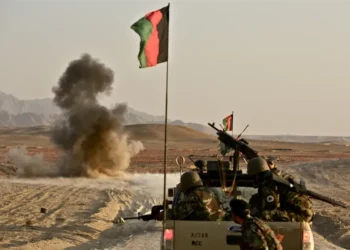
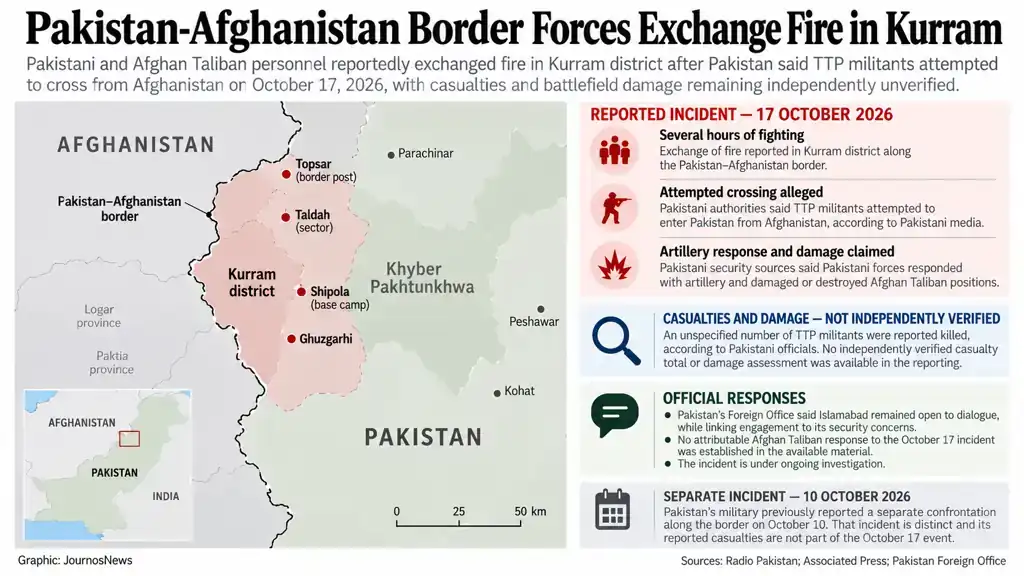
PESHAWAR, Pakistan – Pakistani forces and Afghan Taliban personnel exchanged fire along the northwestern border on October 17 after Pakistani authorities reported an attempted crossing by militants from Afghanistan. Pakistani officials said troops used artillery against Afghan Taliban positions and killed an unspecified number of Pakistani Taliban militants. The reported casualties and battlefield outcomes have not been independently confirmed.
The fighting lasted several hours in the Kurram district of Khyber Pakhtunkhwa, according to an Associated Press report citing three Pakistani security officials who spoke anonymously because they were not authorized to brief the media. Pakistani state media also reported firing in Upper Kurram and other border sectors.
Afghan Taliban authorities had not publicly responded to the incident in the initial reports. A current, attributable Afghan account of the October 17 fighting could not be established from the official and independent sources reviewed for this draft.

What happened along the border
Pakistan’s state broadcaster, Radio Pakistan, reported on October 17 that Afghan Taliban personnel had opened fire in the Taldah sector of Upper Kurram. Citing security sources, the broadcaster said the firing was intended to facilitate the movement of militants across the border. It reported that Pakistani forces responded and destroyed several Afghan Taliban positions.
Other Pakistani media reports identified the Topsar border post and Shipola base camp in Upper Kurram as targets of artillery fire. Reports also referred to fighting near Ghuzgarhi, where security sources said Afghan Taliban personnel had been killed. The locations and claimed damage were reported through Pakistani official or security-source accounts; they have not been independently verified.
The accounts also differ in emphasis. Pakistan’s state media described the initial firing as coming from Afghan Taliban positions, while the Associated Press reported the broader exchange of fire and the alleged attempted crossing using accounts from Pakistani security officials. No independently verified evidence reviewed for this draft establishes the full sequence of firing or independently determines which side initiated the confrontation.
Casualties and reported damage
The Associated Press reported that Pakistani officials said their forces killed an unspecified number of Pakistani Taliban militants who were attempting to enter Pakistan from eastern Afghanistan. The report did not provide a casualty total for the October 17 incident.
Separately, Pakistani media reported that several Afghan Taliban personnel were killed and that Pakistani artillery destroyed or damaged positions, including the Shipola base camp. Those claims remain attributed to Pakistani security sources. No independently verified casualty count or damage assessment is available in the sources reviewed for this draft.


The reporting reviewed also did not establish whether civilians were injured, displaced or otherwise affected by the October 17 fighting. It remains unclear whether either side released verifiable images, video or other evidence sufficient to confirm the claimed battlefield outcomes.
Pakistan and Afghanistan offer different levels of detail
Pakistan’s state media presented the operation as a response to firing by Afghan Taliban personnel and an effort to stop militants from crossing the border. The military-related accounts said Pakistani forces used heavy weapons and artillery against Afghan positions.
The available reporting did not establish a detailed, publicly accessible Inter-Services Public Relations (ISPR) statement for the October 17 incident that independently substantiates each reported location, casualty claim or battlefield result. The state broadcaster’s account cited security sources, while the Associated Press relied on Pakistani security officials for key details.
No attributable Afghan government statement addressing the October 17 clash was identified in the sources reviewed for this draft. That does not establish that Afghan officials made no private communication or that no later statement exists. An updated check of Afghanistan’s defence ministry, foreign ministry and official spokesperson channels is required before publication.
Pakistan’s diplomatic position has also remained firm. At a Foreign Office briefing reported by Dawn on October 18, spokesperson Sajjad Haider Khan said Islamabad was open to discussions or dialogue with Afghanistan and welcomed sincere efforts by other countries to help resolve the dispute. He said talks could not be unconditional and linked engagement to Pakistan’s security concerns.
The statement indicates that Pakistan has not publicly ruled out dialogue, but the sources reviewed do not establish that the October 17 clash prompted a new round of talks, a formal diplomatic protest or an agreement between the two governments.
The TTP and Afghan Taliban are distinct groups
The confrontation is part of a wider dispute over cross-border militancy, but the groups involved must be distinguished.
Tehrik-e-Taliban Pakistan (TTP), commonly called the Pakistani Taliban, is a separate armed organization from the Afghan Taliban, which governs Afghanistan. The two groups have ideological and historical ties, but they are not the same organization.
Pakistan accuses Afghan authorities of allowing TTP members to operate from Afghan territory and launch attacks inside Pakistan. Kabul has repeatedly denied providing safe haven to militants attacking Pakistan. The competing claims remain central to the countries’ security dispute and cannot, on their own, establish responsibility for a specific attack or crossing attempt.
A United Nations report published in January 2026 described concerns about armed groups operating from Afghanistan and the regional consequences of cross-border militancy. UN reporting has also documented civilian harm from cross-border hostilities. On October 1, the United Nations Assistance Mission in Afghanistan said it had documented more than 1,100 civilian deaths and injuries in Afghanistan from cross-border armed violence during 2026. That figure describes the broader conflict environment, not casualties from the October 17 clash.
Pakistan has also reported a sharp rise in militant attacks inside the country. The Associated Press cited Pakistani authorities’ claim that more than 2,800 attacks since January had killed 3,000 people, primarily in the northwest and Balochistan. Those figures are Pakistani authorities’ nationwide totals, not an independently established casualty count for the border confrontation.
The October 10 incident was separate
The October 17 clash followed a separate reported confrontation in Kurram on October 10. In an account published by Radio Pakistan on October 11, the military’s media wing, ISPR, said Pakistani forces had detected a group of militants moving from Afghanistan toward the international border.
ISPR said Afghan Taliban positions then opened fire in support of the attempted crossing. The military claimed that 12 militants and Afghan Taliban personnel were killed and that Pakistani soldier Naib Subedar Hidayat Aman died during the exchange.
Those figures relate to the October 10 incident and must not be transferred to October 17. The available material reviewed for this draft does not establish that the two incidents occurred at precisely the same location or that the military formally linked them as one operation.
What remains unconfirmed
Several key questions remain open. The full chronology of the October 17 fighting has not been independently reconstructed, and the reported attempted crossing has not been corroborated through publicly available independent evidence. The identities and numbers of those killed or injured remain unclear, as do the extent of the reported damage and any effects on civilians.
The available sources also do not establish whether Afghan authorities have provided a later account, whether the two governments have held specific discussions following the clash, or whether any formal de-escalation measures have been agreed.
The confrontation underscores the continuing security dispute between Pakistan and Afghanistan over armed groups near their shared frontier. Establishing responsibility for the October 17 events will require fuller official accounts, independent corroboration and a clearer incident-specific casualty record.
West Bank violence is not relevant to this assignment; use the internal link marker Pakistan-Afghanistan security dispute for related JournosNews coverage.
Reporting Credit: Prepared by Journos News using reporting from the Associated Press, Pakistani state broadcaster Radio Pakistan, Dawn and other published accounts, alongside United Nations material. The reporting completed for this draft includes comparison of the available accounts and separation of the October 17 confrontation from the October 10 incident. Direct interviews with Pakistani and Afghan officials, local eyewitnesses and independent security analysts have not been conducted for this draft. Direct access to a detailed ISPR statement for October 17, a current Afghan official response, independently verifiable casualty evidence and a local civilian-impact assessment remain outstanding.