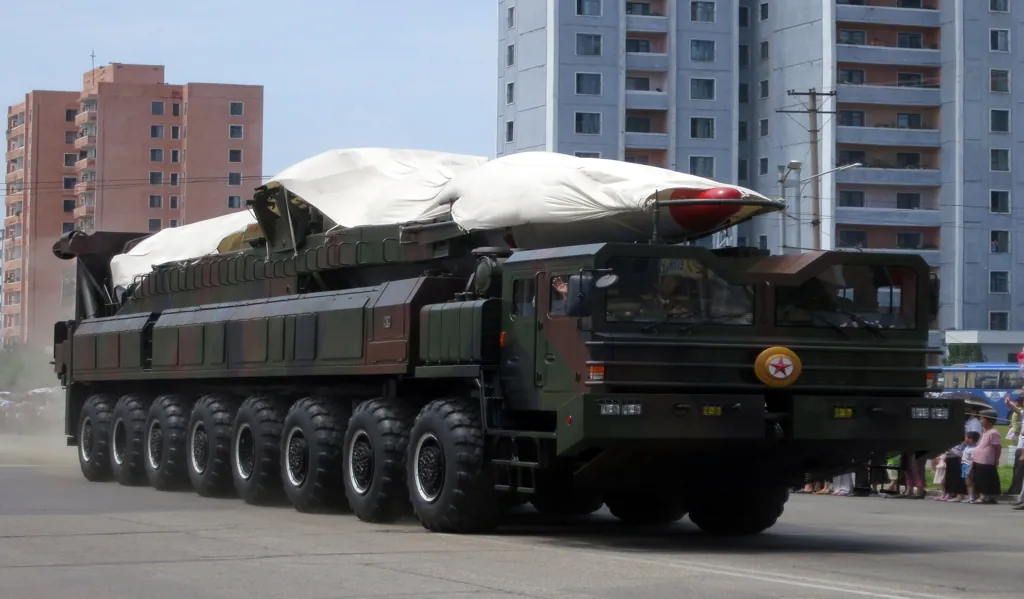
SEOUL, South Korea – North Korea launched a short-range ballistic missile into waters off its east coast on Thursday, resuming ballistic weapons testing just days before the United States and South Korea are scheduled to begin their annual joint military exercises, further raising security tensions on the Korean Peninsula.
South Korea’s Joint Chiefs of Staff said the missile was launched from the eastern coastal city of Wonsan at about 5 p.m. local time. The military said it had strengthened surveillance and maintained close coordination with the United States and Japan in response to the launch.
Japanese Defense Minister Shinjiro Koizumi said the missile landed in waters off North Korea’s east coast and did not enter Japanese territory or waters.

South Korea’s National Security Council condemned the launch as “a provocation” that violates United Nations Security Council resolutions. Japan also lodged a diplomatic protest with Pyongyang through diplomatic channels in Beijing.
Launch Precedes Annual Allied Military Exercises
The missile launch comes days before the United States and South Korea are expected to begin their annual large-scale combined military exercises later this month.
Although officials have yet to announce the full details of this year’s drills, the exercises are traditionally held during the second half of August. Washington and Seoul describe the exercises as defensive and intended to strengthen alliance readiness, while North Korea has long denounced them as preparations for an invasion.
Pyongyang has frequently responded to the exercises with missile launches or other military demonstrations.
The latest launch marks North Korea’s first ballistic missile test since late June, when it tested a tactical ballistic missile carrying what state media described as a “special mission” warhead alongside several other weapons systems.
■ Related News
Following those tests, North Korean leader Kim Jong Un called on the country’s armed forces to strengthen what he described as their “deadly and destructive offensive posture.”
Missile Program Remains Subject to U.N. Sanctions
United Nations Security Council resolutions prohibit North Korea from conducting launches using ballistic missile technology because of its nuclear weapons program.
Although the restrictions do not apply to cruise missiles or conventional artillery systems, security analysts continue to view North Korea’s expanding missile arsenal as a significant threat to South Korea, Japan and U.S. forces stationed in the region.
Pyongyang has accelerated military modernization in recent years.
In early July, Kim oversaw the launch of a nuclear-capable cruise missile from a naval destroyer, highlighting a growing emphasis on expanding North Korea’s maritime strike capabilities alongside its ballistic missile forces.
State media has also promoted ongoing efforts to develop a nuclear-powered submarine as part of the country’s broader military modernization strategy.
Diplomacy Remains Stalled
North Korea has continued expanding its nuclear and missile programs since diplomacy with U.S. President Donald Trump collapsed in 2019.
According to analysts cited by The Associated Press, Pyongyang is seeking broader international recognition as a nuclear-armed state while pursuing relief from international economic sanctions.
North Korea has also strengthened military cooperation with Russia, supplying conventional weapons and troops in support of Moscow’s war in Ukraine, while continuing to deepen relations with China.
Chinese President Xi Jinping visited Pyongyang in June, his first trip to North Korea in seven years, underscoring closer ties between the neighboring countries.
Despite repeated statements by Trump expressing interest in renewed negotiations, Kim has maintained that talks can resume only if Washington abandons its longstanding demand that North Korea commit to denuclearization as a condition for future diplomacy.
With the annual U.S.-South Korea military exercises set to begin, regional attention is likely to focus on whether Pyongyang conducts additional missile launches or other military activities in response.
This report is based on reporting by The Associated Press.