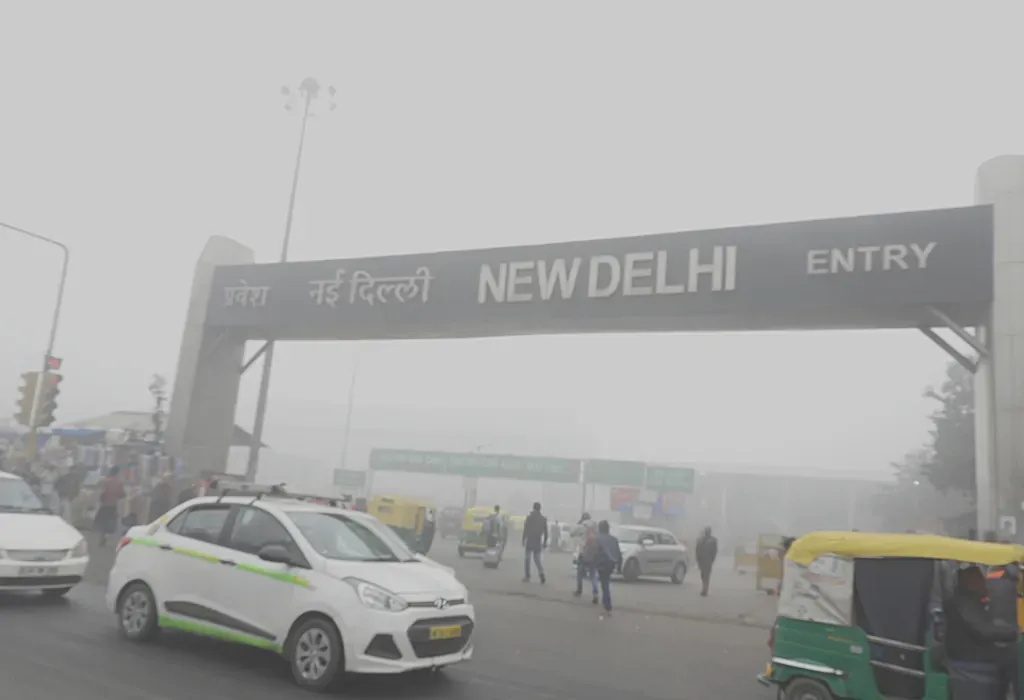
NEW DELHI, India – Delhi’s air quality deteriorated sharply after Diwali celebrations on Sunday, November 8, as firecracker smoke combined with existing pollution to blanket the Indian capital in thick smog and reduce visibility across several neighbourhoods.
The city’s Air Quality Index (AQI) reached 406 on Monday morning, November 9, entering India’s severe pollution category, according to figures reported from the Central Pollution Control Board (CPCB). Several monitoring stations recorded readings above 400, indicating particularly dangerous conditions in parts of the capital.
The deterioration followed widespread fireworks during Diwali celebrations despite restrictions on firecracker use. A Reuters report said residents continued setting off fireworks late into the night, adding smoke and particulate pollution to the city’s already deteriorating air.

Pollution levels rise across the capital
Pollution monitoring stations recorded severe air quality in several parts of Delhi on Monday.
Jahangirpuri registered an AQI of 433, while Chandni Chowk recorded 418 and Mundka reached 417. The ITO area also crossed the severe threshold, with a reading of 406 during early morning monitoring.
Other neighborhoods remained in the very poor category, including Anand Vihar, Indira Gandhi International Airport, R.K. Puram and Lodhi Road.
The readings highlight differences in pollution levels across the city, with some locations experiencing substantially worse conditions than the overall average.
Under India’s CPCB classification, AQI readings between 301 and 400 are considered very poor, while readings from 401 to 500 fall into the severe category.



Fireworks add to existing pollution sources
Firecracker emissions contributed to the deterioration, but they were not the only source of pollution affecting Delhi.
The capital experiences recurring winter air-quality problems driven by vehicle exhaust, industrial emissions, construction dust and agricultural residue burning in neighboring states, particularly Punjab and Haryana.
Weather conditions also influence how quickly pollutants disperse. Cooler temperatures, weak winds and stagnant atmospheric conditions can trap polluted air close to the ground, allowing smog to accumulate over densely populated areas.
The combination of seasonal pollution and additional emissions from Diwali celebrations intensified the pressure on an already polluted urban environment.
Authorities maintain emergency pollution restrictions
Authorities had already activated Stage III of the Graded Response Action Plan (GRAP) across Delhi-NCR on November 6, before Diwali, in anticipation of worsening pollution.
The restrictions include tighter controls on construction activities, diesel generators and vehicle emissions, alongside measures affecting schools and other activities.
Despite these measures, pollution levels increased after the celebrations, demonstrating the difficulty of controlling multiple pollution sources during the winter season.
The Supreme Court had permitted only approved low-polluting green firecrackers during specified hours over the Diwali weekend. However, fireworks continued beyond the permitted conditions in several areas, according to Reuters.
Health concerns grow as smog persists
The deterioration has renewed concerns about the health consequences of prolonged exposure to polluted air.
Fine particulate matter, particularly PM2.5, can penetrate deep into the lungs and enter the bloodstream. Exposure is associated with respiratory and cardiovascular problems, with children, older people and individuals with existing health conditions facing greater risks.
The dense haze also reduced visibility, affecting commuters and road users during the morning hours.
The persistence of severe pollution could prolong exposure for millions of residents if unfavorable weather conditions continue to prevent pollutants from dispersing.
Longer-term pollution challenge remains unresolved
Delhi’s post-Diwali pollution spike reflects a wider environmental challenge that extends beyond annual celebrations.
Fireworks can produce sharp short-term increases in particulate pollution, but the capital’s recurring winter air-quality crisis also involves transport emissions, industrial activity, construction and agricultural burning across northern India.
Addressing the problem therefore requires sustained coordination between Delhi and neighboring states, alongside stronger emissions controls and long-term improvements in transport, energy and waste management.
For residents, the immediate concern remains the persistence of hazardous air conditions as the capital enters another winter pollution season.
Primary Sources: Central Pollution Control Board (CPCB), Delhi Air Quality Monitoring Dashboard, Official monitoring information for Delhi, including station-level AQI readings and pollution classifications, Commission for Air Quality Management (CAQM) Official website Institutional authority responsible for coordinating air-quality management and GRAP measures across Delhi-NCR, Supreme Court of India, Institutional source for judicial restrictions governing permitted firecracker use. The specific November 2026 order should be consulted before publication.