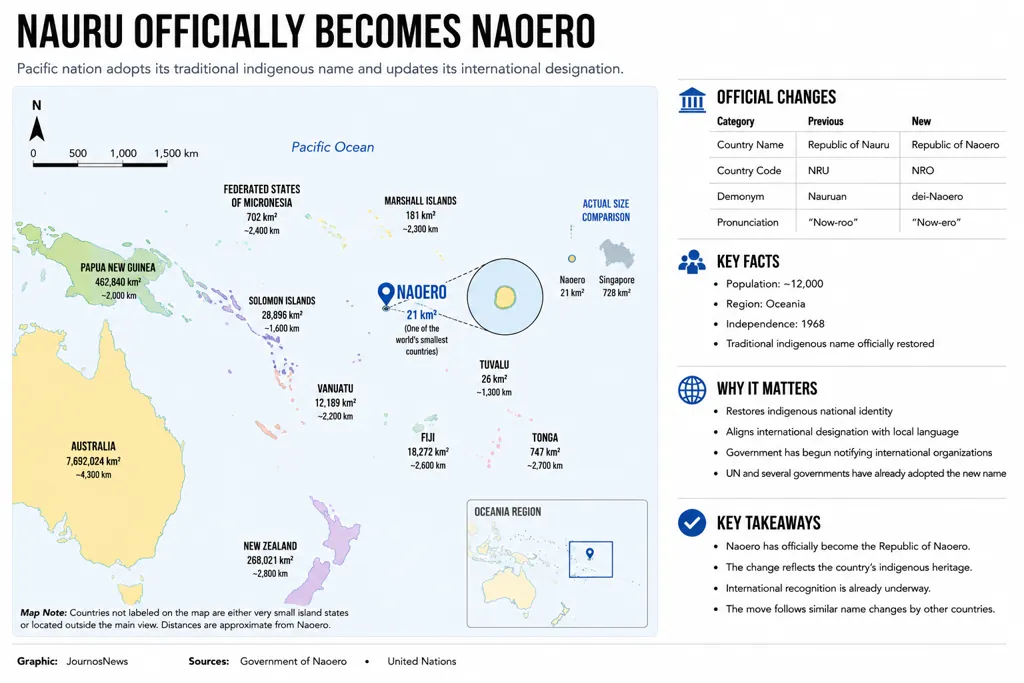
WELLINGTON, New Zealand – The Pacific island nation formerly known as Nauru has officially adopted the name Republic of Naoero, restoring its traditional indigenous name in a move the government says better reflects the country’s language, heritage and national identity.
President David Adeang announced the change, which also includes updating the country’s international code from NRU to NRO. Citizens will now be known as dei-Naoero, replacing the previous term “Nauruan.”
The traditional name is pronounced “Now-ero,” replacing the internationally familiar pronunciation of “Now-roo.”

Government Restores Traditional Name
The government said the decision formally recognizes a name that has remained part of everyday life in the country despite its international designation as Nauru.
When introducing the proposal to Parliament in January, President Adeang said the constitutional amendment was intended to better reflect the nation’s heritage, language and cultural identity.
Parliament approved the proposal in the required two rounds of voting. Although officials did not immediately confirm that the constitutional amendment had been formally incorporated into the Constitution, the government declared the name change official.
Authorities had originally planned to hold a national referendum after Parliament approved the proposal in May. They later concluded that a public vote was unnecessary following extensive public consultations.
Government officials noted that the name Naoero already appears on the country’s coat of arms, is widely used domestically and is recognized under the Constitution.
■ Related News




International Recognition Begins
The government has started notifying foreign governments and international organizations of the official name change.
The United Nations has already updated its website to reflect the country’s new designation after receiving a formal request in June.
Australia and New Zealand have also adopted the name Naoero on their foreign ministry websites. The U.S. and Chinese embassies serving the region have made similar updates.
Officials said the country’s aircraft and ships will also be renamed to reflect the new national designation.
Part of a Wider Trend
Naoero has a population of about 12,000, making it the world’s third-smallest country by population after Tuvalu and Vatican City.
The coral atoll in the South Pacific was colonized by Germany before later being administered by Australia. It gained independence in 1968.
The country enjoyed significant wealth during the phosphate mining boom of the 1970s, but economic conditions deteriorated after phosphate reserves declined in the following decades.
Today, Naoero faces growing challenges from rising sea levels associated with climate change. The government has introduced a paid citizenship program to help finance long-term climate adaptation projects, including relocating communities and infrastructure away from vulnerable coastal areas.
The name change follows similar decisions by other countries to adopt names that more closely reflect their history and national identity. Eswatini replaced Swaziland in 2018, while Türkiye requested the United Nations adopt its domestic name in international usage in 2022.
This report is based on reporting by The Associated Press.