BUDAPEST, Hungary – A prolonged drought and record-low water levels on the Danube River are straining electricity supplies across Central and Eastern Europe, prompting governments to introduce emergency conservation measures as extreme summer heat drives up power demand.
Hungary, Romania and Serbia have all warned that falling river levels are affecting nuclear and hydroelectric generation. Officials say continued hot and dry weather could further reduce electricity production in the coming days.
The Danube, one of Europe’s most important waterways, fell to about 10 centimeters (4 inches) in Budapest on Monday—well below the previous record low of 33 centimeters (13 inches) set in 2018.

Forecasters expect temperatures to exceed 38 degrees Celsius (100 degrees Fahrenheit) this week, increasing electricity demand for cooling while limiting power generation.
Hungary’s Nuclear Plant Faces Possible Shutdown
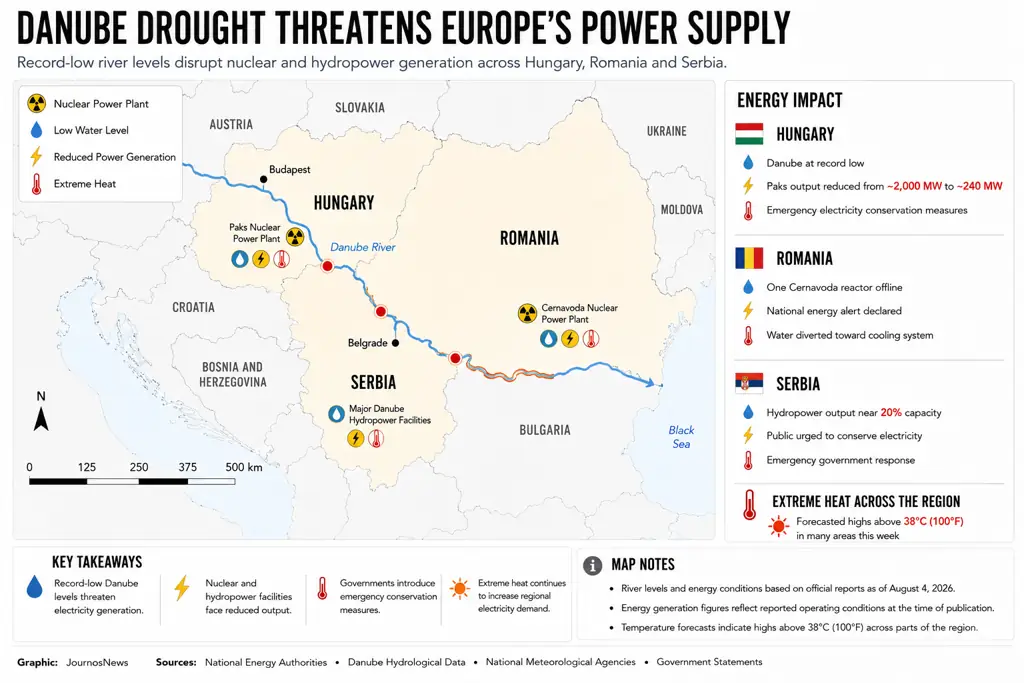
Hungary’s Paks Nuclear Power Plant has sharply reduced electricity production because low Danube water levels have restricted the amount of cooling water available for its reactors.
The facility generated about 240 megawatts on Monday, compared with its normal output of roughly 2,000 megawatts.
Prime Minister Péter Magyar said engineers had managed to keep the plant’s final operating turbine running, temporarily avoiding a complete shutdown that had been expected over the weekend.
He cautioned, however, that the plant could still suspend operations later this week if river levels continue to fall.




Located about 90 kilometers (55 miles) south of Budapest, the Paks facility produces nearly half of Hungary’s electricity and accounts for about one-third of the country’s total power consumption.
To offset lower production, Hungary has increased electricity imports from neighboring countries and expanded its use of renewable energy sources.
Governments Introduce Power Conservation Measures
Hungary has asked major industrial users to reduce electricity consumption and urged households to conserve energy during peak demand between 5 p.m. and 10 p.m.
Beginning Monday, authorities also prohibited electric freight trains from operating during peak hours. Officials estimate the measure will save between 70 and 90 megawatt-hours of electricity each day.
After initially relying on voluntary reductions, the government approved emergency powers allowing mandatory electricity limits for large industrial and commercial consumers if conditions worsen.
According to Magyar, conservation efforts reduced electricity demand by about 700 megawatts on Sunday.
Romania and Serbia Also Face Growing Pressure
The drought has also disrupted electricity production elsewhere along the Danube.
In Romania, military engineers used explosives near the Bala Canal on Monday to redirect more water toward the Danube’s main channel and help maintain cooling operations at the state-owned Cernavoda Nuclear Power Plant.
Officials said river flow had dropped to about 1,500 cubic meters per second—less than one-third of the average July level.
One reactor at the plant has already been shut down, leaving the facility operating at about half of its normal capacity.
Acting Prime Minister Ilie Bolojan declared a nationwide energy alert on Friday and warned that the remaining reactor could also be forced offline if water levels continue to decline.
Several major manufacturers have also reduced operations. Automakers Dacia and Ford suspended vehicle production and began scheduled maintenance until Aug. 19, while other industrial companies agreed to lower electricity use during evening peak hours.
Hydropower Output Falls in Serbia
Serbia is facing similar challenges as historically low Danube levels reduce hydropower generation.
Officials said the country’s main hydroelectric plant is operating at only about 20% of its normal capacity.
Prime Minister Djuro Macut convened an emergency meeting on Monday and appealed to residents to reduce electricity consumption, particularly by limiting the use of air conditioners and other high-energy household appliances.
Macut described the situation as “serious and demanding,” warning that continued drought could place additional pressure on Serbia’s electricity system.
The ongoing drought highlights the growing vulnerability of Europe’s energy infrastructure to prolonged periods of extreme heat, with governments across the region balancing rising electricity demand against declining water supplies needed to sustain power generation.
This report is based on reporting by The Associated Press.