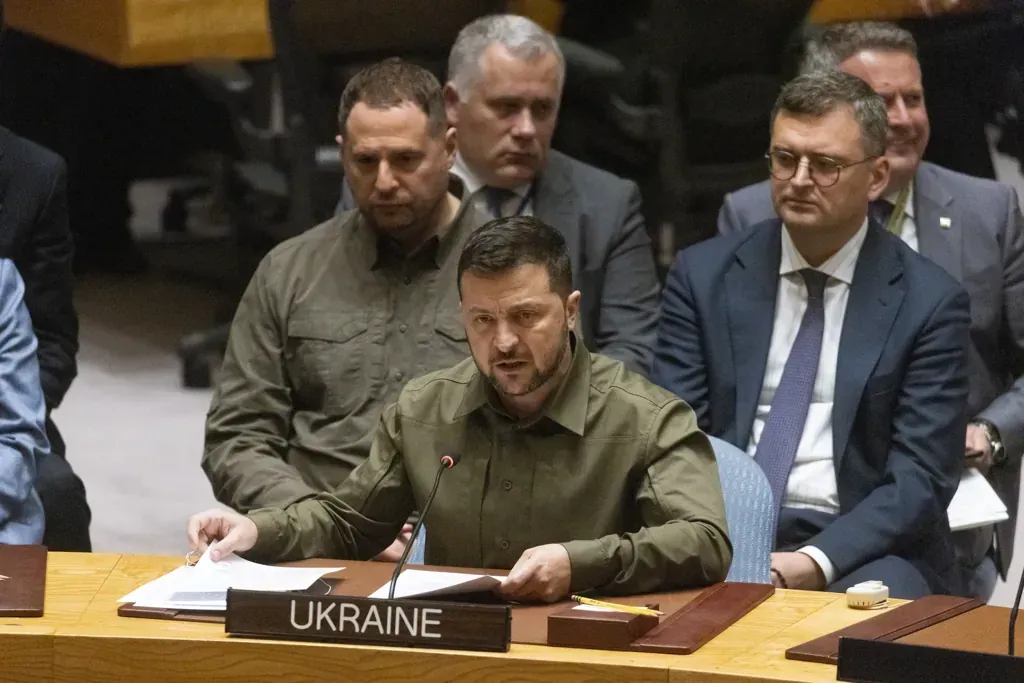
UNITED NATIONS – Ukrainian President Volodymyr Zelenskyy urged world leaders Wednesday to maintain pressure on Russia’s revenue sources, arguing that limiting Moscow’s earnings from trade and energy is necessary to constrain its ability to continue the war.
Addressing the 81st United Nations General Assembly in New York, Zelenskyy said Russia’s revenues should remain a target of international pressure and called for continued restrictions on trade with Moscow. He also pointed to Ukraine’s own attacks on Russian energy infrastructure as part of an effort to reduce the resources available to Russia’s war effort.
His remarks came as Ukraine and its partners continue to pursue sanctions against Russia while Moscow seeks to maintain energy exports and other sources of foreign income.

Zelenskyy links Russian revenue to the war effort
Zelenskyy argued that countries trading with Russia provide Moscow with resources that can extend the conflict.
“When someone gives Russia more money through trade, they give this war more time,” he said in his address, according to the Associated Press. He called for continued efforts to restrict Russian trade and said Ukraine was also targeting Russia’s ability to generate income.
The Ukrainian president specifically distinguished between attacking oil as a commodity and targeting the financial capacity behind Russia’s military campaign.
His argument comes amid continuing Ukrainian strikes against Russian energy infrastructure. Ukraine has said such attacks are intended to disrupt fuel production and reduce the revenue available to finance Russia’s war.
The policy has also generated concern about the effects of disruptions to energy markets, particularly as Russia remains a major oil producer.
■ Related News
Western sanctions remain a central tool
The appeal comes as the United States and European countries continue to use sanctions against Russian companies, officials and energy-related activities.
The U.S. Treasury’s Office of Foreign Assets Control said its Russia sanctions are intended to put pressure on Moscow to end the war. Its September 18 guidance also addressed the possible divestment of assets belonging to Lukoil International, with conditions designed to prevent proceeds from providing a financial benefit to the sanctioned Russian parent company.
The United States has also recently enacted a broader Russia sanctions law.
The legislation targets Russian officials, financial institutions and parts of the country’s energy-export infrastructure. It gives the U.S. president authority to impose tariffs of up to 100% on imports from countries purchasing specified Russian energy products, subject to conditions and exemptions.
The measure followed months of negotiations in Congress and was signed into law on September 18.
Its practical effect will depend on how the administration implements the authorities provided by the legislation.
Ukraine is seeking broader European pressure
Zelenskyy has also been pressing European governments to maintain and expand sanctions.
On September 22, he met European Commission President Ursula von der Leyen in New York, where they discussed additional sanctions against Russia and Ukraine’s financial needs.
Zelenskyy argued that signals about easing sanctions on individual Russian oligarchs would weaken pressure on Moscow. He thanked von der Leyen for her willingness to support additional Russian designations.
A separate meeting with Danish Prime Minister Mette Frederiksen focused on EU sanctions policy and continued support for Ukraine.
Zelenskyy said Russia’s continued escalation should result in stronger sanctions rather than reduced pressure.
The discussions illustrate that sanctions policy remains an active diplomatic issue rather than a settled international position.
Russia says it remains open to negotiations
Russian Foreign Minister Sergey Lavrov also addressed the United Nations on Wednesday.
Lavrov said Moscow was prepared to negotiate toward a lasting peace but rejected the idea of simply pausing the war. He argued that a pause would give Ukraine and its supporters additional time to increase their military capabilities.
Russia has consistently rejected Ukraine’s characterization of the war and has argued that its military actions are linked to its security interests.
The competing positions leave economic pressure and negotiations operating on parallel tracks.
Zelenskyy is arguing that sustained pressure on Russia’s finances can constrain its capacity to continue fighting. Moscow says it remains prepared to negotiate but has not accepted the conditions Ukraine and its Western partners have sought for ending the war.
Energy remains at the center of the pressure campaign
Russia’s energy sector remains particularly important because oil and gas exports generate foreign-currency earnings while also connecting the conflict to global commodity markets.
The U.S. Treasury has repeatedly identified Russia’s energy sector as a target of sanctions intended to reduce the resources available to Moscow.
At the same time, sanctions and disruptions to Russian energy production can affect buyers and global markets beyond the countries imposing the measures.
That creates a central difficulty for policymakers: pressure on Russia’s revenue must be balanced against the economic consequences of disrupting energy supplies.
The recent U.S. sanctions law attempts to extend that pressure beyond Russia by creating potential consequences for countries that continue purchasing certain Russian energy products.
Zelenskyy broadens the argument beyond Ukraine
The Ukrainian president used his UN appearance not only to discuss sanctions but also to argue that Russia’s war has consequences beyond Ukraine.
He described the conflict as contributing to wider instability and urged countries that maintain economic relationships with Russia to consider how those relationships affect the war.
Zelenskyy also criticized what he described as Russia’s use of foreign nationals in its military effort, calling on governments to protect their citizens from being drawn into the conflict.
His broader message was that international pressure should continue while diplomatic efforts remain active.
For Ukraine, the financial dimension is inseparable from the military one: reducing Russia’s ability to generate revenue is presented as another way of limiting its capacity to sustain the conflict.
The pressure campaign faces practical limits
The international sanctions regime has reduced or constrained some Russian economic activity, but it has not eliminated Moscow’s access to export revenue.
Russia continues to sell commodities to international buyers, while restrictions have also encouraged the development of alternative shipping, financial and trading arrangements.
The effectiveness of additional measures therefore depends on enforcement, compliance by third countries and Russia’s ability to adapt.
The newly enacted U.S. sanctions law illustrates the issue. The legislation gives Washington additional tools, but the economic effect will depend on whether and how those authorities are used.
For Zelenskyy, however, the message at the UN was straightforward: economic pressure should remain part of the international response to Russia’s war.
“Russia’s revenues must remain a target,” he told the General Assembly.
The appeal now moves from the UN podium to governments that control sanctions policy, trade relationships and enforcement.
Reporting Credit: United Nations General Assembly — September 23, 2026 General Debate; Office of the President of Ukraine — Zelenskyy’s meetings and sanctions discussions with international partners; U.S. Department of the Treasury, Office of Foreign Assets Control — Russia-related sanctions and enforcement guidance; U.S. Congress — Russia sanctions legislation enacted September 18, 2026; European Commission — EU sanctions policy and financial-support discussions.