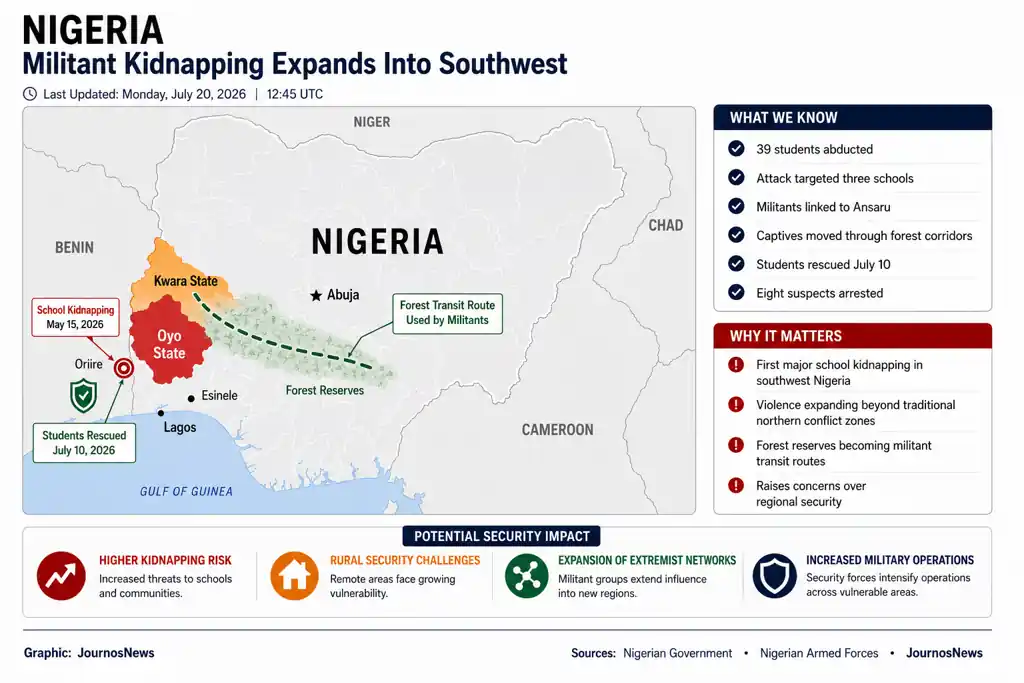
ORIYIRE, Nigeria — Dozens of Nigerian schoolchildren rescued after nearly two months in militant captivity have described beatings, hunger and constant fear, offering a firsthand account of a mass kidnapping that has heightened concerns about the spread of extremist violence into southern Nigeria.
The 39 students were abducted on May 15 when armed militants linked to the al-Qaida-affiliated Ansaru group attacked three schools in the Oriire area of Oyo state. Nigerian security forces rescued the children on July 10 during a joint operation involving the military, intelligence agencies and police.
The attack marked one of the largest school kidnappings ever recorded in southwestern Nigeria, a region that has largely escaped the wave of mass abductions that has plagued the country’s northern states for more than a decade.

Communities Welcome Children Home
Families celebrated the students’ return with prayers, communal meals and thanksgiving services attended by Christian and Muslim leaders in the village of Esinele.
For many parents, the rescue ended weeks of uncertainty.
Farmer Aliyu Saheed, whose three sons were among those abducted, said hearing they were alive was the happiest moment of his life after nearly two months without knowing whether they would ever return.
His youngest son is only five years old.
Village chief Tajudeen Abioye said residents gathered to express gratitude for the safe return of the children, their teachers and the security personnel involved in the operation.
■ Related News



Children Recall Violence in Captivity
Several of the rescued children described harsh conditions while being held in forest camps.
According to the students, they slept outdoors without shelter and survived on small portions of food, often consisting only of boiled rice mixed with palm oil.
Nine-year-old Shuaib said the militants repeatedly beat children who cried or asked questions.
“I could not say anything for fear of getting beaten,” he said. “They flogged us with a cane all over the body, and they hit me in the back with the butt of their gun.”
Alamu Folawe, head of one of the affected schools, said younger children endured particularly severe treatment. Some were allegedly beaten and had cloth stuffed into their mouths to silence them.
Many returned home with physical injuries, while others continue receiving psychological support.
Eight-year-old Kehinde Kaosarat said she rarely slept during captivity because she constantly feared what might happen next. Since returning home, she has remained close to her mother while recovering.
The experience has also left many children fearful of returning to school.
Gabriel Sunday said his children, Jacob and Mary, told the family they no longer wanted to continue their education after their release. Saheed said he also remains uncertain whether it is safe to send his sons back to the classroom.
Forest Corridors Aid Militant Operations
Authorities said the kidnappers moved the children and several teachers through forest reserves linking Oyo state with neighboring Kwara state.
Security officials believe the forests increasingly serve as transit routes and hideouts for armed groups operating between northern and southern Nigeria.
One teacher was killed during the initial attack, while two others reportedly died during captivity.
President Bola Tinubu identified the attackers as members of Ansaru, a militant group that split from Boko Haram and has increased its activity in recent years.
Authorities said security forces arrested eight suspected kidnappers during the rescue operation while several other militants were killed.
Security analyst Joachim MacEbong of Control Risks said Nigeria’s extensive forest reserves have become strategic operating bases because they remain lightly monitored and difficult for security forces to patrol effectively.
Growing Security Concerns in Southern Nigeria
The kidnapping has intensified pressure on President Tinubu, who pledged to improve national security after taking office in 2023.
Although Nigeria continues receiving intelligence and logistical support from international partners, much of that cooperation remains focused on the long-running insurgency in the country’s northeast.
Tinubu said authorities dismantled the militants’ local support network during the rescue mission. However, analysts argue that deeper challenges—including weak security coverage, corruption and poor governance in rural communities—continue to create opportunities for armed groups.
James Barnett, a research fellow specializing in African security, said Ansaru has spent years building networks in southwestern Nigeria and warned that successful operations could encourage additional attacks if those networks are not dismantled.
Residents Remain on Alert
Some families who fled the area have started returning home, but many residents remain uneasy, particularly farmers whose land borders the surrounding forests.
Security forces continue to patrol the region, yet concerns persist that similar attacks could occur again.
Analysts say the successful rescue demonstrates that Nigerian security forces can respond effectively to major kidnappings. Even so, they caution that lasting security will depend on preventing militant groups from establishing permanent footholds in southern Nigeria as well as the country’s long-troubled northern regions.
Reporting Credit: Adapted from verified reporting and official statements.
Article Topics: Nigeria | School Kidnappings | Ansaru | Boko Haram | Child Protection | Terrorism | West Africa | Security