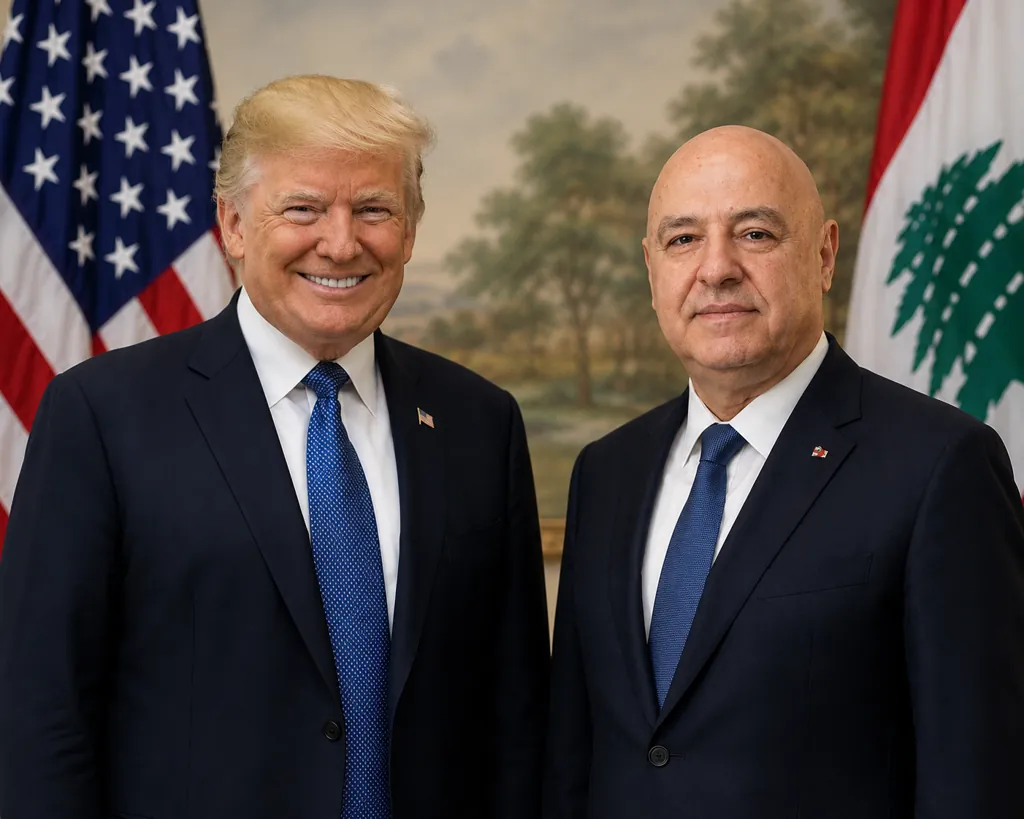
WASHINGTON – President Donald Trump pledged increased U.S. support for Lebanon on Tuesday as he hosted Lebanese President Joseph Aoun at the White House, while also announcing that American airlines will again be permitted to operate direct flights to Lebanon after a suspension that has lasted for more than four decades.
The meeting concluded Aoun’s four-day visit to Washington, where Lebanon’s leadership sought stronger U.S. backing for efforts to restore stability following months of conflict between Israel and the Iran-backed Hezbollah movement. The talks come as Washington attempts to maintain diplomatic momentum in Lebanon amid broader regional tensions linked to the conflict involving Iran.
Trump described Lebanon as a country that had been “very badly treated” and said the United States wanted to help it regain the respect it deserved. While promising significant support, he did not outline specific measures.

Several hours after the meeting, Trump announced on social media that he had directed his administration to allow all U.S. airlines to resume direct service to Lebanon, saying the move would make it easier for Americans to visit the country.
Although the announcement represents a significant policy shift, commercial flights are unlikely to resume immediately. Airlines remain cautious because of ongoing regional security concerns, disruptions to Middle East airspace, and uncertainty surrounding Hezbollah’s continued influence in parts of Lebanon. Direct U.S.-Lebanon flights have been suspended since 1985 following the hijacking of TWA Flight 847 during the Reagan administration.
Framework Agreement Enters Initial Implementation
The White House meeting took place as Lebanon and Israel cautiously began implementing a U.S.-mediated framework agreement announced on June 26.
The arrangement is intended to facilitate a phased withdrawal of Israeli forces from southern Lebanon while expanding the deployment of the Lebanese Armed Forces into areas previously dominated by Hezbollah. It also outlines steps toward the eventual disarmament of the militant group and broader efforts to reduce tensions along the border.
The U.S. State Department said operations had begun in three villages within one pilot zone. Lebanese military forces confirmed they had deployed troops in Zawtar al-Gharbieh, while Israeli officials said they had adjusted military positions to allow the Lebanese army to carry out its mission in the pilot area.
■ Related News


However, the two militaries provided differing accounts of the extent of Israeli troop withdrawals. Lebanese and Israeli officials separately acknowledged uncertainty over whether Israeli forces had recently occupied parts of Zawtar al-Gharbieh, underscoring continued ambiguity surrounding implementation of the agreement.
Security Tensions Persist Despite Diplomatic Progress
The initial rollout of the pilot zone also highlighted continuing security challenges.
The Lebanese military said Israeli troops opened fire near areas where Lebanese soldiers were deploying. Israel’s military responded that Lebanese forces had entered territory outside the agreed pilot zone, prompting Israeli troops to fire warning shots.
Lebanon rejected that account, maintaining its troops remained within the designated deployment area and urging Israel to resolve disagreements through established military coordination channels rather than through the use of force.
The conflicting accounts underscore the fragile nature of the ceasefire arrangements as both sides attempt to implement the U.S.-brokered framework while avoiding renewed escalation.
Lebanon Presses for Broader International Support
Lebanon’s government hopes negotiations with Washington will eventually secure a complete Israeli withdrawal from occupied areas in the south while increasing international financial and military assistance for the Lebanese Armed Forces.
Asked about Israeli forces remaining in Lebanon, Trump said the withdrawal process was underway but did not provide additional details.
Aoun praised Trump’s efforts to pursue peace, describing it as part of the U.S. president’s vision and legacy. Trump responded lightheartedly before reiterating his support for Lebanon.
Trump also acknowledged what he described as “a Hezbollah problem” in Lebanon and suggested he could personally engage with the group if requested. He additionally revived the idea of involving neighboring Syria in confronting Hezbollah, though he stopped short of committing to such an approach. The proposal would likely face strong opposition within Lebanon.
Future Peace Efforts Face Significant Obstacles
The June framework agreement also envisions eventual negotiations toward a formal peace agreement between Lebanon and Israel, two countries that have never established diplomatic relations and technically remain in a state of war.
Secretary of State Marco Rubio, who met Aoun during the visit, reaffirmed Washington’s support for the agreement and said Lebanon’s long-term stability depends on strengthening state institutions capable of replacing Hezbollah as the country’s sole armed authority.
Some Lebanese observers remain concerned that any direct military confrontation with Hezbollah could trigger renewed internal conflict. Government officials instead continue to argue that Israeli withdrawal, expanded international assistance, and stronger national institutions are essential to achieving lasting security.
Israeli officials, meanwhile, have indicated they intend to maintain troops within a security zone in southern Lebanon for the foreseeable future.
Lebanon’s reform-oriented government, which took office in early 2025, has pledged to bring all armed groups under state authority, including Hezbollah. At the same time, Beirut has condemned Israel’s military campaign in Lebanon, which authorities say has killed more than 4,000 people and displaced approximately 1.2 million others.
Despite continuing diplomatic engagement, significant differences remain over Israeli military deployments, Hezbollah’s future role, and the security arrangements needed to achieve a durable peace along the Lebanon-Israel border.
This report is based on reporting by The Associated Press.
Article Topics: Lebanon | United States | Donald Trump | Joseph Aoun | Israel | Hezbollah | Middle East Security | Diplomacy