SAINT-PIERRE-ET-MIQUELON, France – French President Emmanuel Macron has backed Canada’s proposal for a closer relationship with the European Union, including the possibility of becoming the bloc’s first associate member.
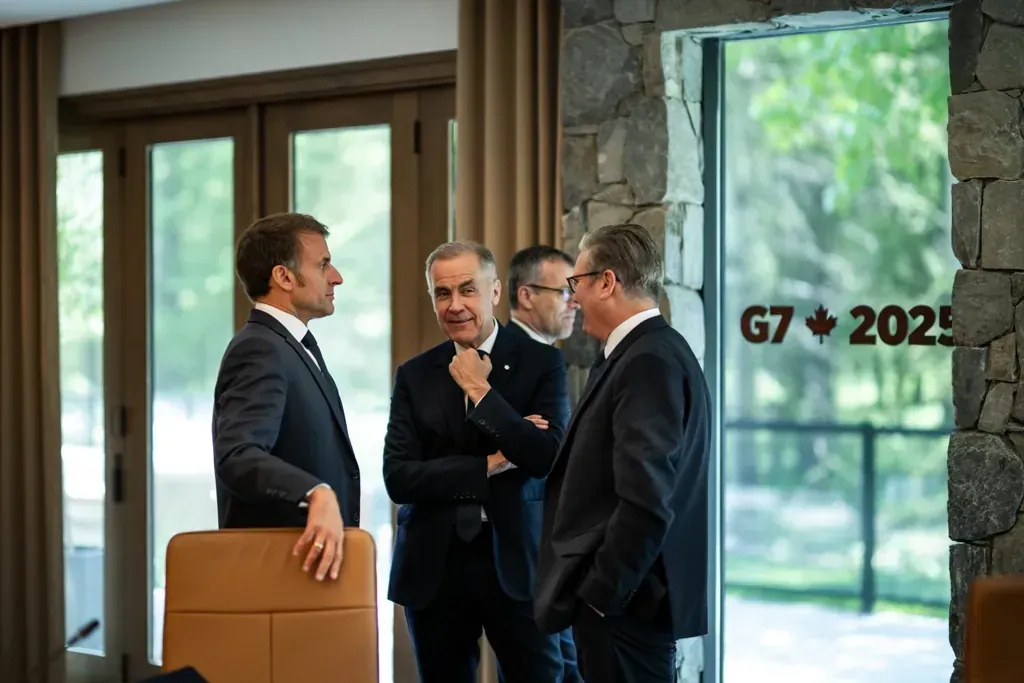
Macron voiced his support Sunday during a meeting with Canadian Prime Minister Mark Carney in Saint-Pierre-et-Miquelon, a French territory off the coast of Newfoundland.
The meeting came days after European Commission President Ursula von der Leyen proposed exploring an associate-member relationship with Canada. Carney has welcomed the idea, but its structure and legal basis have yet to be determined.

Macron and Carney also agreed to expand cooperation in defense, space, energy, critical minerals, telecommunications and emerging technologies.
Macron backs closer Canada-EU ties
Macron said France supports a deeper relationship between Canada and the European Union, including the possibility of associate membership.
His comments followed von der Leyen’s proposal during her State of the Union address to explore a new relationship with Canada.
Von der Leyen described the idea as an “Alliance for the Future.” The proposed partnership could cover defense, the Arctic, energy, critical minerals, advanced manufacturing, artificial intelligence, quantum technology, cybersecurity and economic security.
The proposal is still at an early stage.



The EU does not currently have a formal associate-member category that Canada could simply join. Any new arrangement would require negotiations involving Canada, the European Commission and EU member states.
Canada seeks a deeper partnership
Carney has described the proposal as a way to build a broader strategic relationship with Europe, not as a move toward full EU membership.
In his September 17 address to the European Parliament, Carney said Canada and Europe could combine their strengths in energy, critical minerals, advanced manufacturing, artificial intelligence, quantum technology and defense.
Canada already has extensive ties with the EU.
The Comprehensive Economic and Trade Agreement, or CETA, provides the foundation for much of their economic relationship. Canada also has a Strategic Partnership Agreement with the EU.
More recently, Canada joined the EU’s Security Action for Europe defense procurement program as its first non-European participant.
Carney has welcomed the idea of associate membership while acknowledging that its final structure remains unresolved. Canadian officials have said both the name and substance of any new arrangement would need to be negotiated.
France and Canada expand cooperation
The Saint-Pierre-et-Miquelon meeting produced commitments that extend beyond the EU proposal.
Macron and Carney directed their space agencies, defense ministries and industries to explore cooperation on shared infrastructure, including launch systems and ground-based reception and control facilities.
The two countries also agreed to deepen cooperation in defense, aerospace, energy, wildfire management and other strategic areas.
Their governments highlighted the close relationship between Saint-Pierre-et-Miquelon and Atlantic Canada.
The two sides plan to expand work on economic integration and trade diversification, energy transition, climate resilience, early-warning systems and cross-border security.
Energy adds another dimension
Energy security was also part of the discussions.
Macron said France is interested in greater access to Canadian energy, including liquefied natural gas, as disruptions in global energy markets continue.
Canada is a major producer of oil and natural gas and has significant critical-mineral resources.
Macron said Canadian LNG could play a larger role in Europe’s energy supply as countries seek to diversify their sources.
For Canada, closer ties with Europe could create additional markets for energy and critical minerals.
That gives the proposed political relationship a practical economic dimension beyond diplomacy.
The Arctic brings Canada and Europe closer
The Arctic is another area where Canadian and European interests overlap.
Von der Leyen’s proposal specifically identified the region as a potential area for closer cooperation.
For Canada, Arctic policy involves sovereignty, defense, infrastructure, natural resources and emerging shipping routes.
The location of Macron and Carney’s meeting also underscored the geographic connection.
Saint-Pierre-et-Miquelon lies about 25 kilometers off Newfoundland, making the French territory a close European presence in Canada’s North Atlantic neighborhood.
Canada and France said they would deepen cooperation between the territory and Atlantic Canada while expanding work on security, climate resilience and economic ties.
The proposed status remains undefined
Despite support from von der Leyen, Carney and Macron, Canada has not been granted associate-member status.
The EU treaties do not currently establish “associate member” as a formal category.
The bloc does have various association arrangements with non-member countries, but the proposed Canadian relationship would represent a new form of partnership if it proceeds under that name.
Several questions remain open.
They include how much access Canada would receive to EU programs and markets, whether it would have any role in EU decision-making, what financial commitments would apply and how closely Canada would align with EU rules.
Those details would have to be negotiated.
Canada seeks broader international partnerships
The push toward Europe comes as Ottawa seeks to broaden its economic and strategic relationships.
The United States remains Canada’s largest trading partner, while the Canadian government has increasingly emphasized diversification and stronger ties with Europe and other partners.
Carney has said closer cooperation with Europe would strengthen Canada’s resilience while maintaining Canada’s relationship with the United States.
After meeting Macron, Carney was scheduled to hold talks with Norwegian Prime Minister Jonas Gahr Støre on Arctic security, energy, critical minerals, technology and defense cooperation.
The discussions reflect Canada’s broader effort to strengthen ties with European and Arctic partners.
For now, the proposed EU associate-member relationship remains an idea rather than an established legal status.
Macron’s endorsement gives the proposal additional French support, while von der Leyen’s announcement has opened discussions in Brussels.
The more immediate changes are taking place through cooperation in defense, energy, space, technology, critical minerals and Arctic security.
Whether those efforts eventually develop into a new formal relationship between Canada and the EU will depend on negotiations that have yet to fully begin.
Reporting Credit: Government of Canada — statements and readouts on Canada-EU relations, Mark Carney’s European Parliament address and the September 20 Canada-France meeting; European Commission — Ursula von der Leyen’s 2026 State of the Union proposal and EU-Canada partnership framework; Government of France — presidential statements and bilateral cooperation with Canada; European Union — CETA and existing Canada-EU partnership arrangements.