HONG KONG – Asian stocks mostly rose Monday as investors responded to positive signals from weekend U.S.-China talks ahead of a planned meeting between U.S. President Donald Trump and Chinese President Xi Jinping later this week.
Technology shares led gains in several markets, while Chinese and Hong Kong stocks also advanced. Investors were weighing whether the latest discussions could preserve stability in trade relations between the world’s two largest economies.
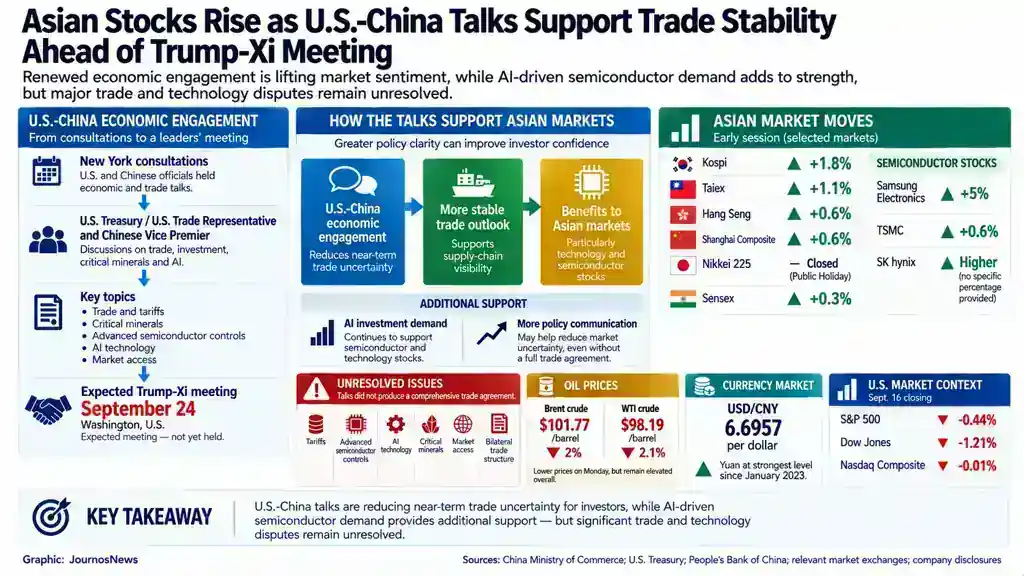
South Korea’s Kospi rose about 1.8%, with Samsung Electronics gaining 5% and SK Hynix also higher. Taiwan’s Taiex rose about 1.1%, while Taiwan Semiconductor Manufacturing Co. gained about 0.6%. Hong Kong’s Hang Seng Index and Shanghai Composite both added about 0.6% during early trading. Japan’s Nikkei 225 was closed for a public holiday.

The gains followed a meeting in New York between U.S. Treasury Secretary Scott Bessent, U.S. Trade Representative Jamieson Greer and Chinese Vice Premier He Lifeng.
Bessent described the talks as a “very successful engagement” and said the discussions covered trade and artificial intelligence. China’s Commerce Ministry described the exchange as candid, in-depth and constructive.
The officials’ discussions are intended to prepare the ground for Trump and Xi’s expected meeting in Washington on Thursday.
Trade discussions move toward the leaders’ meeting
The weekend negotiations focused on several areas that have become central to the U.S.-China economic relationship, including tariffs, trade and investment.
The two sides have been working on arrangements affecting trade in less-sensitive goods, while broader disagreements over technology restrictions and strategic industries remain unresolved.
■ Related News



Chinese and U.S. officials have also been discussing critical minerals and the implementation of a proposed mechanism for continuing economic negotiations. The talks are taking place as the existing period of relative tariff stability between Washington and Beijing approaches another important deadline.
The latest developments do not amount to a comprehensive trade agreement.
For investors, however, the absence of a fresh escalation was itself significant. Asian markets have been particularly sensitive to changes in the outlook for tariffs because supply chains across the region remain closely connected to Chinese manufacturing and U.S. consumer demand.
Artificial intelligence enters the negotiations
AI was another important subject in New York.
Bessent said the United States proposed creating a new mechanism for the two countries to communicate about AI incidents that could rise to the level of national-security concerns.
The proposal would establish a channel for discussing potentially dangerous AI-related incidents and improving transparency between the two countries, according to Bessent. Chinese state media described the AI discussions as candid and constructive.
The proposed dialogue does not resolve the much broader technology dispute.
Washington continues to restrict China’s access to some advanced semiconductor technologies, while Beijing is investing heavily in domestic AI chips and computing infrastructure.
Those restrictions are likely to remain part of the strategic relationship even if the two governments make progress on other areas of trade.
Chip stocks benefit from the broader AI demand
The market reaction also reflected continued investor interest in AI-related technology.
Samsung Electronics and SK Hynix benefited from strength in the semiconductor sector, while TSMC also advanced in Taiwan.
The gains came as Asian chipmakers continue to benefit from demand associated with AI data centers and advanced computing.
That trend gives the region’s technology companies a second source of market support beyond the immediate U.S.-China diplomatic developments.
The combination is particularly visible in South Korea and Taiwan, where semiconductor companies have become major beneficiaries of the global AI investment cycle.
Chinese markets respond cautiously
Chinese equities rose as investors assessed the possibility of continued economic engagement with Washington.
The Shanghai Composite gained about 0.6%, while Hong Kong’s Hang Seng Index also rose about 0.6%. The CSI 300 was higher as well, with technology and property shares among the stronger sectors in mainland trading.
The moves came alongside a strengthening yuan.
The Chinese currency reached about 6.6957 per U.S. dollar during Monday’s trading, its strongest level since January 2023, according to Reuters. The People’s Bank of China also set its daily midpoint at its strongest level since February 2023.
The currency move occurred as the summit approached, although analysts cautioned against treating the recent appreciation as evidence of a lasting change in China’s exchange-rate policy.
The yuan’s movement therefore provided another market signal of the more stable tone surrounding the immediate talks, but it did not resolve broader differences over monetary policy, economic conditions or trade.
Investors are not pricing in a complete settlement
The market response has been positive, but the gains do not necessarily indicate that investors expect a comprehensive U.S.-China agreement.
The major issues separating the two countries extend beyond tariffs.
They include advanced semiconductor controls, AI technology, critical minerals, market access and the structure of bilateral trade.
Analysts cited by market reports have described expectations for the summit as measured, with attention focused more on maintaining relative stability than on reaching a sweeping new agreement.
That distinction is important for Asian markets.
A prolonged period without additional tariff escalation would give manufacturers and exporters greater visibility over costs and supply chains. A renewed deterioration, by contrast, could quickly revive concerns over trade barriers and investment decisions.
Oil adds another variable for Asian markets
Oil prices were moving lower Monday, providing another source of support for Asian equities.
Brent crude fell about 2% to around $101.77 a barrel in early trading, while West Texas Intermediate declined about 2.1% to around $98.19. Prices remained substantially above pre-war levels because the conflict involving the United States and Iran continues to disrupt energy markets.
Reports that more Middle Eastern oil was reaching international markets helped ease some of the immediate pressure.
For Asian economies, lower oil prices can reduce the inflationary burden created by higher energy costs, although the regional impact remains dependent on the duration of the Middle East disruption and the reliability of energy shipments.
That leaves Asian markets balancing several competing forces at once: expectations surrounding U.S.-China relations, continued AI investment, elevated energy prices and the effects of tighter global monetary policy.
The summit remains the next major market test
Trump and Xi are expected to meet in Washington on September 24.
The leaders’ discussions are expected to cover trade and investment as well as AI and broader geopolitical issues. The U.S. and China have already used the New York negotiations to establish areas of discussion and potential mechanisms for continuing talks.
But the preparatory talks have not eliminated the structural disputes between the two economies.
For Asian investors, the immediate question is therefore less whether every disagreement will be resolved and more whether the two governments can maintain a stable negotiating framework.
Monday’s market gains reflected that expectation of continued engagement.
What happens after the leaders meet will depend on whether the discussions produce concrete arrangements and whether those arrangements are implemented.
Until then, technology demand and the prospect of more stable U.S.-China trade relations are providing support to Asian equities, while elevated energy prices and global interest-rate pressures remain significant risks.
Reporting Credit: China Ministry of Commerce — official account of the September 20 U.S.-China economic and trade consultations and AI dialogue; U.S. Treasury — statements by Secretary Scott Bessent on the New York discussions; People’s Bank of China — official daily yuan midpoint; Taiwan Semiconductor Manufacturing Co., Samsung Electronics and SK hynix — semiconductor and AI-related corporate information.