WASHINGTON, United States – The United States began blocking nearly $1 billion worth of Canadian imports Tuesday, adding alcohol, dairy products and motorcycles to an escalating trade dispute between the two countries.
The new restrictions took effect at 12:01 a.m. Eastern time on September 29 under presidential proclamations issued earlier this month. The measures target products that had previously been subject to additional U.S. tariffs.
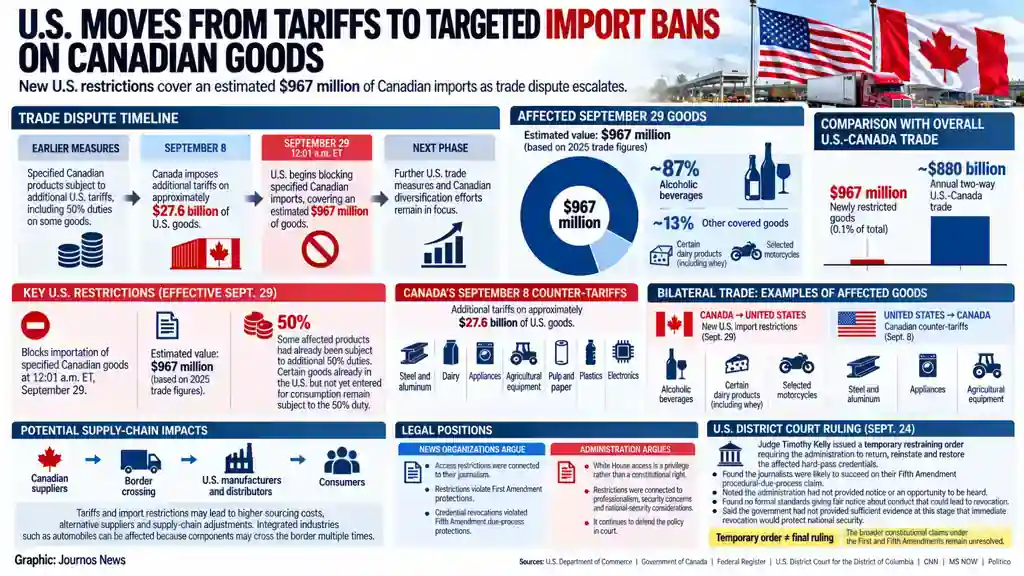
The import ban covers an estimated $967 million of Canadian goods based on 2025 trade figures, according to an analysis cited by The Associated Press. About 87% of that value consists of alcoholic beverages.

The restrictions represent another step in a trade confrontation that has already placed tariffs on tens of billions of dollars in goods moving between the two North American economies.
What the United States is blocking
The measures cover specified Canadian alcoholic beverages, certain dairy products and selected motorcycles.
Among the dairy products affected is whey, a milk-processing byproduct widely used in food and animal-feed industries. Quebec-based Bombardier Recreational Products said its three-wheel Can-Am Spyder and Canyon motorcycles are included in the restrictions.
The White House said the bans were authorized under Section 338 of the Tariff Act of 1930. The administration argues that Canada’s treatment of U.S. products in the alcohol, dairy and motor-vehicle sectors disadvantages American commerce.
The proclamations specifically move certain products that were already subject to additional 50% duties into the more restrictive category of goods excluded from U.S. importation.




Products that had already entered the United States, but had not yet been entered for consumption or withdrawn from bonded warehouses before September 29, remain subject to the 50% duty rather than the new ban.
Canada had already retaliated
The latest U.S. action follows Canada’s September 8 implementation of additional tariffs on about $27.6 billion of U.S. goods.
Canada said those countermeasures matched the value of the U.S. Section 338 tariffs imposed on Canadian products and covered sectors including steel and aluminum, dairy, appliances, agricultural equipment, pulp and paper, plastics and electronics.
The Canadian government has described the U.S. tariffs as unjustified and said it is working to protect affected Canadian businesses while diversifying trade relationships.
Canada’s trade minister Dominic LeBlanc said in early September that Ottawa remained open to constructive engagement with Washington while pursuing measures to strengthen Canada’s economic resilience and expand market opportunities elsewhere.
The two governments therefore remain engaged, but the sequence of measures has moved the dispute beyond conventional tariff increases into outright restrictions on specific imports.
The economic effect is limited compared with total trade
The banned goods represent a small share of the two countries’ overall commercial relationship.
Annual two-way trade between the United States and Canada is worth roughly $880 billion, meaning the newly prohibited products amount to a relatively small portion of total bilateral commerce.
That does not mean individual companies or industries will be unaffected.
Canadian producers that depend heavily on U.S. consumers could lose access to an important market, while American distributors and retailers that rely on Canadian suppliers may have to find alternative sources.
The immediate effect may also be smaller than the headline value suggests because the affected goods were already subject to tariffs as high as 50%.
Trade attorney Patrick Childress told AP that for some products, the earlier tariffs had effectively made Canadian imports uneconomical even before the outright restrictions took effect.
The new measures therefore change the legal status of the trade more dramatically than they necessarily change the volume of goods already moving across the border.
Washington says the measures respond to Canadian policy
The Trump administration has framed the restrictions as a response to what it calls discriminatory Canadian trade practices and retaliation against U.S. exports.
The White House said Canada had maintained or increased measures affecting American alcohol, dairy and motor-vehicle commerce after previous negotiations failed to produce an agreement acceptable to Washington.
U.S. Trade Representative Jamieson Greer said the administration was using Section 338 to respond to what Washington characterized as unequal treatment of U.S. commerce. The USTR also said the administration was removing some Canadian products from earlier tariff measures while adding others to the affected lists.
Canada disputes the U.S. characterization of its policies and has imposed its own countermeasures.
The two sides therefore continue to describe the dispute differently, with Washington focusing on discrimination against American exports and Ottawa emphasizing the economic impact of U.S. tariffs on Canadian businesses and workers.
More trade measures are ahead
The import bans are not the only pressure facing the North American trade relationship.
The Trump administration has also announced further tariff measures affecting Canadian automobiles, auto parts and steel, with additional changes scheduled for January, according to recent U.S. trade-policy reporting.
That creates a larger concern for integrated North American manufacturing.
The United States and Canada have spent decades building supply chains in which components cross the border multiple times before a finished product reaches consumers. The auto industry is particularly dependent on that integration.
Higher tariffs or import restrictions can therefore affect companies on both sides of the border even when a particular product is not directly banned.
The broader dispute also raises questions about the future of the United States-Mexico-Canada Agreement, the trade framework that governs much of North American commerce.
Ottawa is looking beyond the U.S. market
Canada remains deeply dependent on the American market, but the trade confrontation has accelerated efforts to diversify.
The Canadian government has said it wants to expand trade with other countries and strengthen domestic industries rather than rely as heavily on the United States.
Prime Minister Mark Carney has also pursued closer economic relationships with other major markets, including the European Union, India and China.
That diversification cannot happen immediately.
The United States remains Canada’s dominant export market, and many Canadian supply chains were built specifically around proximity to the American economy.
Replacing that demand would require new infrastructure, trade agreements, customers and production arrangements.
The dispute enters a new phase
The September 29 measures are unlikely by themselves to transform the overall size of U.S.-Canada trade.
Their significance lies more in the direction of the dispute.
What began with tariffs has expanded into targeted import bans and broader restrictions on government procurement and trade access. The United States has also continued to threaten or implement additional measures, while Canada has responded with its own tariffs and plans to reduce dependence on its largest trading partner.
For businesses, the uncertainty may matter as much as the tariffs themselves.
Companies planning production, sourcing and investment across the U.S.-Canada border now have to account for the possibility that additional products could move from ordinary tariff treatment to outright import restrictions.
The two countries remain major trading partners, but the rules governing that relationship are becoming less predictable.
The new bans therefore mark another escalation in a dispute whose economic value extends far beyond the roughly $1 billion of goods directly affected on September 29.
Reporting Credit: The White House — presidential proclamations establishing the September 29 import bans and the administration’s stated rationale; Office of the United States Trade Representative — Section 338 authority and U.S. trade-policy position; Government of Canada / Department of Finance — September 8 counter-tariff measures and affected U.S. products; Global Affairs Canada — Canadian government position on bilateral trade and economic diversification.