Indonesia, Jakarta – Indonesia’s forest and land fires have triggered severe haze across parts of Southeast Asia, with Malaysia declaring an emergency in Sarawak’s Serian district after air pollution reached a critical level.
The episode is unfolding during an unusually dry season that Indonesia’s Meteorology, Climatology and Geophysical Agency (BMKG) has linked to a strong El Niño. Fires have spread across Sumatra and Kalimantan, while smoke has affected neighboring areas, highlighting the regional consequences of fires that cross national boundaries.
Environmental Impact
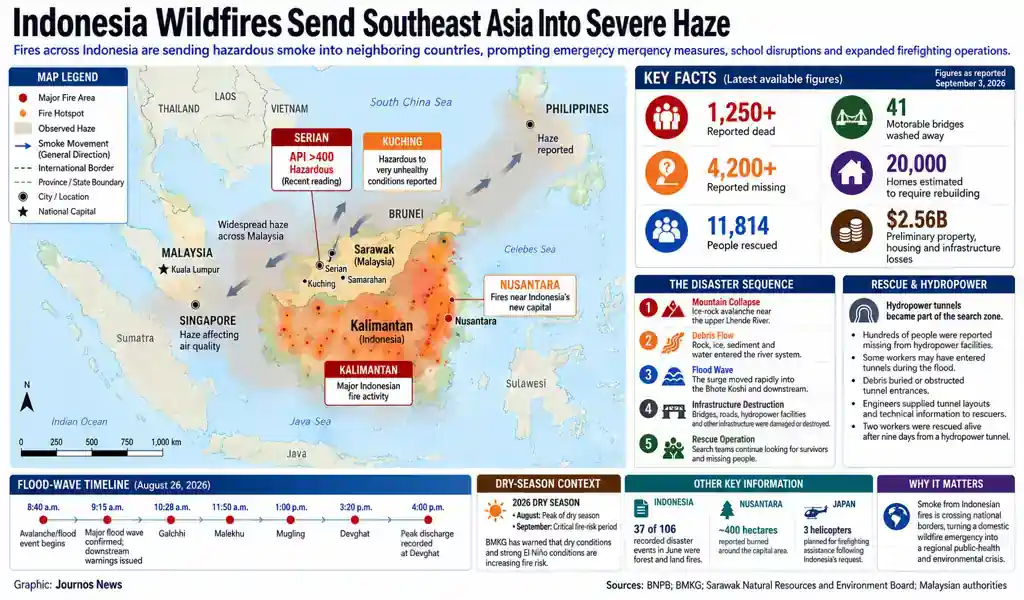
Serian recorded an Air Pollutant Index (API) of 521 on Sept. 4, prompting Malaysia to declare a state of emergency in the district. The emergency covers a 20-kilometer radius and permits stronger measures to protect public health and safety.

Sarawak’s capital, Kuching, recorded an API of 311, while other locations also reached unhealthy or hazardous levels. Sarawak’s Natural Resources and Environment Board reported a reading of 408 in Serian on Sept. 3, with several other monitoring stations classified as very unhealthy or hazardous.
Schools have been closed in affected parts of Sarawak, while authorities have also used cloud-seeding operations as they respond to the deteriorating conditions.
The haze has also affected the Philippines, where authorities have suspended classes in some areas and issued advisories to limit exposure to polluted air.
Fire Activity Across Indonesia
Indonesia is confronting widespread fires during the peak of its dry season.
The country’s National Disaster Management Agency, BNPB, reported that forest and land fires were the most frequent category of disaster recorded in June, with 37 of 106 disaster events attributed to fires.
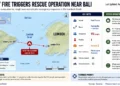

More recent satellite monitoring cited by the Associated Press identified 717 fire hotspots in Indonesia since Aug. 1, including 103 detected during a 24-hour period. Indonesian authorities have also arrested 112 people suspected of deliberately setting fires for land clearing, while five companies have had their licenses suspended and 167 cases involving about 4,700 hectares are under investigation.
Reuters reported that nearly 95,000 hectares burned in Indonesia during July, while more than 9,000 hotspots were detected in August.
Scientific Context
BMKG said Indonesia’s 2026 dry season is expected to be drier and longer than normal in many areas. Its June forecast identified August as the peak dry-season period for the largest share of Indonesia’s seasonal zones, with September also a significant period for dry conditions.
By late July, BMKG said El Niño had become strong and warned that fire risk was expected to increase from July, reaching particularly high levels during August and September. The agency identified Sumatra and Kalimantan as major areas requiring intensified monitoring.
The environmental consequences are particularly difficult in peatlands. Fires can continue smoldering beneath the surface, making them harder to extinguish and allowing smoke-producing fires to persist even after flames are no longer visible. Reuters reported that peatlands in Borneo are among the areas complicating firefighting operations.
Fire Threat Near Nusantara
Fire activity has also moved closer to Nusantara, Indonesia’s developing new capital in East Kalimantan.
Reuters reported that about 400 hectares had burned around the capital area, including roughly 300 hectares in Bukit Suharto forest park, about 50 kilometers from the city center. Authorities have been using water-bombing aircraft and cloud-seeding operations to limit the spread.
The fires add pressure to protect forested areas surrounding Nusantara as Indonesia attempts to contain outbreaks during one of its most difficult fire seasons.
Regional Response
Indonesia has expanded aerial and ground firefighting operations, including water bombing and weather-modification efforts. Japan is also preparing assistance after ordering the deployment of a unit centered on three firefighting helicopters and a transport vessel carrying the aircraft.
The Japanese Ministry of Defense said the deployment was ordered as an international disaster-relief activity in response to severe forest fires in Indonesia. The operation is intended to support Indonesian authorities and people affected by the fires.
Malaysia’s emergency declaration demonstrates how rapidly Indonesia’s fires can become a cross-border environmental and public-health issue. Smoke from fires in one country can degrade air quality hundreds of kilometers away, creating consequences for communities and authorities beyond the immediate fire zones.
What Remains Uncertain
The full environmental damage from the current fire season is still developing. Authorities continue to investigate the causes of individual fires, including possible deliberate burning for land clearing, while satellite observations and ground assessments continue to update the scale of affected areas.
Weather conditions will remain an important factor. BMKG expects El Niño to persist into early 2027 and has identified August and September as key periods for elevated fire risk, but the timing and distribution of rainfall will determine how conditions evolve in individual areas.
For now, Indonesia and its neighbors are focused on containing active fires, reducing exposure to hazardous smoke and limiting further spread. The episode also underscores the continuing challenge of managing fire-prone forests and peatlands during prolonged dry conditions.
Reporting Credit: Indonesia’s National Disaster Management Agency (BNPB), Indonesia’s Meteorology, Climatology and Geophysical Agency (BMKG), Sarawak Natural Resources and Environment Board, Malaysian authorities, Japan Ministry of Defense