HANOI, Vietnam (Journos News) – Indonesia is moving to tighten state control over its vast nickel resources, a decision that could reverberate across global electric-vehicle supply chains at a time when the United States and China are competing for access to critical minerals. The policy shift comes after years of aggressive expansion aimed at building a domestic EV industry around the metal.
With Indonesia now accounting for roughly 60% of global nickel supply in 2024, up from 31.5% in 2020 according to S&P Global Market Intelligence, the country occupies a pivotal role in the energy transition. That rise followed a 2020 ban on raw nickel ore exports introduced under former President Joko Widodo, which spurred a surge of Chinese-backed investment in domestic smelting and refining.
Yet the tightening of control comes as global battery technology shifts, reducing reliance on nickel-heavy chemistries and raising questions about the long-term payoff of Indonesia’s strategy.

Environmental trade-offs and industrial expansion
Indonesia holds the world’s largest nickel reserves, much of them concentrated on the island of Sulawesi. According to the Institute for Energy Economics and Financial Analysis (IEEFA), the island accounts for more than half of global nickel mine production.
China has long sourced nickel from Indonesia, but ties deepened after the 2020 export ban redirected raw ore into domestic processing. Imports of nickel matte — a semi-processed material used in battery chemicals and alloys — into China increased nearly 28-fold between 2020 and 2023, with more than 90% of supply coming from Indonesia, trade data show.
During the same period, the share of global nickel output from North and South America fell from 16% to 7%, while Europe’s share declined from 35% to 10%, according to the International Nickel Study Group.
The rapid buildout has come at an environmental cost. An analysis by the World Resources Institute found that mining drove the loss of about 370,000 hectares of Indonesian forests between 2001 and 2020 — more than in any other country during that period. Over one-third of the loss involved old-growth rainforest, critical for carbon storage and biodiversity.
Coal-fired power has underpinned much of Indonesia’s nickel processing expansion, complicating its climate goals. IEEFA reported in 2024 that major nickel producers emitted roughly 15 million metric tons of greenhouse gases in 2023, largely due to coal reliance. The growth of smelters has increased fossil-fuel demand even as Jakarta seeks to reduce emissions.
■ Related News


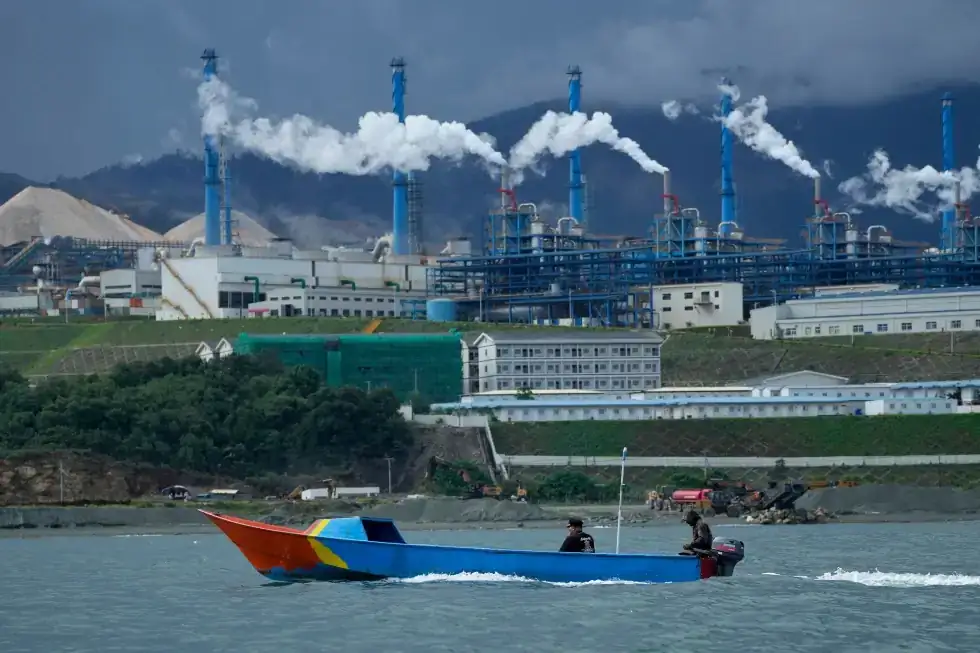
In one high-profile episode last year, Indonesian soldiers accompanied by local media took control of part of what is considered the world’s largest nickel mine. The site is mostly owned by Tsingshan Holding Group. A 2024 report by the nonprofit Climate Rights International cited deforestation, pollution, coal-related emissions and displacement of communities linked to the operation.
Analysts say the recent state interventions are not primarily aimed at environmental remediation. Instead, they reflect efforts to reassert greater national leverage over a sector that has become strategically vital.
EV ambitions meet shifting battery technology
Indonesia’s nickel policy was designed to anchor a fully domestic electric-vehicle value chain, spanning mining, battery production and vehicle assembly. Early interest came from South Korean and Chinese firms seeking to secure supplies for the rapidly growing EV market.
In July 2024, Hyundai Motor Group and LG Energy Solution opened Indonesia’s first EV battery-cell plant, with capacity to supply more than 150,000 vehicles annually. However, in April 2025, LG Energy Solution withdrew from a larger $8.4 billion battery investment, citing market and investment conditions.
Chinese automaker BYD is building an EV plant in Indonesia, while CATL, the world’s largest EV battery maker, is constructing a battery factory in partnership with Indonesian state firms.
Domestically, EV adoption remains limited. Indonesia sold just over 43,000 electric vehicles in 2024, about 5% of total car sales, according to the Indonesian Business Council. Public charging infrastructure numbered around 1,500 stations nationwide.
Even if Indonesia were to produce one million EVs annually — roughly equivalent to total yearly auto sales — and rely heavily on nickel-rich batteries, that would consume less than 1% of its national nickel output, according to the Jakarta-based Energy Shift Institute. The scale of domestic demand remains small compared with production capacity.
At the same time, battery chemistry is evolving. Automakers are increasingly adopting lithium iron phosphate (LFP) batteries, which use little or no nickel or cobalt. The International Energy Agency has reported that LFP batteries are now used in nearly half of all EVs globally, reflecting their lower cost and improved stability.
The shift has tempered expectations that nickel will dominate the EV transition indefinitely.
Between Washington and Beijing
Indonesia’s tightening of state control unfolds against intensifying geopolitical competition. Both Washington and Beijing view critical minerals as central to economic security and clean-energy leadership.
Some analysts suggest that Indonesia’s nationalization drive could reduce Beijing’s dominance over segments of the supply chain, potentially creating room for greater U.S. engagement. Jakarta has invited American investment in its critical minerals sector as part of ongoing trade and tariff discussions.
One possible concession under discussion has been lifting the ban on raw nickel exports to the United States, a move that would mark a significant shift from the resource-nationalist policy introduced in 2020.
Yet balancing relations between the two powers presents a challenge. China remains Indonesia’s largest industrial partner in nickel processing, while the United States seeks to diversify supply chains away from Chinese control.
Regional governments across Southeast Asia are closely observing how Jakarta navigates this terrain. Greater state intervention could strengthen national control, but it may also introduce regulatory uncertainty.
Analysts caution that land seizures and abrupt policy changes risk deterring foreign capital at a time when large-scale investment remains essential to sustain mining and downstream processing.
For Indonesia, nickel has become both an economic opportunity and a test of governance. The country sits at the heart of the global critical-minerals race, but the future of its strategy now depends on how it manages environmental pressures, technological shifts and geopolitical crosscurrents.
Source: AP News – Indonesia tightens control on nickel as the US and China scramble for critical minerals