CAPE CANAVERAL, Florida – Scientists say a SpaceX rocket stage that drifted through cislunar space for more than a year after launching two private lunar landers has struck the moon, providing what researchers describe as strong observational evidence of a long-predicted impact.
Although no telescope directly captured the moment of impact, astronomers reported detecting a plume of material consistent with the collision after the approximately four-ton upper-stage rocket struck the lunar surface at about 5,400 mph (8,700 kph).
Researchers said the findings provide compelling evidence that the inactive rocket stage completed its unintended journey and impacted the moon, drawing renewed attention to the growing challenge of managing human-made debris as lunar exploration accelerates.

Telescope observations support predicted impact
A research team led by Boston University astronomer Carl Schmidt used the European Southern Observatory’s Very Large Telescope in Chile to monitor the expected impact site.
The team detected a plume of sodium and lithium extending tens of kilometers above the lunar surface that remained visible for between five and 10 minutes after the predicted collision.
“We don’t have images of the impact,” Schmidt said, but noted that the telescope observations clearly revealed the resulting debris plume.
He said the researchers are “100% certain” the observations represent evidence of the lunar impact.
Scientists say collision was inevitable
Retired astrophysicist Jonathan McDowell said observations made the night before the impact showed the rocket stage traveling directly toward the moon.
■ Related News




The impact is believed to have occurred near Einstein Crater, located on the moon’s sunlit western limb near the boundary between the near and far sides, an area that is difficult to observe from Earth.
“There’s no doubt in my mind” that the rocket “is now in teeny, little pieces scattered over the moon near Einstein Crater,” McDowell told The Associated Press.
He added that, based on orbital mechanics, the collision had become unavoidable.
Dutch astronomer Marco Langbroek also attempted to observe the event but did not detect a visible plume.
“We knew this would be a long shot,” Langbroek said, adding that he also has “no doubt” the rocket struck the lunar surface.
Scientists expect definitive confirmation once NASA’s Lunar Reconnaissance Orbiter photographs the impact site during a future orbital pass.
Rocket remained in space after lunar mission
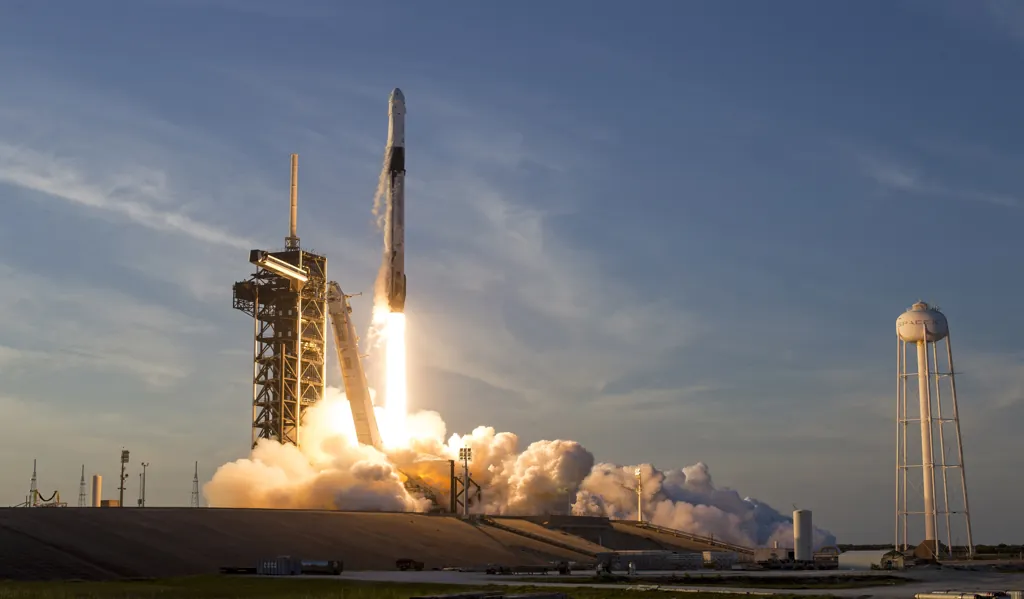
The Falcon upper stage launched from Cape Canaveral on Jan. 15, 2025, carrying Firefly Aerospace’s Blue Ghost and ispace’s Resilience lunar landers.
After deploying both spacecraft, the upper stage remained in cislunar space instead of returning to Earth.
According to SpaceX Vice President Julianna Scheiman, the lunar impact was not intentional. She said changing solar activity and gravitational forces gradually altered the rocket’s trajectory until it intersected the moon.
Scheiman said SpaceX is working with NASA to reduce the likelihood of similar incidents on future missions.
The mission’s two lunar landers had different outcomes.
Firefly Aerospace’s Blue Ghost became the first privately developed spacecraft to achieve a successful lunar landing, while ispace’s Resilience crashed during its landing attempt.
Growing lunar activity raises debris concerns
Scientists say the incident illustrates a broader issue as lunar missions become increasingly frequent.
In 2022, another discarded rocket stage believed to belong to China unintentionally struck the moon. Researchers also suspect that additional rocket stages from earlier decades impacted the lunar surface without being detected.
The number of missions operating near the moon is expected to increase significantly over the coming years.
NASA plans additional robotic and crewed Artemis missions, while SpaceX and Blue Origin continue developing lunar landing systems intended to support future astronaut missions.
SpaceX is testing its Starship launch system, and Blue Origin is preparing its Blue Moon lunar lander for future missions.
NASA currently plans Artemis III as a docking rehearsal in Earth orbit next year before a later crewed lunar landing, with astronauts potentially returning to the moon as early as 2028.
McDowell said the increasing number of spacecraft operating around the moon means accidental impacts will become a more significant concern.
“Things are going to get a lot busier near the moon,” he said. “At that point an impact like this on the lunar surface plowing up huge amounts of dust going for hundreds of miles around is not going to be acceptable.”
This report is based on reporting by The Associated Press.