Europe and the United Kingdom will experience a major solar eclipse on Aug. 12, with a narrow path of totality crossing parts of Spain and the North Atlantic while much of the continent sees the Moon cover most of the Sun.
Observers in parts of Spain and Iceland will have an opportunity to see the Sun completely obscured by the Moon. Across much of Europe, the eclipse will remain partial but will cover a large portion of the Sun.
In the United Kingdom, the path of totality will remain offshore southwest of the country. Much of the UK is expected to see around 90% of the Sun covered, with the highest coverage in western areas.

The eclipse will also provide scientists and observers with a brief opportunity to view features of the Sun that are normally hidden by its bright visible surface.
Totality follows a narrow path
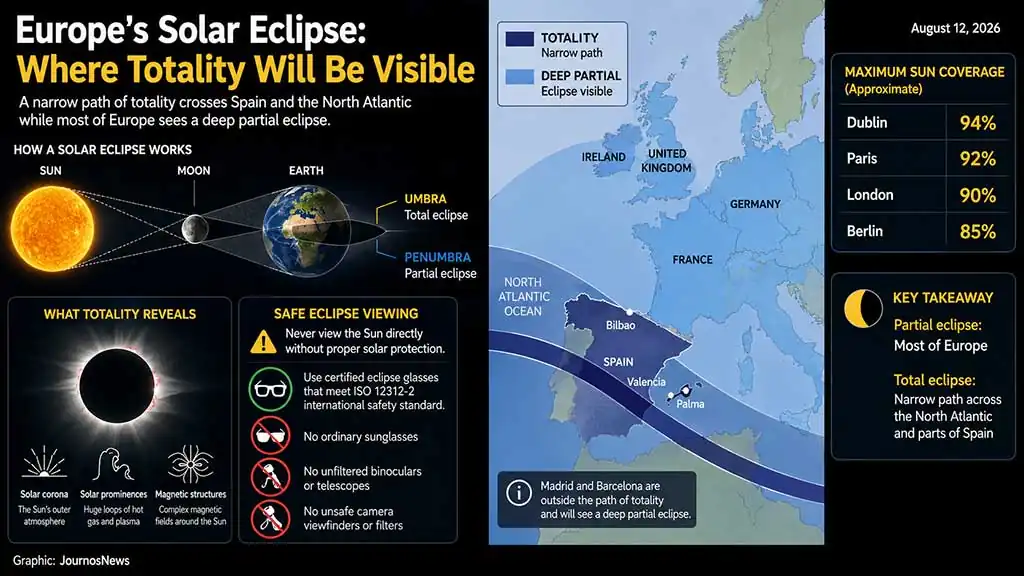
The path of totality will begin near the northern tip of Siberia before extending across areas between Iceland and Greenland.
Much of the route will pass over sparsely populated parts of the Arctic and the North Atlantic Ocean. The Moon’s shadow will then reach Spain, where totality will be visible from locations including Bilbao, Valencia and Palma on Mallorca.
The path will eventually cross Mallorca and Menorca before moving over the Mediterranean as the Sun sets.
For observers inside the central path, totality will be brief. In most locations, the period when the Moon completely covers the Sun will last less than two minutes.
■ Related News



Outside the path, the eclipse will remain partial. The supplied material gives estimated maximum coverage of about 94% in Dublin, 92% in Paris, 90% in London and 85% in Berlin.
Even a deep partial eclipse differs significantly from totality. A small remaining portion of the Sun can continue to overwhelm the much fainter solar corona and prevent the sky from reaching the darkness associated with a total eclipse.
UK will see a deep partial eclipse
The entire United Kingdom will fall within the Moon’s partial shadow.
However, the path of totality will remain offshore. Western areas are expected to receive the greatest coverage, with Cornwall and Pembrokeshire potentially seeing about 95% of the Sun obscured.
Much of the rest of the UK will experience around 90% coverage.
The eclipse is expected to reach its peak between 19:02 and 19:16 BST, depending on the observer’s location. Because the event will occur late in the day, the Sun will sit relatively low in the western sky.
That makes an unobstructed view toward the horizon particularly important. Cloud, buildings and local terrain could also affect visibility.
Spain offers the clearest European view of totality
Spain will provide some of the most accessible locations in Europe for viewing totality.
The path will include cities and areas around Bilbao, Valencia and Palma. Totality is expected to peak between 20:26 and 20:33 local time, depending on location.
Madrid and Barcelona will experience more than 99% coverage but will remain outside the path of totality.
That small difference matters. Even a tiny visible section of the Sun can continue to produce enough light to prevent the distinctive darkness and visibility of the corona associated with totality.
Totality reveals the Sun’s outer atmosphere
During a total solar eclipse, the Moon blocks the Sun’s bright visible surface. This allows the much fainter outer atmosphere, known as the corona, to become visible.
Observers may also see prominences, structures made of hot plasma that extend from the Sun and are shaped by its magnetic fields.
Some prominences can be associated with coronal mass ejections, in which solar material is released into space.
The brief alignment therefore creates unusual observing conditions. Features normally overwhelmed by sunlight become visible for a short period while the Moon completely covers the solar disk.
Why the eclipse occurs
A solar eclipse occurs when the Moon passes between Earth and the Sun and blocks some or all of the sunlight reaching a portion of Earth’s surface.
The Moon’s umbra is the darkest part of its shadow. It creates the narrow area where totality can be seen.
The surrounding penumbra produces a partial eclipse. The farther an observer is from the centre of the Moon’s shadow, the smaller the portion of the Sun that will be covered.
Solar eclipses do not occur every month because the Moon’s orbit is tilted relative to Earth’s orbit around the Sun. The necessary alignment therefore occurs only at particular points in the lunar orbit.
The apparent similarity in size between the Sun and Moon as seen from Earth also plays a role. The Sun is vastly larger than the Moon but is much farther away, allowing the two bodies to appear roughly similar in size from Earth’s surface.
The Moon is gradually moving farther from Earth. Over very long periods, that will change the geometry that currently allows total solar eclipses to occur.
Eye protection remains essential
People watching the eclipse should use purpose-made solar or eclipse glasses when viewing the Sun directly.
Ordinary sunglasses do not provide sufficient protection.
Viewers should also never look directly at the Sun through binoculars or telescopes while wearing standard eclipse glasses. Magnification can concentrate sunlight and cause serious eye injury.
The same caution applies to camera viewfinders that are not designed for safe solar observation.
For observers in the UK and other areas outside the path of totality, the Sun will remain partially visible throughout the event. Appropriate eye protection should therefore remain in place during direct viewing.
Indirect methods, including a pinhole projector, provide another way to observe the changing shape of the Sun without looking directly at it.
The eclipse will produce different experiences across Europe depending on location. Most of the continent will see a deep partial eclipse, while observers along a narrow path will briefly experience totality as the Moon, Sun and Earth align.
Reporting credit: BBC News.