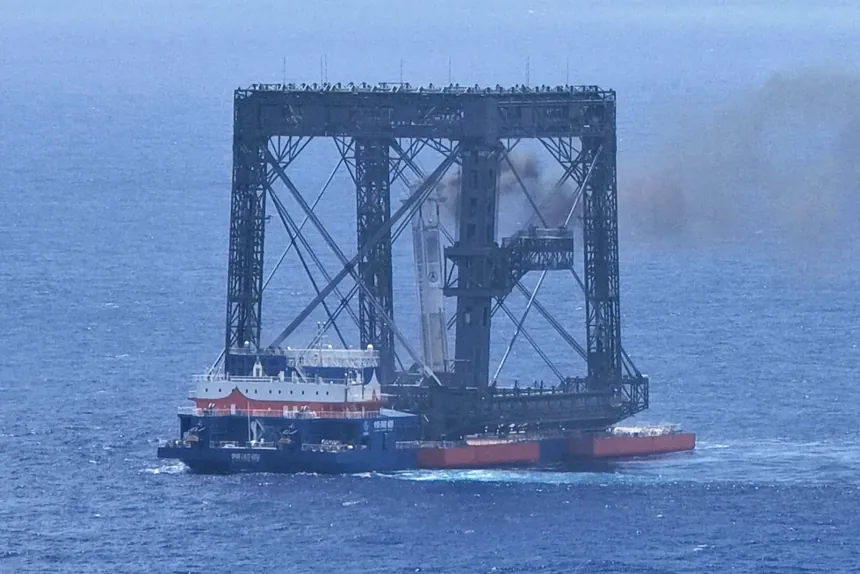
BEIJING, China – China successfully recovered the first stage of one of its rockets following a launch on Friday, marking a major milestone in the country’s pursuit of reusable space technology and bringing it closer to industry leaders that have transformed commercial launch economics through booster recovery.
According to China’s state-run Xinhua News Agency, the first stage of a Long March-10B rocket separated from the upper stage after liftoff before returning to a recovery platform at sea. It was the first time China had successfully retrieved the first stage of an orbital launch vehicle for future reuse.
The achievement represents an important step in China’s long-term strategy to develop more cost-effective launch capabilities as competition in the global space sector continues to expand.

China joins the reusable rocket race
Recovering and reusing rocket boosters has become a defining technology for modern space launch providers because it significantly reduces the cost of placing satellites and other payloads into orbit.
SpaceX pioneered routine booster recovery, using reusable Falcon 9 first stages to support frequent commercial, scientific and government missions. The company has completed more than 600 successful landings, recovering boosters on both offshore drone ships and land-based landing zones.
Earlier this week, SpaceX launched a Falcon 9 first-stage booster for a record 36th flight, demonstrating the operational advantages of reusable launch systems.
Blue Origin has also developed reusable rocket technology, first recovering its New Shepard boosters after suborbital missions in Texas before expanding the capability to its larger New Glenn launch vehicle, whose boosters are recovered on a floating platform off Florida’s coast.
China’s successful recovery places it among a small group of countries and companies that have demonstrated reusable first-stage technology.



Long March program expands launch capability
The reusable Long March-10B lifted off from Hainan Island, China’s southern coastal launch site and a major center for the country’s expanding space program.
According to Xinhua, the reusable version of the rocket is capable of delivering payloads of up to 16,000 kilograms (35,275 pounds) into low Earth orbit.
By comparison, SpaceX says its Falcon 9 can carry up to 22,800 kilograms (50,265 pounds) to low Earth orbit. Falcon 9 rockets regularly transport satellites, cargo and astronauts, including missions to the International Space Station.
The latest recovery marks a significant technological advancement for China’s launch industry as it seeks to improve launch efficiency and reduce operating costs through reusable systems.
Global competition continues to grow
China’s achievement comes as reusable launch technology becomes an increasingly important area of competition among national space agencies and commercial launch providers.
The successful booster recovery follows years of development by SpaceX and Blue Origin and precedes Japan’s planned reusable rocket demonstration this weekend, underscoring growing international efforts to develop lower-cost access to space.
As more countries pursue reusable launch vehicles, the technology is expected to play an increasingly central role in commercial satellite deployment, scientific missions and national space programs.
This report is based on reporting by The Associated Press.
Article Topics: China | Long March Rocket | Reusable Rockets | Space Technology | Space Exploration | SpaceX | Blue Origin | Aerospace