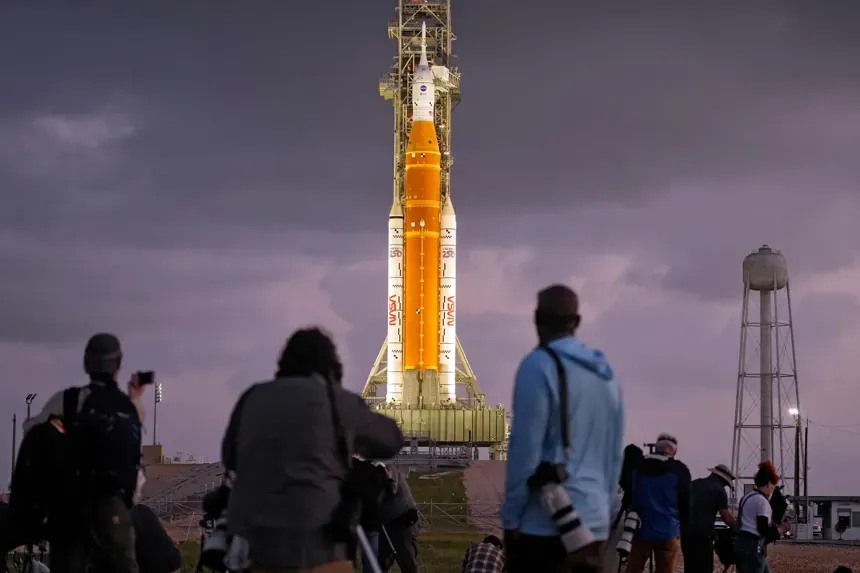
NASA’s Artemis II mission is set to deliver the most significant deep-space systems test since the Apollo era, as four astronauts prepare for an approximately 10-day lunar flyby designed to validate human-rated spacecraft performance beyond low Earth orbit. Rather than attempting an immediate landing, the mission centers on testing the Space Launch System rocket, Orion life-support systems, navigation, communications, and reentry hardware under real mission conditions. The findings are expected to shape later lunar surface missions and broader Mars planning.
Launching aboard NASA’s Space Launch System from Kennedy Space Center, Artemis II will carry astronauts Reid Wiseman, Victor Glover, Christina Koch, and Canadian Space Agency astronaut Jeremy Hansen on a free-return trajectory around the Moon. NASA describes the mission as the first crewed Artemis flight and a critical validation step after the uncrewed Artemis I test in 2022, with particular emphasis on human factors and spacecraft resilience.
Study Design and Mission Methodology
The mission architecture functions as an operational systems experiment in deep space. During the first day, Orion will remain in a high Earth orbit while the crew performs proximity operations using the discarded upper stage as a visual docking target. This phase is intended to test crew procedures and manual navigation techniques that future lunar missions may require.

After orbital checks, Orion’s main propulsion system will send the crew toward the Moon on a gravity-assisted free-return path, minimizing fuel use while allowing mission controllers to assess trajectory performance, communications stability, and spacecraft autonomy over extended distances. NASA says the spacecraft will travel roughly 5,000 miles beyond the lunar far side, farther than any humans have traveled before.
Key Findings Expected From the Mission
From a scientific and engineering standpoint, Artemis II is less about lunar observation and more about operational data collection. The mission will generate performance datasets on life-support endurance, radiation exposure, onboard human workflows, propulsion reliability, and thermal shielding during high-speed return.
One of the most closely watched systems is Orion’s heat shield. During Artemis I, post-flight analysis revealed unexpected erosion patterns after atmospheric reentry. Artemis II will provide the first crewed validation of revised descent parameters designed to reduce thermal stress while preserving splashdown safety margins.
The lunar far-side flyby may also offer additional observational value. While not a dedicated science mission, high-resolution crew photography and direct human visual assessments could support future landing site analysis and terrain familiarization for later Artemis surface operations.
Limitations and Uncertainty
As a test flight, Artemis II is inherently limited in scientific scope compared with a landing or orbital survey mission. It will not deploy instruments, enter lunar orbit, or conduct surface experiments. Its primary evidence value lies in engineering verification and crewed operational performance.
■ Related News



Uncertainty also remains around long-term hardware durability. NASA has previously faced hydrogen leak concerns in Space Launch System fueling systems, and while the agency says launch readiness reviews cleared major issues, Artemis II’s real-world flight data will provide the most meaningful assessment of integrated system reliability.
Broader Scientific Context
The broader research significance of Artemis II lies in its role as a systems-validation bridge between prototype testing and sustained lunar operations. Space agencies increasingly frame deep-space missions as iterative engineering research, where each mission produces evidence for subsequent design changes rather than serving as a standalone milestone.
For NASA, Artemis II’s operational data will directly inform Artemis III and later missions targeting the Moon’s south polar region, where future long-duration research stations may support geology, resource extraction, and life-support experiments relevant to Mars exploration.