TOKYO, Japan – Japan successfully completed the first test flight of its experimental reusable rocket on Saturday, marking a significant step in the country’s effort to develop lower-cost launch technology and strengthen its position in the increasingly competitive global space industry.
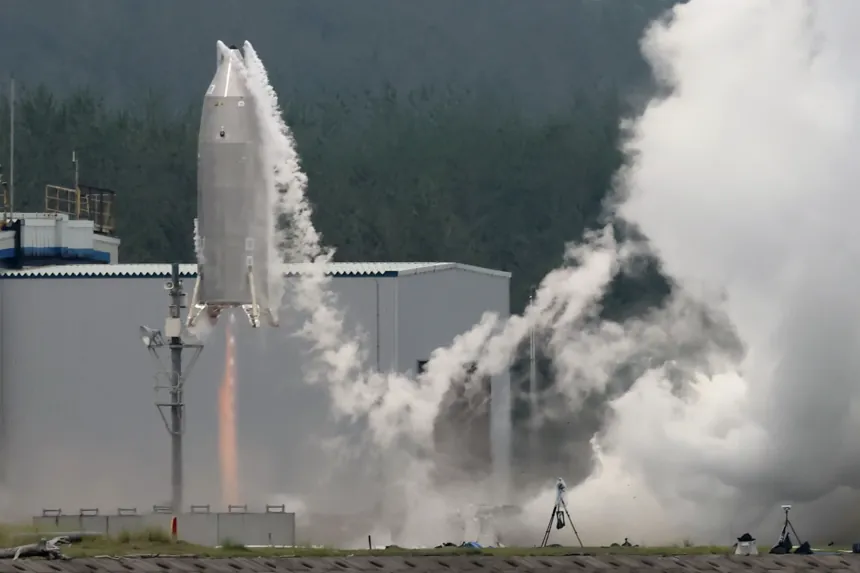
The reusable vehicle, known as the RV-X, lifted off from the Japan Aerospace Exploration Agency’s (JAXA) Noshiro Testing Center in northeastern Japan before hovering, moving horizontally and landing safely during a flight lasting less than one minute. The test was livestreamed by NVS, a Japanese space enthusiasts’ group.
JAXA said it would provide additional details on the demonstration during an online briefing later on Saturday.

Reusable technology targets lower launch costs
The successful flight supports Japan’s long-term objective of developing reusable rocket technology capable of reducing the cost of placing satellites and other payloads into orbit.
SpaceX has demonstrated reusable rocket operations for several years, significantly lowering launch costs and reshaping the commercial space sector. Japan is seeking to narrow that technological gap by developing a reusable successor to its current H3 launch vehicle.
The RV-X program represents an early stage in that effort, with Saturday’s demonstration serving as a key technology validation before more advanced testing.
Successor to the H3 rocket under development
Japan’s H3 rocket was introduced as a more economical replacement for the H-2A launch vehicle, which built a near-perfect launch success record during its operational life. Despite improvements in manufacturing and operating costs, the H3 remains a single-use rocket, leaving further cost reductions necessary for Japan to compete more effectively in the global launch market.
The Japanese government has identified reliable and commercially competitive launch capability as an important element of both the country’s space program and its national security strategy.
■ Related News




Future tests planned as development continues
JAXA and Mitsubishi Heavy Industries are jointly developing the RV-X reusable rocket.
The experimental vehicle measures 1.8 meters (5.9 feet) in diameter and 7.3 meters (23.9 feet) in length. It is equipped with engines designed for repeated use and four shock-absorbing landing legs intended to support vertical recovery after flight.
The agency is also collaborating with France and Germany on reusable launch technologies as part of broader international development efforts.
JAXA plans to expand testing by flying the RV-X to an altitude of about 100 meters (328 feet) during future demonstrations, building on the successful initial flight.
Regional competition in reusable launch technology
The test comes one day after Chinese state media reported that China had achieved its first successful recovery of a rocket’s first stage following launch, highlighting growing competition among Asian space programs to develop reusable launch systems.
As governments and commercial operators seek lower-cost access to space, reusable rocket technology is becoming an increasingly important capability for national space programs aiming to compete in the global launch market.
This report is based on reporting by The Associated Press.
Article Topics: Japan | JAXA | Reusable Rockets | Space Exploration | H3 Rocket | Space Technology | Commercial Space | Aerospace