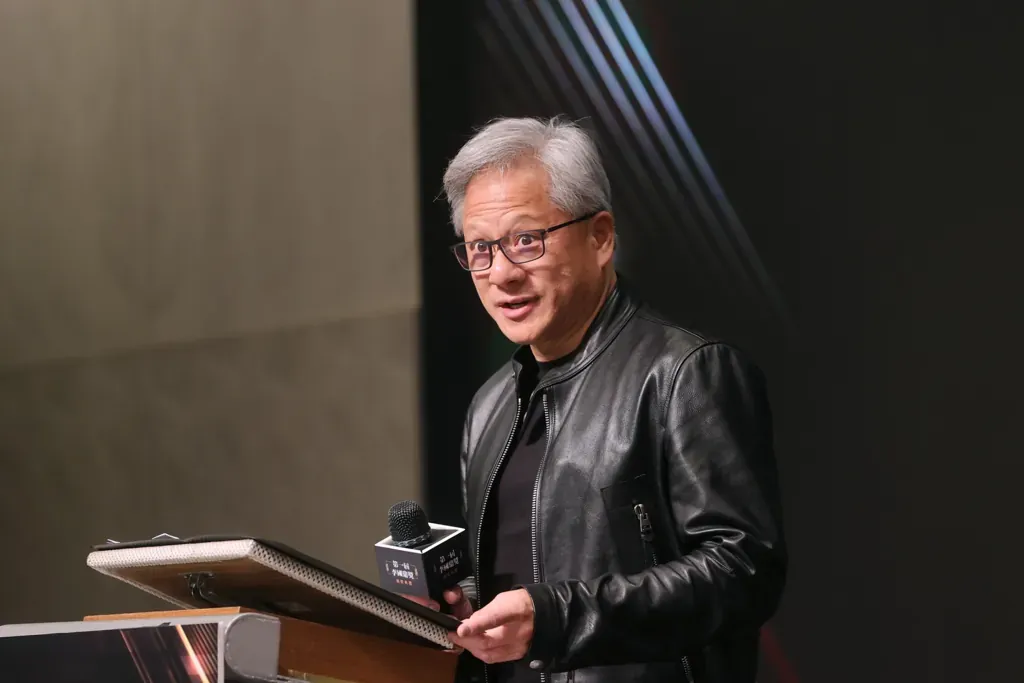
BERLIN, Germany — Nvidia chief executive Jensen Huang urged German manufacturers to adopt artificial intelligence more quickly on October 19, arguing that digital technology can strengthen the country’s industrial capabilities rather than replace them.
Huang made the case during a discussion with Chancellor Friedrich Merz at the Invest in Germany Summit in Berlin. The same day, Germany’s economy and research ministries signed a declaration of intent with Nvidia to advance industrial AI and develop specialised models for applications involving physical machinery and production.
The initiative aims to combine Germany’s manufacturing data, engineering expertise and industrial research with AI technology. The government says it will involve companies, research institutions and small and medium-sized businesses. It has not, however, published a complete funding package or implementation timetable in the announcement reviewed by JournosNews.

The agreement comes as Germany faces pressure to improve industrial competitiveness. AI could help manufacturers design products, plan production and manage equipment more efficiently. But the technology is not a quick fix for the country’s wider economic challenges, and its benefits will depend on whether companies can deploy it reliably and affordably.
Why Germany is turning to industrial AI
Germany has a large industrial base built around automotive manufacturing, machinery, engineering and specialised suppliers. Many companies hold years of production records, design information and practical knowledge that could help AI systems support industrial work.
The challenge is turning those resources into useful tools while preserving the quality and reliability expected of German manufacturing.
Reuters reported that Germany’s economy ministry warned of a likely slowdown in the third quarter of 2026. Its account cited weak industrial activity, elevated energy prices, economic uncertainty and higher financing costs as pressures on growth.
German manufacturers also face international competition, including in the automotive sector. AP reported that competition from China, high energy costs and lengthy administrative procedures have added to the pressures on an economy heavily reliant on complex machinery and exports.
■ Related News



AI may help companies improve some operations, but it cannot by itself resolve energy costs, weak demand, financing constraints or regulatory delays. Its value will depend on whether productivity improvements justify the investment and whether companies can apply the technology to real production problems.
What Huang argues about AI and manufacturing
Huang’s argument centres on what Nvidia calls “physical AI”: systems that use AI to interact with the physical world, including through robotics, vehicles and industrial machinery.
Rather than treating AI as a substitute for industrial expertise, Huang says manufacturers should use it to extend what their workers and equipment can do. At the Berlin summit, he argued that Germany’s engineering knowledge and industrial data could provide a strong foundation for the next generation of AI applications.
That position is relevant to Germany’s industrial strategy, but it also reflects Nvidia’s commercial interests. The company sells AI chips, computing systems, software and related infrastructure. Wider industrial adoption could create additional demand for those products.
The distinction matters. Huang’s argument is a business and technology strategy, not independent proof that AI will raise productivity in every factory or protect every manufacturing job.
What the government–Nvidia agreement covers
The German federal government announced on October 19 that the Federal Ministry for Economic Affairs and Energy and the Federal Ministry for Research, Technology and Space had signed a joint declaration of intent with Nvidia. The agreement sets out cooperation to advance specialised AI models for physical applications.
The initiative is linked to Germany’s AI roadmap and its Industry 4.0 Platform, a network connecting government, industrial companies, research institutions and trade associations. The government says the platform will focus more directly on industrial AI and help connect infrastructure, research and practical applications.
The declaration also envisages work on specialised, open models for industrial AI, building on models including Nvidia Nemotron and Nvidia Cosmos. Nvidia says it will expand its engagement with German partners. The government expects the initiative to include smaller businesses alongside major manufacturers and research organisations.
The announcement does not provide a full programme budget, a binding adoption target or a detailed timetable for deployment. A declaration of intent establishes a framework for cooperation, but it should not be confused with a completed programme or evidence that manufacturers have already achieved specific benefits.
Nvidia also announced planned investments in four German startups: Agile Robots, Avelios Medical, Mirelo and Reflex Aerospace. Reuters reported that the investments formed part of Nvidia’s broader commitment to support the European technology ecosystem. These startup investments are separate from the government’s declaration of intent and should not be treated as the funding budget for the industrial-AI initiative.
What industrial AI can do inside a factory
Industrial AI covers a range of technologies that use data, simulations and AI models to support engineering and production. Its applications differ in maturity and should not all be assumed to operate autonomously or at scale.
A digital twin is a computer-based representation of a physical product, machine or factory. Engineers can use it to simulate changes before applying them to equipment in the real world.
AI can also help inspect products, identify patterns that may signal equipment failure, support product design and generate alternative production plans. In robotics, AI systems can help machines respond to changing objects or conditions rather than relying only on fixed instructions.
One example is the Siemens electronics factory in Erlangen, Germany. Siemens and Nvidia announced new industrial-AI applications there on October 19. They said the systems were being developed and tested in live production. <Cite refs={[“turn937161view1”]} />
Siemens reported that AI-generated representations of circuit-board assemblies could help engineers train visual inspection systems before physical prototypes become available. The company said this approach could reduce engineering effort for production preparation by up to 85% and shorten time to market by up to 40%.
The factory is also testing an AI agent that generates production-planning scenarios. The system considers factors such as capacity, materials, delivery dates and production lines. Planners can compare the alternatives, and a digital twin helps test proposals before implementation. Siemens said this approach could enable cost savings of up to 20%.
Those figures are Siemens’ reported results and projections for specific workflows, not independently verified estimates of what every factory can achieve. The company also said more than 100 AI algorithms were already in use across production, logistics, inspection and maintenance at the Erlangen site.
The example nevertheless shows how industrial AI can move beyond general-purpose chatbots. In this setting, its purpose is to help engineers and planners make decisions about actual machines, materials and production schedules.
Can smaller manufacturers benefit?
Germany’s Mittelstand includes many small and medium-sized companies that specialize in machinery, components and industrial services. These businesses may hold valuable production knowledge but lack the resources of large manufacturers.
The government’s initiative explicitly aims to include smaller companies, rather than limiting its benefits to major corporations. That is important because suppliers often form part of larger industrial networks, and improvements at one company can affect production across several others.
However, participation does not guarantee that every smaller business will be able to adopt the technology. Companies may need modern sensors, reliable data systems, computing capacity, cybersecurity measures and staff who can integrate AI into existing equipment.
They must also weigh the costs of implementation against likely returns. A large manufacturer may be able to fund dedicated AI teams and long testing periods. A smaller supplier may have limited capital and little room to interrupt production while new systems are installed.
The initiative’s practical value will therefore depend on whether participating organizations can provide affordable technical support, suitable tools and clear routes from research to deployment. The government’s announcement identifies broad participation as an objective but does not yet establish how every smaller company will access those resources.
Industrial data and technological control
Manufacturers’ data can include detailed product designs, production processes, machine performance, quality records and supplier information. These records may be commercially sensitive. Sharing them can improve AI systems, but it can also create risks if companies lose control over who can access the information or how it is used.
Germany’s initiative seeks to build industrial AI around domestic engineering knowledge and manufacturing data. The government has linked the effort to technological sovereignty, meaning the ability to maintain important technological capabilities and make key decisions without excessive dependence on outside providers.
That goal does not automatically mean all data will remain inside Germany or that the country will become independent of foreign technology. The announced cooperation involves Nvidia, a US company that supplies important AI infrastructure and software. The government’s public announcement does not set out every arrangement for data storage, processing, access rights or ownership.
Manufacturers will need clear safeguards covering confidentiality, cybersecurity, intellectual property and responsibility for systems that use their data. They will also need to understand where computing takes place and which providers can access their information.
Domestic data storage can be one safeguard, but it is not the same as complete technological independence. Control also depends on the software, hardware, contracts and expertise needed to operate and maintain the systems.
Productivity gains do not settle the employment question
Huang argues that AI will augment industrial capabilities rather than replace them. That is his view of the technology’s potential, not a guarantee about future employment.
AI could help engineers analyze designs, support workers in diagnosing equipment problems and give production planners more options. Robotics and automated systems could also take over some repetitive or physically demanding tasks.
At the same time, automating a task can change the number and type of workers a company needs. Some roles may grow, others may require retraining, and some tasks may disappear. The overall effect will depend on how individual companies reorganize their operations and how quickly new demand creates work elsewhere.
Productivity improvements also do not automatically translate into higher wages or more jobs. Companies may use gains to increase output, reduce costs, address labor shortages or change staffing levels. The results can differ across industries and businesses.
For Germany, the relevant test is whether industrial AI helps manufacturers compete while supporting workers through changes in skills and job requirements. The government’s announcement does not establish a quantified employment impact, and the company examples available so far cannot prove what the technology will mean for the wider workforce.
What happens next
The declaration of intent provides a framework for cooperation between Nvidia and Germany’s two ministries. The government says it will use the Industry 4.0 Platform to connect businesses, researchers and other participants and to encourage the development and use of industrial AI.
The next steps will need to turn that framework into specific activities. Important details include which organizations will participate, how projects will be selected, what resources will be committed and when manufacturers can access the resulting tools. Those details were not fully established in the government announcement reviewed for this article.
Evidence of progress should go beyond the number of companies signing up or the number of AI models developed. Useful measures would include independently assessed changes in production time, product quality, equipment downtime, energy use and total operating costs. Evaluations should also account for implementation expenses and the time needed to integrate systems into existing factories.
The Siemens–Nvidia work in Erlangen offers one example of testing AI against defined manufacturing tasks. Its reported results will need to be assessed in context, and similar gains should not be assumed across other factories or industries.
Germany’s challenge is to turn its engineering expertise and industrial data into practical, competitive AI applications. The cooperation with Nvidia may help, but its success will depend on implementation, clear safeguards and measurable benefits—not simply the promise of a new technology.
JournosNews reporting based on the German federal government’s October 19 announcement, Associated Press and Reuters coverage of the Berlin summit, and Siemens’ published description of its industrial-AI work with Nvidia at the Erlangen factory. Company-reported performance figures are attributed and were not independently verified by JournosNews. No direct interviews were conducted for this report.