NEW YORK — The Vera C. Rubin Observatory has officially launched a decade-long astronomical survey using the world’s largest digital camera, marking the beginning of an ambitious effort to map the southern sky in unprecedented detail.
Located on a mountaintop in Chile, the observatory will capture hundreds of images every night for the next 10 years. Researchers say the repeated observations will help detect faint celestial objects that previous surveys could not observe.
The project is expected to produce one of the largest astronomical datasets ever assembled. Scientists around the world will use the observations to study billions of stars in the Milky Way and billions of galaxies beyond it.

“We’re going to see large numbers of scientists across the world working with this data set, studying the universe in a way that they haven’t been able to before,” said Phil Marshall, the observatory’s deputy director of operations.
Survey Designed for Repeated Sky Observations
Unlike many telescopes that concentrate on individual targets, the Rubin Observatory will repeatedly scan large sections of the southern sky. As a result, astronomers expect to identify faint objects that have previously escaped detection.
The repeated imaging will also allow researchers to monitor how celestial objects change over time. In addition, the observatory’s digital camera can capture hundreds of images each night, providing a continuous stream of scientific data throughout the survey.
Researchers Aim to Expand the Cosmic Census
Scientists hope the observations will create one of the most comprehensive maps of the universe ever produced.
The survey will record billions of stars across the Milky Way as well as billions of distant galaxies. Researchers expect these observations to improve studies of how galaxies form, evolve, and cluster over billions of years.
■ Related News




Furthermore, repeated observations may uncover previously unseen objects, offering new opportunities to examine the large-scale structure of the universe.
Observatory Ready After Instrument Calibration
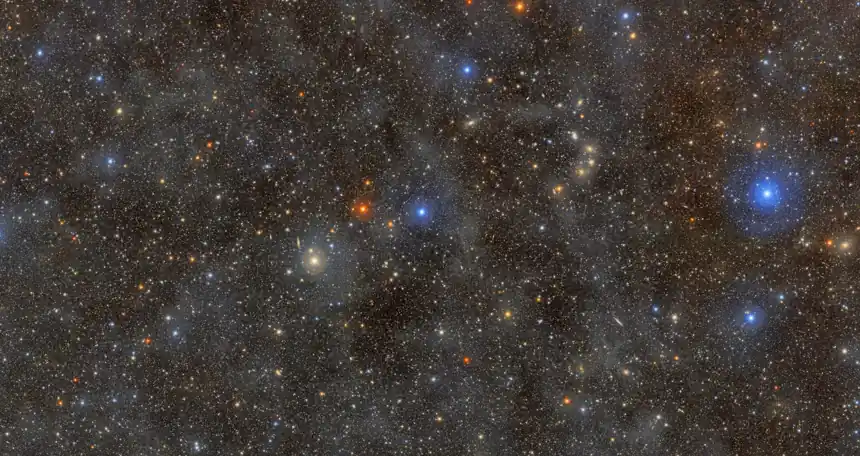
The Rubin Observatory released its first public images last year, including detailed views of the Trifid Nebula and Lagoon Nebula, both located thousands of light-years from Earth.
Since then, engineers and researchers have calibrated the observatory’s instruments to achieve the depth and precision required for the full survey. Those preparations have now been completed, allowing routine scientific observations to begin.
Dark Matter and Dark Energy Remain Major Research Goals
In addition to mapping the cosmos, researchers hope the survey will provide new evidence about two of astronomy’s biggest mysteries: dark matter and dark energy.
The observatory is named after astronomer Vera Rubin, whose research provided early evidence that an unseen form of matter influences the motion of galaxies.
Although researchers expect the new observations to offer additional clues about dark matter and dark energy, they have not suggested that the survey will provide definitive answers. Instead, the data may help scientists better understand how these poorly understood components influence the evolution of the universe.
The Vera C. Rubin Observatory is funded by the U.S. National Science Foundation and the U.S. Department of Energy. Researchers expect the decade-long project to become one of the most valuable astronomical resources for the global scientific community.
Tags: Vera C. Rubin Observatory, Vera Rubin, Space Exploration, Astronomy, Astrophysics, Dark Matter, Dark Energy, Milky Way, National Science Foundation, Chile