Journos News - Breaking News, World News, Top Stories, Todays Headlines and Flash Reports
Monday, July 13, 2026
  • Login
  • Home
  • World
    • Africa
    • Americas
    • Asia
    • Europe
    • Middle East
    • Oceania
  • Politics
  • Business
  • Technology
  • Health
  • Science
  • Sports
  • Entertainment
  • Culture
No Result
View All Result
  • Home
  • World
    • Africa
    • Americas
    • Asia
    • Europe
    • Middle East
    • Oceania
  • Politics
  • Business
  • Technology
  • Health
  • Science
  • Sports
  • Entertainment
  • Culture
No Result
View All Result
Journos News - Breaking News, World News, Top Stories, Todays Headlines and Flash Reports
No Result
View All Result
Home Science

Artemis II Splashdown Validates NASA’s Deep-Space Systems for Future Lunar Research

Successful reentry data strengthens confidence in upcoming moon landing and orbital docking missions

The Daily Desk by The Daily Desk
June 23, 2026
in Science, Space & Astronomy
0
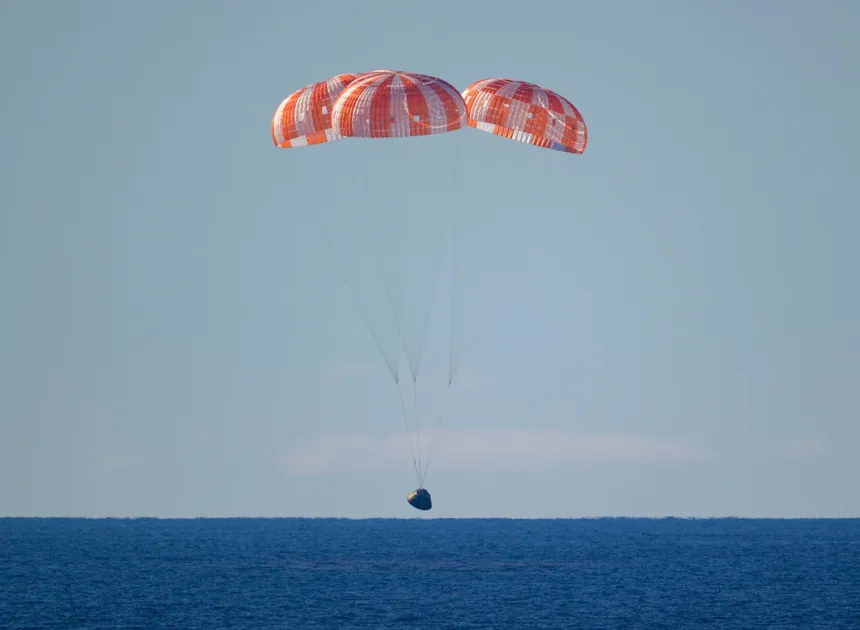
Artemis II Orion capsule splashes down after lunar return mission - Bill Ingalls/NASA via AP

NASA’s Orion capsule lands safely after a 10-day lunar flyby mission. - Bill Ingalls/NASA via AP

NASA’s Artemis II mission concluded with a Pacific splashdown after nearly 10 days in deep space, delivering the first crewed lunar flyby return in more than 50 years and generating critical engineering data for future moon missions. The flight’s most significant scientific value lies in its validation of Orion’s high-speed reentry systems, thermal protection architecture, and crew survivability under lunar-return conditions.

The mission did not attempt a landing or lunar orbit insertion, but it successfully tested the integrated performance of NASA’s Space Launch System and Orion spacecraft during a full crewed cislunar profile. Engineers will now use the reentry, communications blackout, and heat-shield performance data to refine spacecraft models ahead of the next phases of the Artemis program, which target docking rehearsals and eventual south polar surface operations.

Aboard the Orion capsule were NASA astronauts Reid Wiseman, Victor Glover, Christina Koch, and Canadian Space Agency astronaut Jeremy Hansen, whose mission also marked several historic firsts in crew diversity for lunar exploration. Beyond symbolism, the mission provided NASA with operational human-factors data on long-duration crew systems, consumables, and habitat performance in deep space.

Study Design and Mission Systems Validation

From a research and engineering perspective, Artemis II functioned as a full-scale experimental flight of NASA’s lunar transportation stack. The spacecraft traveled roughly 694,000 miles on a free-return trajectory that pushed the crew to a record 252,756 miles from Earth, surpassing Apollo 13’s human-distance benchmark.

The most consequential systems test came during atmospheric reentry, when Orion struck Earth’s upper atmosphere at roughly Mach 33. During this phase, the capsule encountered extreme plasma heating, causing a planned communications blackout that served as a real-world validation point for thermal simulations and reentry guidance models.

RELATED POSTS

Vera C. Rubin Observatory Launches Decade-Long Sky Survey With World’s Largest Digital Camera

Scientific Imaging Reveals Hidden Layers in Raphael Portrait’s Restoration History

Artemis II Lunar Flyby Will Test Deep-Space Systems Ahead of Future Moon Landings

NASA resumes Artemis II preparations after repairs on Space Launch System rocket

Total Lunar Eclipse Colors the Moon Reddish-Orange Across Multiple Continents

Chile Telescope Discovery Reveals Striking New Image of Cosmic ‘Butterfly’

NASA and recovery teams are expected to conduct post-flight inspections of the ablative heat shield, parachute deployment sequence, and capsule structural integrity. These analyses are essential because lunar-return velocities impose substantially higher thermal and mechanical stress than low-Earth orbit missions.

Key Scientific and Operational Findings

The mission produced significant observational value despite its engineering-first design. Crew members documented unprecedented human-view imagery of the lunar far side and captured a total solar eclipse during the flyby, offering visual and positional datasets that may assist future mission planning and public science outreach.

Operationally, the flight also surfaced several manageable system anomalies, including valve-related issues affecting drinking water and propellant subsystems, as well as sanitation malfunctions. These are not minor footnotes in aerospace research reporting; such anomalies provide crucial failure-mode data that informs redundancy design and life-support upgrades for later Artemis missions.

One major insight from this phase is that the spacecraft maintained full mission success despite subsystem inconveniences, suggesting robust fault tolerance in Orion’s architecture.

Limitations and Uncertainty

While the splashdown represents a major milestone in space systems research, the mission remains a test flight rather than proof of readiness for sustained lunar surface operations. A flyby profile does not replicate the complexity of orbital rendezvous, lunar descent, surface habitat deployment, or extended polar mission logistics.

The spacecraft also returned with a limited sample size of one crewed reentry under lunar conditions. Aerospace engineers will need additional repeated mission data before confirming long-term reliability trends, especially for heat-shield wear, avionics resilience, and human-system performance.

Further uncertainty remains around budgetary, scheduling, and hardware readiness factors that could affect downstream Artemis timelines.

Broader Scientific Context

Artemis II’s strongest contribution to research lies in reducing uncertainty for future human lunar science campaigns. By demonstrating safe crew transport beyond Earth orbit and back, NASA has materially advanced the evidence base required for more complex exploration objectives, including south polar geology missions and eventual lunar infrastructure development.

The data from this mission is likely to shape not only Artemis III and IV flight rules, but also long-term systems engineering for Mars transit vehicles, where reentry protection, crew autonomy, and life-support resilience become even more critical.

Rather than a symbolic return to Apollo-era achievements, Artemis II represents a modern experimental platform for validating the technologies needed for sustained human research beyond Earth.


Tags: #AerospaceEngineering#ArtemisII#DeepSpace#FutureMoonLanding#JournosNews#LunarResearch#MoonMission#NASA#OrionCapsule#ScienceNews#SpaceExploration#SpaceScience
The Daily Desk

The Daily Desk

The Daily Desk is a contributor at JournosNews.com covering politics, media, governance, and the evolving dynamics of public discourse. Stories published under this byline are produced in accordance with JournosNews' editorial standards, with an emphasis on verified reporting, accuracy, context, and impartiality.

Related Posts

Vera C. Rubin Observatory Launches Decade-Long Sky Survey With World’s Largest Digital Camera

by The Daily Desk
July 2, 2026
0
Vera C. Rubin Observatory telescope beginning its decade-long southern sky survey - NSF–DOE Vera C. Rubin Observatory/NOIRLab/SLAC/AURA via AP

NEW YORK — The Vera C. Rubin Observatory has officially launched a decade-long astronomical survey using the world's largest digital...

Read moreDetails

Scientific Imaging Reveals Hidden Layers in Raphael Portrait’s Restoration History

by The Daily Desk
June 23, 2026
0
X-ray analysis reveals hidden layers in Raphael unicorn portrait - Alamy/ Galleria Borghese

Advanced imaging and conservation research are reshaping scholarly understanding of Raphael’s Portrait of a Young Woman with a Unicorn, with...

Read moreDetails

Artemis II Lunar Flyby Will Test Deep-Space Systems Ahead of Future Moon Landings

by The Daily Desk
June 23, 2026
0
Artemis II crew aboard Orion during lunar flyby systems test - AP Photo/Chris O’Meara

NASA’s Artemis II mission is set to deliver the most significant deep-space systems test since the Apollo era, as four...

Read moreDetails

NASA resumes Artemis II preparations after repairs on Space Launch System rocket

by The Daily Desk
June 23, 2026
0
NASA rocket moved back to launch pad for Artemis II mission - AP Photo/Terry Renna

NASA has returned its massive Space Launch System (SLS) rocket to the launch pad at Kennedy Space Center, marking a...

Read moreDetails

Total Lunar Eclipse Colors the Moon Reddish-Orange Across Multiple Continents

by The Daily Desk
June 23, 2026
0
Red lunar eclipse visible across Asia and Americas sky - Petros Giannakouris/AP

A total lunar eclipse on Tuesday is giving the moon a reddish-orange hue, visible across Asia, Australia, the Pacific Islands,...

Read moreDetails

Chile Telescope Discovery Reveals Striking New Image of Cosmic ‘Butterfly’

by The Daily Desk
June 24, 2026
0
Gemini South telescope captures glowing Butterfly Nebula image - NSF NOIRLab via AP

A Chile-based telescope has captured a sweeping new image of the Butterfly Nebula, offering one of the clearest looks yet...

Read moreDetails

1,700-Year-Old Roman Sarcophagus Unearthed in Budapest

by The Daily Desk
June 23, 2026
0
1,700-Year-Old Roman Sarcophagus Unearthed in Budapest’s Óbuda District - Gabor Lakos, Budapest History Museum via AP

Roman Sarcophagus Found in Budapest Reveals Pristine 4th-Century Burial A remarkably preserved Roman sarcophagus, dating back approximately 1,700 years, has...

Read moreDetails

Researchers Analyze DNA Believed to Belong to Hitler, Reveal Possible Genetic Condition

by The Daily Desk
June 23, 2026
0
Researchers analyze Hitler’s DNA, suggesting a rare hormonal disorder and debunking ancestry rumors in new documentary. - Blink Films via CNN

Analysis of Hitler’s DNA Suggests Rare Hormonal Condition, Genetic Study Sparks Debate A team of researchers led by Turi King...

Read moreDetails

China’s Stranded Astronauts Set to Return Aboard Replacement Spacecraft

by The Daily Desk
June 24, 2026
0
China to Bring Home Stranded Tiangong Astronauts After Debris Hits Shenzhou-20 - AP Photo/Andy Wong, File

China Prepares Return of Stranded Tiangong Astronauts After Space Debris Incident China’s space agency says three astronauts who remained aboard...

Read moreDetails
Load More
Next Post
U.S. and Iranian delegations arrive in Islamabad for ceasefire negotiations - AP Photo/Anjum Naveed

Islamabad Talks Face Diplomatic Fallout as Iran Adds New Ceasefire Conditions

Samay Raina performs in comeback special Still Alive - Samay Raina via YouTube/BBC

Samay Raina Returns With Still Alive as Career Reset After Comedy Backlash

Traditional British pub crowd following unspoken bar etiquette rules - P. Batchelder/Alamy/BBC

How to Navigate a British Pub Without Social Missteps

JournosNews logo

Journos News delivers globally neutral, fact-based journalism that meets international media standards — clear, credible, and made for a connected world.

  • Categories
  • World News
  • Politics
  • Business & Markets
  • Technology
  • Health
  • Science
  • Sports
  • Arts & Culture
  • Resources
  • Editorial Standards
  • Submit a Story
  • Advertise with Us
  • Syndication & Partnerships
  • Site Map
  • Press & Media Kit
  • Editorial Team
  • Careers

Join thousands of readers receiving the latest updates, tips, and exclusive insights straight to their inbox. Never miss an important story again.

  • About Us
  • Accessibility Statement
  • Contact Us
  • Privacy Policy
  • Terms and Conditions

© JournosNews.com – Trusted source for breaking news, trending stories, and in-depth reports.
All rights reserved.

Welcome Back!

Login to your account below

Forgotten Password?

Retrieve your password

Please enter your username or email address to reset your password.

Log In
JournosNews

Independent Journalism.
Verified Facts.

You're about to read a professionally edited article from JournosNews.com.

Every article is produced in accordance with our editorial standards, emphasizing factual accuracy, transparent attribution, fairness, editorial independence, and meaningful context.

Editorial Standards
No Result
View All Result
  • Home
  • World
    • Africa
    • Americas
    • Asia
    • Europe
    • Middle East
    • Oceania
  • Politics
  • Business
  • Technology
  • Health
  • Science
  • Sports
  • Entertainment
  • Culture

© JournosNews.com – Trusted source for breaking news, trending stories, and in-depth reports.
All rights reserved.

This website uses cookies. By continuing to use this website you are giving consent to cookies being used. Visit our Privacy and Cookie Policy.