DUBAI, United Arab Emirates – Major oil-producing countries in the Persian Gulf are accelerating pipeline projects aimed at reducing their reliance on the Strait of Hormuz, as the conflict involving Iran underscores the vulnerability of one of the world’s most important energy transit routes.
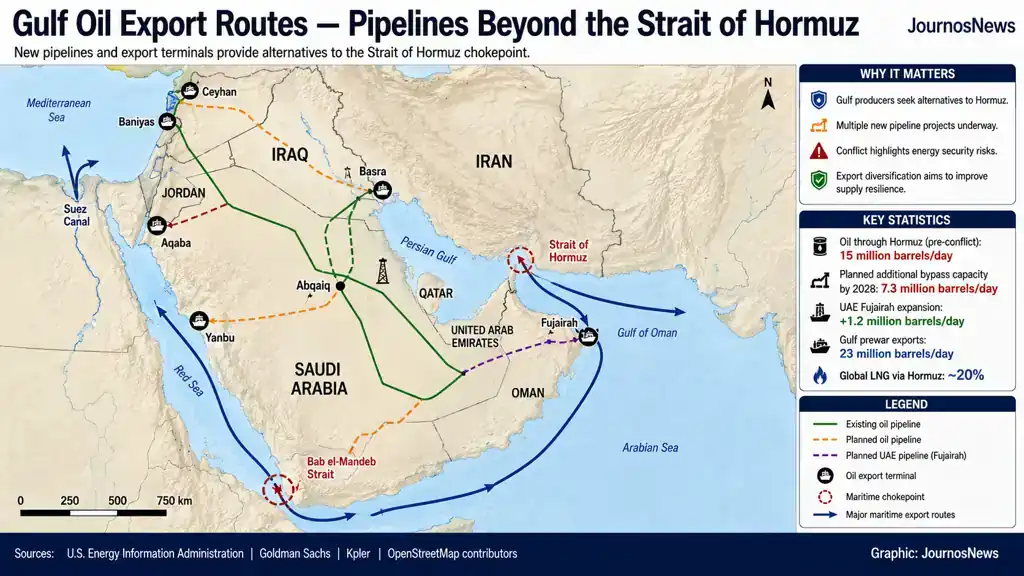
Before the conflict, roughly 15 million barrels of crude oil passed through the strait each day. Gulf governments and state-owned energy companies are now investing in alternative export routes that would allow more oil to reach international markets through ports on the Red Sea, the Gulf of Oman and the Mediterranean Sea, reducing dependence on the narrow maritime chokepoint.
Government officials, energy companies and industry analysts say at least seven major pipeline projects are under construction, in advanced planning or under active consideration. The renewed investment reflects growing concern that prolonged instability could disrupt global energy supplies.

Victoria Grabenwöger, a senior research analyst at data firm Kpler, said Gulf producers increasingly view heavy reliance on the Strait of Hormuz as an unsustainable long-term strategy despite the higher costs associated with alternative export routes.
Existing Pipelines Become More Important
The Gulf region already has limited alternatives that have become increasingly valuable during the current disruption.
Saudi Arabia’s East-West Pipeline, originally built during the Iran-Iraq War in the 1980s, transports crude oil from processing facilities in Abqaiq to the Red Sea port of Yanbu. From there, shipments can travel through the Red Sea and Suez Canal or south toward the Arabian Sea without passing through the Strait of Hormuz.
The United Arab Emirates has also relied more heavily on its pipeline connecting Abu Dhabi’s oil fields to the export terminal at Fujairah on the Gulf of Oman, approximately 145 kilometers (90 miles) south of the strait.
According to the U.S. Energy Information Administration, the Saudi and Emirati pipeline systems previously had between 3.5 million and 5.5 million barrels per day of spare capacity before the conflict. Both are now operating near maximum capacity as producers seek to maintain exports while reducing exposure to regional disruptions.
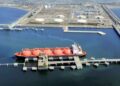


UAE Expands Fujairah Export Capacity
Abu Dhabi’s state-owned oil company has accelerated construction of a parallel pipeline designed to increase export capacity to Fujairah.
The approximately 300-kilometer (186-mile) project, valued at about $3 billion, is expected to add more than 1.2 million barrels per day of additional export capacity.
Construction began before the conflict, but Kpler estimates the project is now about halfway complete. Although initially scheduled for completion in early 2027, analysts now expect it to enter service around the middle of that year because upgrades at Fujairah’s port facilities must also be completed.
Grabenwöger said the disruption to shipping has made the previously ambitious construction schedule more achievable.
Iraq Pursues Alternative Export Corridors
Iraq is also expanding efforts to diversify its export infrastructure after the conflict disrupted production and heightened concerns about export security.
Oil revenues account for approximately 90% of Iraqi government income, increasing pressure on Baghdad to secure reliable routes to international markets.
One proposal under discussion with U.S. companies would transport crude from Basra to the Turkish Mediterranean port of Ceyhan. Before the conflict, Basra handled more than 3 million barrels of crude exports per day.
Plans also include a branch extending to Syria’s Mediterranean port of Baniyas, potentially allowing up to 2 million barrels per day to reach the eastern Mediterranean through what the U.S. State Department has described as a strategically important regional energy corridor.
Iraqi officials are also continuing discussions with Jordan on reviving a long-planned pipeline linking Basra with the Red Sea port of Aqaba, creating another export route that bypasses the Strait of Hormuz.
Alternative Routes Still Face Security Risks
Despite increased investment, analysts caution that alternative export routes remain vulnerable to regional instability.
Iran-backed Houthi rebels in Yemen said Thursday they had attacked two Saudi oil tankers in the Red Sea, highlighting risks to another vital shipping corridor. The group has repeatedly targeted commercial vessels operating near the Bab el-Mandeb Strait, which connects the Red Sea to the Gulf of Aden.
Saudi Arabia’s East-West Pipeline has also demonstrated the limits of overland infrastructure. The system was temporarily shut down after a Houthi drone attack in May 2019.
Analysts at Goldman Sachs estimate the collection of pipeline projects could add approximately 3.8 million barrels per day of additional bypass capacity by the end of next year and about 7.3 million barrels per day by the end of 2028.
If completed as planned, the projects could allow roughly 60% of the Gulf’s estimated 23 million barrels per day of prewar oil exports to avoid the Strait of Hormuz when necessary.
Challenges Remain for Global Energy Markets
Alternative export routes also present logistical and commercial challenges.
Crude transported to Mediterranean ports must travel longer distances around southern Africa before reaching Asian markets, increasing shipping times and transportation costs.
Oil shipped through Saudi Arabia’s Red Sea terminals can also move north via the Suez Canal, but the canal cannot accommodate the largest crude carriers commonly used for long-distance energy shipments, reducing overall efficiency.
Pipeline expansion also does little to address vulnerabilities affecting liquefied natural gas exports.
Before the conflict, approximately 20% of global LNG shipments, including large volumes exported from Qatar to Asia, passed through the Strait of Hormuz.
While Gulf producers are investing heavily to diversify export routes, analysts say the projects reduce—but do not eliminate—the geopolitical risks facing one of the world’s most strategically important energy-producing regions.
This report is based on reporting by The Associated Press.