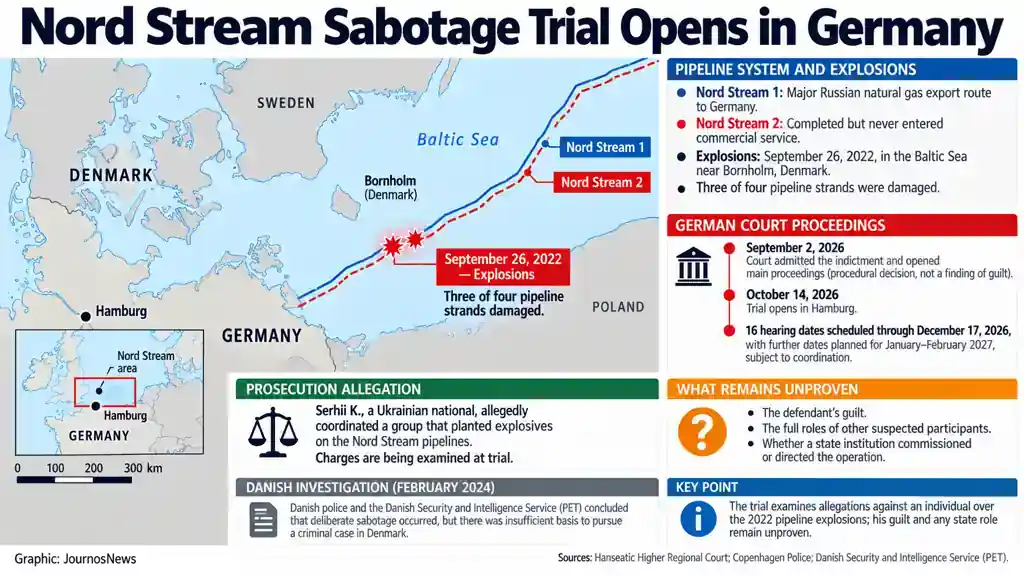
HAMBURG, Germany – A former Ukrainian military officer went on trial in Hamburg on October 14 over the explosions that damaged the Nord Stream gas pipelines in the Baltic Sea in September 2022, opening a major criminal proceeding into one of Europe’s most consequential acts of infrastructure sabotage.
The defendant, identified in court as Serhii K. under German privacy rules and publicly named as Serhii Kuznietsov in earlier extradition proceedings, faces charges including causing an explosion, destroying structures, disrupting public services and committing a war crime involving an attack on civilian objects.
German prosecutors allege that he coordinated a group that planted explosives on the underwater pipelines. The accusations have not been proved at trial, and the proceedings do not by themselves establish that Ukraine’s government or military leadership ordered the operation.

The Hanseatic Higher Regional Court admitted the indictment and opened the main proceedings on September 2. In its preliminary assessment, the court found sufficient grounds to put the defendant on trial for the charged offences. That procedural decision is not a conviction.
Prosecutors allege a coordinated operation at sea
According to the prosecution’s account, the defendant worked with other participants who used a rented sailing yacht and falsified identification documents to support an operation against the pipelines.
Investigators allege that the group travelled to waters near the Danish island of Bornholm and attached timed explosive devices to the underwater infrastructure. The prosecution’s case identifies the defendant as a central coordinator, while other suspected participants allegedly included divers and an explosives specialist.
The alleged operation involved equipment and preparations suited to work at substantial underwater depths. However, the extent to which each suspected participant contributed, and the evidence connecting the defendant to particular acts, must be assessed through the criminal proceedings.
The public information available at the opening of the trial does not establish who ultimately commissioned the operation, whether a state institution directed it or what chain of command may have been involved.
■ Related News



Defence disputes the evidence
The defendant was arrested in Italy in August 2025 under a European arrest warrant and transferred to Germany on November 27, 2025. He has remained in pretrial detention.
Contemporaneous German reporting indicates that the defence disputes the strength of the evidence linking him to the sabotage. The detailed defence position, including any formal statement made during the opening hearing, could not be independently confirmed from the court’s published notice.
The distinction is important: the indictment sets out the prosecution’s theory, while the defence is entitled to challenge the evidence and the legal basis of the charges. The defendant is presumed innocent unless found guilty under the applicable law.
The case also raises questions about the extent to which a court can assess an alleged covert military operation when important information about its planning, participants and command structure may remain disputed or undisclosed.
Three pipeline strands were damaged
The explosions occurred on September 26, 2022, damaging Nord Stream 1 and Nord Stream 2 beneath the Baltic Sea. Three of the system’s four pipeline strands were ruptured.
Nord Stream 1 had been a major route for Russian natural gas exports to Germany. Nord Stream 2 was completed but never entered commercial service.
The damage disrupted the infrastructure’s ability to transport gas, but the wider reduction in Russian gas supplies to Europe had other causes, including Russia’s invasion of Ukraine and earlier interruptions and reductions in pipeline deliveries. The explosions should not be treated as the sole cause of Europe’s shift away from Russian gas.
Denmark’s police and security service concluded in February 2024 that the explosions were deliberate sabotage but said there were insufficient grounds to pursue a criminal case in Denmark. Germany continued its investigation, while Sweden had also conducted a separate investigation before closing it.
The German trial therefore forms part of a wider international effort to establish responsibility for the attack, although the investigations have not produced a single publicly established account of who authorized it.
Trial schedule extends into 2027
The Hamburg court scheduled 16 hearing dates from October 14 through December 17, 2026. It also said further hearings were planned for January and February 2027, with the final schedule still subject to coordination among the parties.
The court has not published a definitive completion date. The timetable leaves room for the examination of evidence and witnesses, procedural disputes and further judicial decisions as the case progresses.
The proceedings are expected to examine the prosecution’s account of the alleged voyage, the use of the yacht, the explosives and the defendant’s suspected role. What can be established publicly will depend on the evidence presented in court and any restrictions imposed on disclosure.
Individual criminal liability is not proof of state responsibility
The case carries political implications because the defendant is Ukrainian and Germany has been a major supporter of Ukraine since Russia’s full-scale invasion in 2022. Ukraine has denied involvement in the Nord Stream sabotage, but the allegations against one individual cannot independently establish responsibility by the Ukrainian state.
The legal questions before the court concern the defendant’s alleged conduct and whether the prosecution can prove the charged offences. Establishing who may have ordered or sponsored the operation is a separate question that requires its own evidence.
The trial may inform public debate about European energy security, the protection of critical infrastructure and Germany’s relationship with Ukraine. It should not, however, be treated as a judicial verdict on those broader political questions before the evidence has been tested and the court reaches its findings.
Reporting Credit: Hanseatic Higher Regional Court in Hamburg; Copenhagen Police; Danish Security and Intelligence Service (PET).