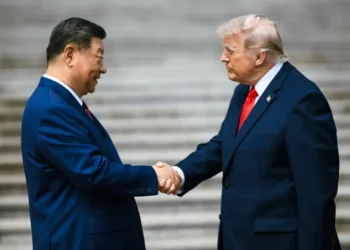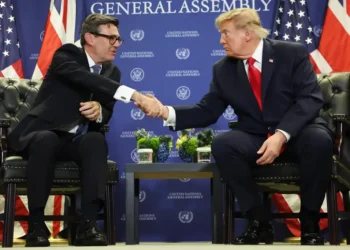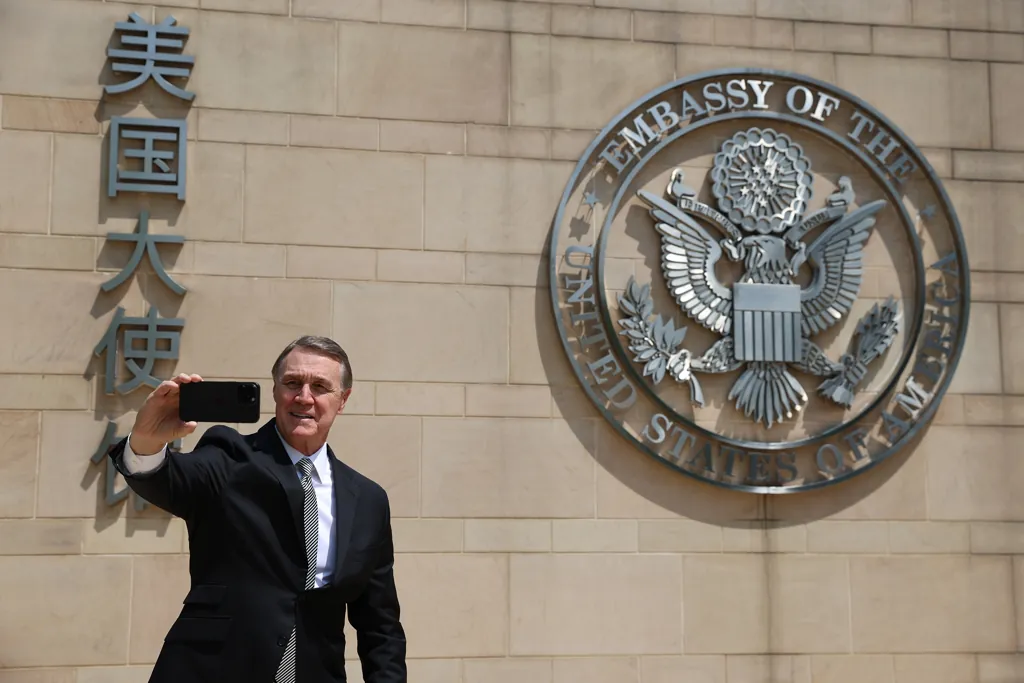
WASHINGTON, United States – U.S. Ambassador to China David Perdue says President Donald Trump at one point asked Chinese President Xi Jinping whether China wanted to buy American weapons, an unusual disclosure that came days after the two leaders held a state visit in Washington.
Perdue made the comment Sunday, September 27, during an interview on Fox News Sunday while discussing Trump’s conversations with Xi about U.S. arms sales to Taiwan.
According to Perdue, Trump sought to explain the Taiwan sales by telling Xi that the United States sells weapons to countries around the world and then asked whether China itself would like to buy some. Perdue did not say when the exchange occurred or disclose Xi’s response.

The State Department subsequently said there is no U.S. plan to sell arms to China, while the White House also said the United States has no plans to make such a sale. The State Department said U.S. law prohibits arms sales to China and that there is “no offer or plan” for such a transaction.
The distinction is important: Perdue described a question raised by Trump in a private conversation, but the administration has not announced or proposed an arms-sale agreement with Beijing.
The comment came during a Taiwan arms dispute
The exchange was disclosed in the context of a much more established issue in the Trump-Xi relationship: U.S. weapons sales to Taiwan.
Xi has repeatedly pressed Washington to stop selling arms to Taiwan, which Beijing regards as part of its territory. China opposes U.S. military support for the island and has demanded that Washington change its policy. Reuters reported before Xi’s September visit that Beijing expected the issue to be a major point in the discussions with Trump.
The United States does not recognize Taiwan as a separate sovereign state, but U.S. law directs Washington to make available defense articles and services in quantities necessary for Taiwan to maintain a sufficient self-defense capability. The law also gives the president and Congress responsibility for determining the nature and quantity of that support.


That statutory framework has remained an important foundation for U.S.-Taiwan security ties even as successive administrations have maintained strategic ambiguity over how Washington would respond to a Chinese attack.
A delayed package remains part of the dispute
Trump has already approved major arms sales to Taiwan during his presidency, but another package worth about $14 billion has remained delayed.
Reuters reported ahead of Xi’s Washington visit that China wanted the United States to halt the pending package, while the Trump administration and lawmakers continued to discuss Taiwan’s defense needs. An earlier $11 billion package had already been approved in 2026.
The issue was therefore directly connected to the Trump-Xi meeting.
Perdue said Trump continues to discuss future Taiwan arms sales with Xi and characterized the president as strongly supportive of Taiwan while opposing both Taiwanese independence and coercion. Perdue made the comments while rejecting suggestions that Washington’s weapons policy had changed because of Chinese pressure.
China’s position is different.
Beijing has consistently opposed U.S. arms transfers to Taiwan and considers the issue tied to its claims over the island. During Xi’s Washington visit, Chinese state media reported that he urged Trump to oppose Taiwan independence.
Perdue did not describe a proposed sale to China
The wording of Perdue’s account leaves several important questions unanswered.
He did not say what type of weapons Trump mentioned, whether the question was serious or rhetorical, whether Xi responded, or whether any U.S. agency was asked to examine a possible sale.
There is also no indication of a formal U.S. military-sales process involving China.
That matters because major U.S. arms transfers are subject to statutory and administrative procedures. In the case of Taiwan, federal law specifically requires congressional processes for relevant defense transfers, while the Taiwan Relations Act establishes the policy framework for providing defensive capabilities.
The administration’s subsequent statements therefore draw a line between an unusual remark in a presidential conversation and actual government policy.
Washington and Beijing are still negotiating several sensitive issues
The weapons discussion was only one part of Trump’s September meeting with Xi.
Xi’s state visit to the United States ran from September 23 to 25 and covered the broader relationship between the two countries, including trade and other strategic issues. China’s Foreign Ministry described the visit as an opportunity to manage differences and expand cooperation.
Taiwan remains among the most sensitive issues in that relationship.
For Beijing, U.S. arms sales to Taiwan are a direct challenge to its claim over the island. For Washington, the issue is tied to longstanding U.S. law and its broader security relationship with Taipei.
That makes Perdue’s disclosure unusual not because an arms agreement has emerged, but because of the contrast between the parties involved.
The United States supplies weapons to Taiwan while treating China as a major strategic competitor. China’s government opposes those Taiwan sales, while Perdue says Trump nevertheless asked Xi whether China wanted to buy U.S. weapons itself.
The administration says policy has not changed
Perdue separately told CNBC on Friday that U.S. Taiwan policy had not changed after Xi’s visit. He said the United States still opposes both Taiwanese independence and coercion against the island.
The White House’s response after the Fox interview was similarly narrow: there was no plan to sell weapons to China.
The State Department went further, saying U.S. law prohibits such arms sales and that there is no offer or plan to sell weapons to Beijing.
No Chinese government response to Perdue’s specific account had been publicly identified in the reporting reviewed for this article.
That leaves the precise circumstances of Trump’s question unclear.
A striking remark, but not a new arms policy
Perdue’s disclosure adds an unusual detail to a much larger negotiation over Taiwan and the U.S.-China relationship.
The president’s reported question to Xi does not, by itself, establish that Washington considered selling military equipment to Beijing. The public record currently shows no announced proposal, sale or formal process.
What it does establish is that Trump, according to his ambassador, raised the idea directly with Xi while discussing Washington’s broader practice of selling weapons abroad.
The administration’s subsequent clarification places the remark outside current U.S. arms policy toward China.
At the same time, the episode underscores how closely Taiwan’s defense needs remain intertwined with the broader U.S.-China relationship. Washington is legally committed to helping Taiwan maintain a sufficient self-defense capability, while Beijing continues to demand that those arms transfers end.
For now, the reported conversation remains just that — a disclosure about what the president said in a private exchange, rather than evidence of a U.S.-China weapons deal.
Reporting Credit: U.S. State Department — clarification that U.S. law prohibits arms sales to China and that there is no offer or plan to sell weapons to China; U.S. House Office of the Law Revision Counsel — current statutory text of the Taiwan Relations Act governing U.S. defense support for Taiwan; White House — administration position following the Trump-Xi state visit; David Perdue, U.S. Ambassador to China — account of Trump’s reported conversation with Xi and statements on current Taiwan policy.