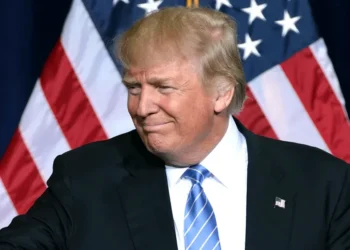
COPENHAGEN, Denmark — President Donald Trump has triggered fresh diplomatic tensions in the North Atlantic after posting a map that depicted Iceland, Greenland and other territories under the U.S. flag, prompting formal objections from Iceland and Denmark.
Trump posted the image on Truth Social on Sept. 7 without an accompanying explanation. The map showed the United States, Canada, Greenland, Iceland, Mexico, Central America and the Caribbean covered by the American flag and labeled as part of the United States.
Iceland’s Foreign Minister Thorgerdur Katrín Gunnarsdóttir summoned U.S. Ambassador Billy Long over the post. Iceland’s Foreign Ministry said the image was “wholly inappropriate.”

The episode has revived concerns among U.S. allies about Trump’s territorial ambitions in the Arctic, particularly his repeated push for greater U.S. control of Greenland, an autonomous territory within the Kingdom of Denmark.
Iceland objects to U.S. map
Iceland’s government treated the post as a diplomatic issue rather than a joke or ordinary political commentary.
Gunnarsdóttir called Long to convey Iceland’s position after the image appeared online. The ministry said the ambassador was told clearly that the post was inappropriate.
Prime Minister Kristrún Frostadóttir also criticized the image, describing it as an affront to the sovereignty of Iceland and other countries shown under the American flag.
Iceland is a NATO member and has traditionally maintained close security and diplomatic relations with the United States. The dispute therefore adds strain to an alliance relationship that has already been affected by Trump’s approach to Greenland.
■ Related News




Denmark faces renewed Greenland pressure
The map also comes as Denmark and Greenland continue to reject Trump’s efforts to bring Greenland under U.S. control.
Danish Prime Minister Mette Frederiksen said in Nuuk that Greenland’s government and people have repeatedly made clear that they do not want Greenland to become part of the United States.
The Danish government had scheduled meetings in Nuuk on Sept. 7 and 8 involving Denmark, Greenland and the Faroe Islands, with security and defense issues in the North Atlantic and Arctic among the subjects under discussion.
That meeting took place as European governments continued to strengthen their political and security ties with Greenland in response to growing pressure surrounding the territory.
Arctic ambitions widen diplomatic strain
Trump’s latest map extends the controversy beyond Greenland.
His administration’s focus on Greenland has already raised concerns among Denmark and other European allies about sovereignty and the future of Arctic security. The inclusion of Iceland in the latest image has now brought Reykjavik directly into the dispute.
The map itself does not establish that the United States has formally claimed Iceland or any other territory shown in the image. Trump did not provide an explanation for the post.
The diplomatic response nevertheless reflects the sensitivity of territorial sovereignty among U.S. allies in the region.
The European Union has also moved to strengthen its relationship with Greenland. European Commission President Ursula von der Leyen recently announced €200 million in support for Greenland during a visit to Nuuk, emphasizing the importance of territorial integrity and the island’s future being determined by its people and Denmark.
Iceland’s concerns extend beyond the map
The latest dispute follows months of friction between Iceland and the Trump administration over Greenland.
Trump has repeatedly discussed acquiring Greenland and has at times referred to Iceland while discussing the Danish territory. U.S. Secretary of State Marco Rubio previously acknowledged that Trump had confused the two countries.
Iceland also recently held a referendum on whether to resume negotiations over European Union membership. The proposal was rejected, although concerns about U.S. reliability and Trump’s Arctic policy formed part of the wider political debate surrounding the vote.
The latest incident could therefore reinforce concerns in Iceland about the direction of U.S. policy toward its North Atlantic allies.
North Atlantic tensions continue
The map has not been accompanied by a formal U.S. announcement seeking to change the status of Iceland or other countries depicted in it.
But the reaction from Reykjavik and Copenhagen underscores how Trump’s territorial rhetoric is affecting relations with longtime U.S. partners.
For Denmark, the central issue remains Greenland and its sovereignty. For Iceland, the latest dispute has raised a separate concern after its territory was depicted as part of the United States.
The immediate diplomatic response has been clear: both governments continue to reject any suggestion that their territories can be incorporated into the United States without their consent.
Reporting Credit: Icelandic Ministry for Foreign Affairs — diplomatic response to Trump’s map and the Sept. 8 meeting between Foreign Minister Thorgerdur Katrín Gunnarsdóttir and U.S. Ambassador Billy Long; Danish Prime Minister’s Office — Sept. 1 announcement of the Sept. 7–8 meetings in Nuuk concerning cooperation among Denmark, Greenland and the Faroe Islands and North Atlantic security; European Commission — announcement of financial support and strengthened cooperation with Greenland during President Ursula von der Leyen’s visit to Nuuk.