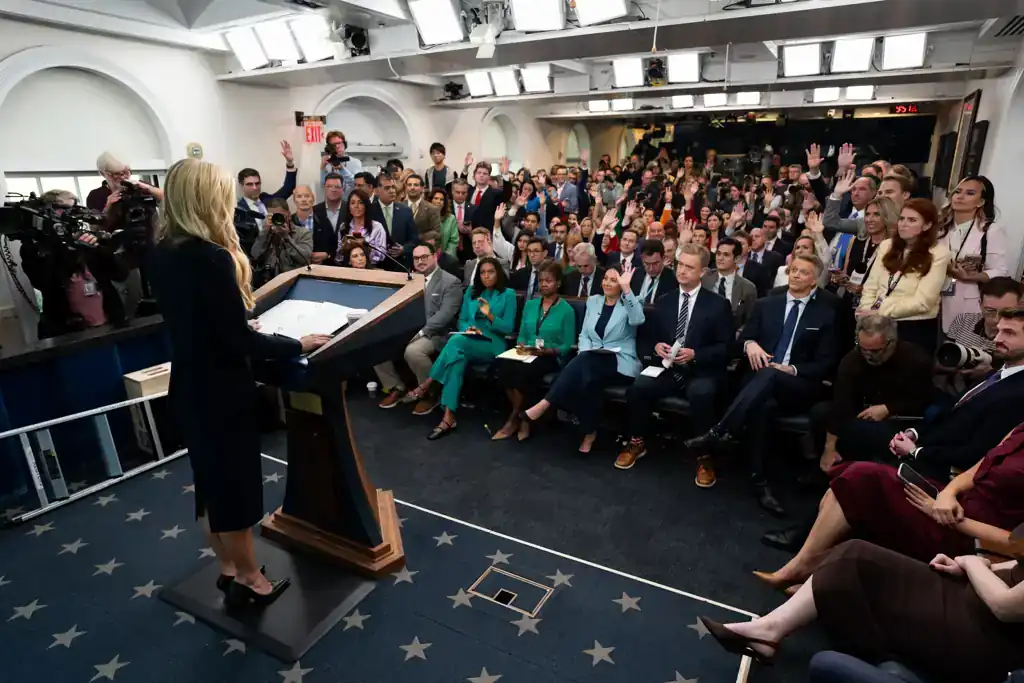
WASHINGTON, United States – A government-accountability watchdog has asked California’s State Bar to investigate White House press secretary Katie Zacharia’s repeated descriptions of herself as a lawyer, moving questions about her professional credentials into a formal regulatory channel.
Campaign for Accountability announced on October 14 that it had filed a complaint asking the regulator to examine whether Zacharia misrepresented her qualifications or held herself out as entitled to practice law without the required authorization.
The complaint follows public scrutiny of Zacharia’s legal background after she was appointed to the White House role. It is a request for investigation, not a finding of professional misconduct, a criminal charge or a determination that she unlawfully practiced law.

The State Bar of California has said it has no record of Zacharia, including under her reported maiden name, Kate Sharon Black, having been licensed to practice law in the state. The regulator has not confirmed whether it received the complaint or opened an investigation, citing confidentiality restrictions, according to reporting published on October 14.
Watchdog cites public claims and professional roles
Campaign for Accountability said its complaint concerns Zacharia’s repeated public descriptions of herself as a lawyer, including statements made in television appearances and podcasts.
The organization also cited her reported work as general counsel for Fix California, a California-based nonprofit, and professional descriptions referring to legal work involving international transactions and organizations associated with the World Bank Group and the International Finance Corporation.
Zacharia received a law degree from Pepperdine University’s Caruso School of Law in 2011. Her professional profile says she worked as an associate on the international practice team at Zhong Lun, a law firm in Beijing, from 2011 to 2013.
Those credentials establish an educational background and reported legal-sector employment, but they do not independently establish admission to a particular bar or authorization to practice law in a specific jurisdiction.

The watchdog is asking the State Bar to assess whether Zacharia’s public representations and reported activities raise issues under California law. Its allegations remain unproven, and the complaint itself does not establish that any particular legal service was performed unlawfully.
Zacharia says she had appropriate credentials
Questions about Zacharia’s qualifications intensified after reporters asked her on October 13 where she had passed the bar examination.
“When I moved to China,” she replied in the reported exchange, without identifying a licensing jurisdiction in that answer.
The White House subsequently provided a statement from Zacharia saying she had practiced international transactional law “with all the appropriate credentials.” The statement, as reported, did not identify a state or country where she had been admitted to practice or provide a bar number or licensing record.
White House communications director Steven Cheung also defended her suitability for the press secretary position. The administration’s public response did not resolve the specific question of where Zacharia holds, or has held, a professional law license.
The available material does not establish that Zacharia has never held any qualification or authorization outside California. It also does not independently verify the precise legal responsibilities she performed during her employment in Beijing or at Fix California.
A law degree is not the same as a law license
California law distinguishes legal education from authorization to practice law. Section 6125 of the state’s Business and Professions Code generally requires an active State Bar license to practice law in California, subject to applicable statutory and court-rule exceptions.
Section 6126 addresses unauthorized practice and certain representations of entitlement to practice. It provides for criminal penalties where its requirements are met. Whether the statute applies to Zacharia’s conduct would depend on the facts, the nature and location of the activities involved, and any applicable authorization or exception.
A Juris Doctor degree demonstrates completion of a law-school program. It does not, by itself, establish admission to practice in a U.S. state. Likewise, employment by a law firm or work involving international transactions does not automatically prove admission to a local bar.
Foreign and international legal work can also involve different rules from domestic legal practice. Determining what Zacharia was authorized to do in China would require evidence of her actual role and the relevant professional requirements. Her employment at a Beijing law firm alone does not establish that she was admitted to practice Chinese law.
The distinction matters because the complaint concerns both how Zacharia described her credentials and whether any relevant conduct falls within California’s legal restrictions. Those are questions for the appropriate authorities to assess, not conclusions that can be drawn solely from her degree or job titles.
State Bar has not confirmed an investigation
The State Bar’s reported statement that it has no record of Zacharia being licensed in California is limited to that jurisdiction. It does not, by itself, establish that she has never held a license elsewhere or that every form of legal work she performed was unauthorized.
The regulator also has not publicly confirmed whether it received the watchdog’s filing or initiated an investigation. That uncertainty should not be interpreted as evidence either that the complaint has been accepted for investigation or that it has been rejected.
Campaign for Accountability’s filing therefore marks a new procedural development, but the next substantive step depends on the regulator’s handling of the complaint and any additional records or explanations that may emerge.
A formal finding, if one is eventually issued, would be distinct from the allegations in the filing. No such finding has been established by the material reviewed for this report.
What happens next
The central questions are whether Zacharia has held a professional license or other relevant authorization, what she meant by her statement about passing a bar examination after moving to China, and what legal work she performed in her previous roles.
Official licensing records, a detailed response from Zacharia, and any public procedural update from the State Bar could clarify those issues. The regulator may be limited in what it can disclose while reviewing a complaint.
For now, the filing places the issue before a professional regulator without resolving it. The complaint’s allegations must be distinguished from verified licensing information, Zacharia’s own explanation and any eventual determination by an authorized body.
Reporting Credit: Campaign for Accountability; State Bar of California; Pepperdine University.