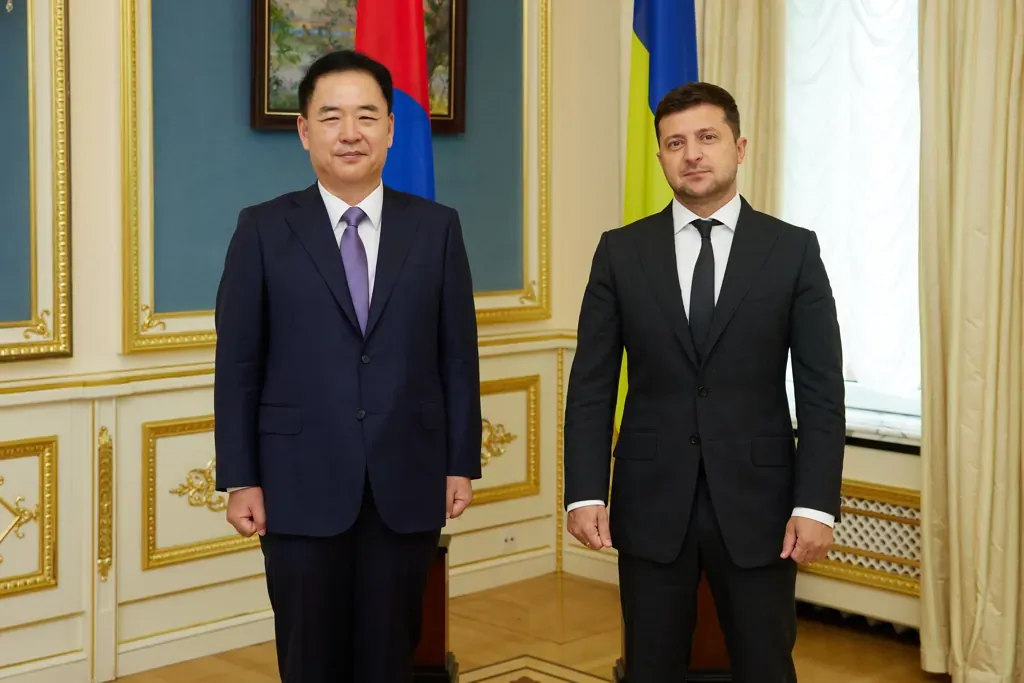
SEOUL, South Korea – South Korea will withdraw some diplomatic personnel from Ukraine amid an unresolved dispute over the transfer of two North Korean prisoners of war to Seoul, the South Korean Foreign Ministry said on October 20. The ministry cited Ukraine’s failure to take what Seoul considered constructive steps to resolve the disagreement, as well as continuing Russian airstrikes that pose risks to diplomatic personnel.
The partial withdrawal follows South Korea’s recall of its ambassador to Ukraine earlier in October. Seoul says the disclosure of the soldiers’ transfer breached a confidentiality arrangement intended to protect them and their relatives in North Korea. Ukraine has disputed the existence of such an agreement, leaving the disagreement unresolved.
South Korea has said its chargé d’affaires will maintain diplomatic communication with Ukraine and consular personnel will remain to assist South Korean nationals. The decision does not amount to a full embassy closure or a severing of diplomatic relations.

Seoul says Ukraine has not addressed its concerns
South Korean Foreign Ministry spokesperson Park Doo-soon said Ukraine had not taken “positive steps” to resolve the dispute despite Seoul raising its concerns through multiple channels.
Seoul has sought an official explanation, an apology and assurances that a similar disclosure will not happen again. South Korean Foreign Minister Cho Hyun has said the two governments agreed to keep the transfer confidential from the outset, with the stated aim of protecting the soldiers and their families, who remained in North Korea at the time. Cho also said Ukraine had initially requested that the matter not be made public.
Those statements describe South Korea’s position. The existence and precise terms of the alleged confidentiality arrangement remain disputed and should not be presented as an independently established agreement.
The dispute intensified after Zelenskyy’s public announcement and the Ukrainian presidential office’s denial that an agreement to keep the transfer secret existed. South Korea subsequently recalled Ambassador Park Ki-chang to Seoul on October 8. The October 20 staffing decision marks another step in Seoul’s diplomatic response.
Seoul has nevertheless said it wants an amicable resolution through continued consultations. Park said the two governments remained in communication, indicating that diplomatic channels had not been severed.
■ Related News

Ukraine’s position differs from Seoul’s
Ukrainian President Volodymyr Zelenskyy disclosed the transfer of the two North Korean prisoners during his address to the United Nations General Assembly in New York on September 23. Ukraine’s official presidential website published the address on September 24. Zelenskyy said Ukraine had recently sent the prisoners to South Korea and described the circumstances of their capture and treatment.
Ukraine’s position, as reported by Yonhap, is that no confidentiality agreement of the kind Seoul describes was reached. Ukrainian Foreign Minister Andrii Sybiha later characterized the controversy as “a closed matter,” according to the news agency. Seoul rejected that approach as insufficient to resolve its concerns.
The available reporting does not establish a mutually accepted account of the alleged agreement. A full account of Ukraine’s position should include a direct, current statement from the Ukrainian Foreign Ministry or presidential office if one is available before publication.
The disagreement concerns both the public disclosure and the governments’ understanding of how sensitive information about the soldiers and their families should have been handled. It has become a diplomatic dispute, but the available evidence does not establish that either government has ended bilateral relations.
The two North Korean soldiers were captured fighting for Russia
The two North Korean soldiers were captured by Ukrainian forces in January 2025 while fighting for Russia in the Kursk region, according to South Korean officials cited by Yonhap. They arrived in South Korea in mid-September 2026, the agency reported.
Zelenskyy’s UN address described the soldiers as North Korean prisoners captured alive by Ukrainian forces. He said one had attempted suicide when he realized he would be taken prisoner. That account was part of the Ukrainian president’s public explanation of the transfer.
The soldiers had reportedly expressed a desire to resettle in South Korea rather than return to North Korea. Their case carries diplomatic significance because it involves North Korean personnel captured while supporting Russia’s war against Ukraine, as well as questions about their safety and future status.
The soldiers’ circumstances should not be generalized to all North Korean troops or other prisoners. Their current legal arrangements, personal wishes and resettlement status should be described only to the extent confirmed by reliable reporting or official statements.
For Seoul, the stated confidentiality concern centers on protecting the two men and their relatives. For Kyiv, the public disclosure formed part of Zelenskyy’s account of North Korean involvement in the war and the transfer of the prisoners to South Korea. The governments’ differing accounts remain central to the dispute.
Security concerns also shape the withdrawal
South Korea has cited continuing Russian airstrikes as a separate reason for reducing its diplomatic presence. The Foreign Ministry said the threat made it difficult to ensure the safety of diplomatic personnel.
The ministry did not initially confirm the exact number of staff members who would leave. Yonhap later reported that officials expected roughly half of the embassy staff to depart. The withdrawal is expected to take place after the embassy helps around 85 South Korean nationals currently in Ukraine move to neighboring countries.
The distinction between the two reasons for the decision matters. Seoul has linked the staffing reduction both to the unresolved diplomatic dispute and to personnel safety amid Russian attacks. The available statements do not establish that either factor alone explains the entire decision.
South Korea has said the embassy will continue to issue safety information and assist South Korean nationals who wish to evacuate. Officials said they would coordinate with the embassy to identify the safest and most effective means of helping those seeking to leave.
The chargé d’affaires will remain to maintain diplomatic communication, while consular personnel are to stay in Ukraine to continue assisting South Korean nationals. Those arrangements indicate that Seoul intends to retain a functioning diplomatic and consular presence, despite reducing the number of personnel.
What the decision means for bilateral relations
The withdrawal follows the ambassador’s recall and adds pressure to an already strained relationship. However, neither measure by itself proves that South Korea has ended its diplomatic relationship with Ukraine or suspended all forms of assistance.
The available reporting does not establish that Seoul has terminated broader cooperation with Kyiv. Any claim that military, economic or humanitarian assistance has been halted would require separate confirmation from the South Korean government.
The dispute also illustrates the diplomatic sensitivity surrounding North Korean personnel captured while fighting for Russia. Seoul’s stated concern involves confidentiality and the safety of the soldiers’ families, while Ukraine’s public account highlighted North Korean participation in the war and the transfer of the prisoners.
Resolving the dispute may require both governments to clarify their respective accounts of the alleged agreement and determine whether further consultations can address Seoul’s demands. South Korea says it remains open to an amicable resolution. Ukraine’s reported description of the controversy as closed, however, has not met Seoul’s expectations.
Diplomatic channels remain open as withdrawal details emerge
South Korea’s October 20 announcement calls for a partial withdrawal of embassy personnel, not a complete closure of its mission. The chargé d’affaires and consular staff are expected to remain, with the embassy continuing to provide safety information and assistance to South Korean nationals.
The exact number of departing personnel and the final withdrawal timetable were not fully specified in the ministry’s initial announcement. Yonhap subsequently reported that roughly half the staff were expected to leave after assisting around 85 South Korean nationals to relocate to neighboring countries.
The central disagreement remains unresolved: Seoul says the transfer of the two North Korean prisoners was covered by a confidentiality arrangement, while Ukraine has denied that an agreement of that kind existed. South Korea has demanded an explanation, an apology and assurances against a recurrence, while continuing to describe a negotiated resolution as its goal.
The next steps depend on whether the two governments can narrow that disagreement and clarify the arrangements surrounding the transfer. The staffing reduction and ambassadorial recall have raised the diplomatic cost of the dispute, but the evidence available does not establish a break in relations or a wider suspension of cooperation.
Reporting Credit: Office of the President of Ukraine: Zelenskyy’s address to the UN General Assembly, published September 24, 2026, documenting his public disclosure of the transfer of the two North Korean prisoners.