PARIS, France – France’s long tradition of public protest is facing renewed scrutiny after violent demonstrations led to mass arrests, clashes with police and widespread property damage. The unrest has raised concerns about whether violence is overshadowing peaceful demands for better living conditions and public services.
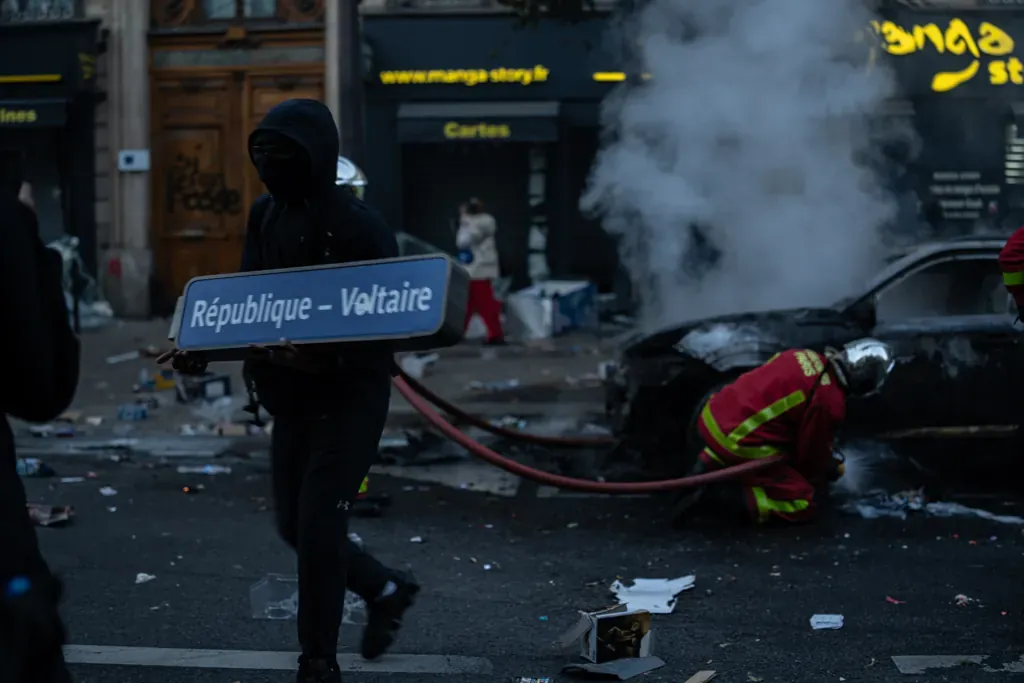
At least 2,400 people were arrested across France on Saturday, according to the Associated Press report. Rioters clashed with police, set cars on fire, entered public buildings, looted shops and set a historic city hall ablaze. Further demonstrations could follow.
Outgoing President Emmanuel Macron condemned the destruction on Sunday. He said the violence could not be justified and expressed both anger and shame over the damage.

Yet France’s protest culture has deep historical roots. Public demonstrations have long served as a way for citizens to challenge political leaders, demand reforms and defend their rights. The same tradition has also included periods of violent unrest and severe government repression.
A Protest Tradition Rooted in Revolution
The French Revolution of 1789 helped shape the modern idea that civic participation extends beyond voting. Demonstrations became a means for ordinary people to challenge political elites and press for change.
France’s national anthem, La Marseillaise, dates to 1792. Its themes of resistance to tyranny remain part of the country’s political identity.
Magali Della Sudda, research director in political science at France’s National Center for Scientific Research in Bordeaux, described protest as a way to build collective identity and political community.
The right to demonstrate is also constitutionally protected in France. For many citizens, taking part in a protest forms part of a long-standing tradition of political engagement.

However, the country’s history has not followed a simple path from demonstrations to reform. Popular uprisings, state repression and political concessions have repeatedly shaped its political development.
In 1871, government troops crushed the Paris Commune, a short-lived revolutionary municipal government. Thousands were reportedly killed during the crackdown.
Other protests produced significant concessions. In 1968, student demonstrations and a general strike pressured the government to make changes, including an increase in the minimum wage.
From Yellow Vests to Recent Demonstrations
More recent protests have followed a similar pattern of economic grievances expanding into wider demands.
In 2018 and 2019, the gilets jaunes, or yellow vest movement, began with opposition to a proposed fuel tax increase. The demonstrations grew to include complaints about living costs and inequality.
Some protests involved burning cars, looting and confrontations with police. Violence by a minority of participants sometimes overshadowed otherwise peaceful marches.
The latest demonstrations have also expanded beyond their initial focus on education. Protesters have raised broader grievances amid concerns about rising living costs and poor conditions in schools.
Authorities have faced the challenge of separating peaceful demonstrators from people involved in looting and other crimes. The available reporting does not establish how many people who ransacked shops had joined the original demonstrations or were opportunists.
Officials have imposed nightly curfews in response to the unrest. Calls for further protests have also emerged.
Policing and Public Trust Under Pressure
Political scientist Fabien Jobard, who studies protest and policing, said more recent unrest reflects patterns that have developed over several decades.
Since the 1990s, France has experienced recurring episodes of what French officials call violences urbaines, or urban violence. Jobard said such unrest is often triggered by allegations of police violence.
In 2005, nationwide riots followed the deaths of two teenagers who were fleeing police. Another major wave of unrest occurred in 2023 after an officer fatally shot a 17-year-old during a traffic stop outside Paris.
Jobard said riots have become one form of collective expression among some young people in the suburbs.
The role of police tactics has also drawn criticism during the latest demonstrations. Government critics and human rights campaigners have accused officers of using excessive force.
Much of the criticism has focused on rubber-bullet launchers, known in France as LBDs, and stun grenades. Critics say these weapons have caused serious injuries among protesters.
Arrests Raise Questions About the Government Response
The scale of recent arrests has added to concerns about the authorities’ response to public dissent.
Della Sudda noted that nearly 8,000 arrests in the weeks leading up to October 17 far exceeded the few dozen detentions recorded during a 1998 demonstration. That earlier protest brought about 500,000 students into the streets over teacher shortages and deteriorating school conditions.
The figures highlight the scale of the recent police response. They do not, by themselves, establish whether individual arrests were justified or whether police used excessive force.
A wider problem is the growing perception among some protesters that political leaders are not listening to their demands.
Della Sudda pointed to the government’s response to the yellow vest movement as an example. Instead of relying solely on direct negotiations, Macron’s government launched a digital consultation known as the Grand Débat National, or Great National Debate.
Anti-government protesters criticized the initiative. Della Sudda has argued that the response contributed to growing mistrust.
Peaceful Protest and Public Disorder
France’s current unrest highlights a difficult distinction between the right to demonstrate and acts of violence committed during protests.
Hundreds of thousands of people have taken part in peaceful demonstrations against rising living costs and conditions in schools, according to the supplied reporting. At the same time, clashes, looting and arson have drawn attention away from those demands.
The authorities must respond to violence while respecting the right to peaceful assembly. Critics, meanwhile, are questioning whether police tactics and government engagement have deepened tensions.
France’s history shows that protest can lead to political concessions, but it can also bring bloodshed and repression. The recent unrest has renewed that debate without resolving the underlying grievances.
The course of events will depend in part on whether the government can address public concerns and rebuild trust, while preventing further violence and protecting peaceful demonstrators.
Reporting Credit: French Ministry of the Interior — Official information on public order, policing and government responses to demonstrations, where available, French Ministry of Justice — Official information on judicial proceedings and related legal developments, where available. French National Center for Scientific Research (CNRS) — Institutional affiliation of political scientist Magali Della Sudda, whose analysis is cited in the source report.