Wildfires spreading across western Canada and the United States have forced thousands of people from their homes, destroyed or damaged hundreds of structures and killed residents and firefighters as emergency crews confront a broad and active fire season.
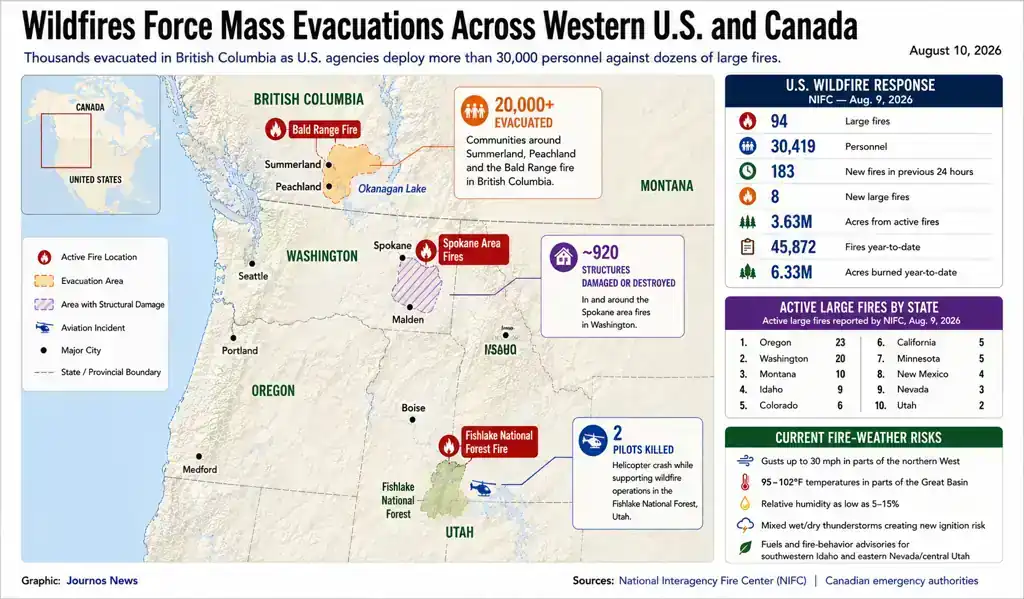
In British Columbia, more than 20,000 people were evacuated from communities around Okanagan Lake after a fast-moving wildfire destroyed homes and prompted aircraft rescues. In Washington state, firefighters continued containment and cleanup operations around three fires in the Spokane area that have burned for more than a week.
The scale of the U.S. response underscores the extent of fire activity. The National Interagency Fire Center reported Aug. 9 that 94 large fires were burning across the country, with 30,419 personnel assigned to incidents nationwide, including 645 crews, 1,870 engines and 226 helicopters.

U.S. Fire Response Reaches National Scale
The National Interagency Fire Center said 183 new fires had been reported nationwide during the previous 24 hours, including eight new large fires. Four fires were contained during that period.
Oregon had the largest number of active large fires, with 23, followed by Washington with 20, Montana with 10 and Idaho with nine. Active large fires were also reported in Colorado, California, Minnesota, New Mexico, Nevada, Utah, Arizona, Alaska, Florida, Wyoming and Oklahoma.
NIFC reported 3.63 million acres from all active fires as of Aug. 9.
The agency’s year-to-date figures show that 45,872 fires had been reported in the United States through Aug. 9, burning 6.33 million acres. By comparison, 42,962 fires had burned 3.60 million acres during the same period in 2025.
The National Interagency Fire Center said predictive services had issued new fuels and fire-behavior advisories for southwestern Idaho and eastern Nevada and central Utah. The agency also emphasized the importance of quickly suppressing new fires before they grow large enough to require extended incident-management resources.
■ Related News

NIFC noted that most wildfires are contained during the initial attack stage and never become large enough to appear on the national incident-management summary.
Weather Keeps Fire Danger Elevated
Weather conditions were adding to the operational challenge across parts of the western United States.
The National Interagency Fire Center reported persistent breezy conditions in the Cascade gaps, the northern Great Basin and portions of the central and northern Rockies, with gusts reaching 30 mph.
Hot temperatures and low relative humidity were also expected across parts of the West, while isolated mixed wet-and-dry thunderstorms posed a risk of new fire ignitions from the eastern Sierra through the central Great Basin.
Temperatures were forecast to reach 95 to 102 degrees Fahrenheit in parts of that region, with relative humidity as low as 5% to 15%. Similar thunderstorm activity was expected from the southern Great Basin into northern Arizona.
The agency also reported that maximum temperatures in the southern Plains were expected to remain at or above 100 degrees for a sixth consecutive day. Warm, dry conditions were also contributing to elevated fire potential in Alaska’s Upper Tanana Valley.
The combination of heat, low humidity, wind and thunderstorms can increase the potential for new ignitions and rapid fire growth, adding to demands on firefighters and aircraft already committed to large incidents.
British Columbia Evacuations Exceed 20,000
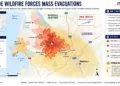
The most extensive evacuations in the supplied reporting were in British Columbia, where residents of Summerland and nearby communities were forced to leave as fires spread rapidly around Okanagan Lake.
Anette Boulet, a Summerland resident, said she and her family left their home at about 4:30 a.m. Saturday as heavy smoke obscured the area. She evacuated to a center in Penticton.
The Royal Canadian Mounted Police said Sunday that an 80-year-old woman died while attempting to escape the wildfire in the Okanagan Lake region.
The Bald Range fire, first reported Friday evening, also prompted the evacuation of about 8,000 people in and around Peachland. British Columbia declared a state of emergency Saturday.
Canada’s Minister of Emergency Management and Community Resilience, Eleanor Olszewski, said Sunday that she had approved British Columbia’s request for federal assistance to provide shelter and accommodation for people displaced by the fires.
The scale of the evacuations highlights the pressure on emergency services as rapidly advancing fires affect populated areas and force large numbers of residents to move with little warning.
Spokane Fires Keep U.S. Communities on Alert
In Washington, crews continued mop-up operations Sunday around containment lines for three wildfires in the Spokane area. A team managing the fires said none was expanding, although the blazes have damaged or destroyed about 920 structures.
The fires have also prompted repeated changes to evacuation warnings. Residents of Malden, about 35 miles south of Spokane, were told Saturday to leave immediately. By Sunday, the evacuation level had been reduced to an order to remain prepared to leave quickly if conditions changed.
John Goyke, whose company operates Malden’s water system under contract, said relatively calm winds and a lack of fire progression had eased immediate concerns. Residents were being urged to conserve water so supplies could remain available for firefighting, while Malden’s fire department transported water from nearby Rosalia.
Malden has already experienced a major wildfire disaster. A 2020 blaze destroyed much of the town, including its fire station, post office, city hall and library.
A man was arrested and charged earlier in the week with intentionally setting the largest of the three Spokane-area fires, according to the supplied reporting. The allegation will be subject to the legal process.
Helicopter Crash Kills Two Utah Pilots
The wildfire response also turned deadly in Utah, where two helicopter pilots were killed when their aircraft crashed Friday while they were fighting a fire in the Fishlake National Forest.
Crews reached the crash site Saturday after steep, difficult terrain and continuing fire activity delayed access. Sevier County Sheriff Nathan Curtis said firefighters encountered smoke from both the crash site and an active fire moving toward them.
The National Transportation Safety Board is investigating the cause of the crash.
The deaths add to the risks faced by emergency crews operating in difficult terrain and rapidly changing wildfire conditions, even as authorities continue evacuations and containment efforts across the region.
With dozens of large fires still active across the United States and major evacuations continuing in western Canada, emergency agencies are balancing immediate threats to communities with the need to keep enough firefighters and equipment available to attack new fires before they grow.
This report is based on reporting by The Associated Press.