BEIJING, China – Typhoon Dolphin reached China’s eastern coast on Sunday after forcing the evacuation of hundreds of thousands of people and disrupting air and sea travel across parts of East Asia.
The storm made landfall near Taizhou in Zhejiang province, bringing strong winds and heavy rain to coastal areas and neighboring Fujian province. Authorities warned of flooding and landslides as forecasters expected significant rainfall across parts of eastern China.
The storm’s effects had already extended beyond China, with heavy rain in Taiwan and storm-enhanced monsoon conditions contributing to flooding and landslides in the Philippines.

Storm reaches eastern China after mass evacuations
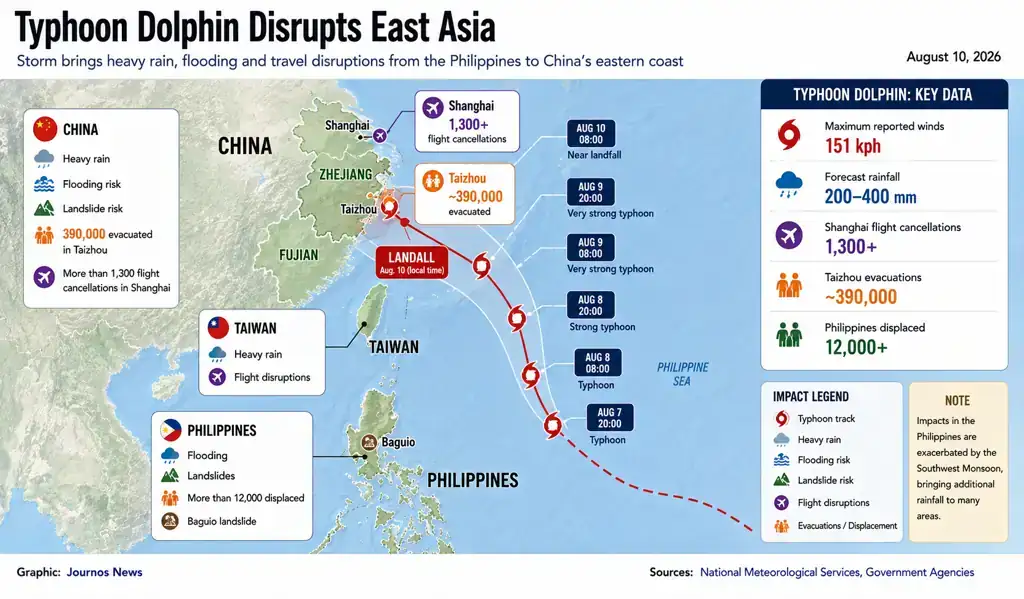
Dolphin made landfall near Taizhou with winds estimated at 151 kph (93 mph), generating large waves along the coast. Authorities warned that heavy rainfall could trigger flooding and landslides in vulnerable areas.
Chinese forecasters predicted rainfall totals of 200 to 400 millimeters (7.9 to 15.7 inches) in some areas during the following days.
Zhejiang authorities evacuated about 390,000 people in Taizhou on Saturday evening as the storm approached. Shanghai also moved more than 30,000 residents from locations considered vulnerable to the storm.
Ferries and cruises in Zhejiang were suspended as authorities prepared for hazardous coastal conditions.
Shanghai cancels more than 1,300 flights
The approaching storm caused major disruptions at Shanghai’s two principal airports.
■ Related News




Shanghai’s Hongqiao and Pudong airports canceled about 60% of scheduled flights Sunday, according to the city’s state media outlet, the Paper. The cancellations affected more than 1,300 flights as authorities prepared for worsening weather.
The storm also disrupted travel elsewhere in East Asia. Its outer bands brought heavy rain to northern Taiwan, including Taipei, on Saturday, while some Taiwanese airlines canceled flights to China on Sunday.
The travel disruptions demonstrate how quickly major tropical systems can affect transportation networks beyond the areas directly hit by the storm.
Heavy rain contributes to landslide in Philippines
Dolphin also intensified seasonal monsoon conditions in the Philippines, contributing to flooding and landslide risks after days of heavy rainfall.
In Baguio, a mountain resort city in northern Luzon, five people were rescued and seven remained missing after a landslide struck three houses Sunday. Officials said the slide was triggered by days of heavy monsoon rain strengthened by the typhoon.
Flooding affected areas of northern Luzon, including parts of metropolitan Manila. Disaster officials said more than 12,000 people were displaced, while schools in several northern cities and towns were closed Friday and Saturday.
The severe weather followed a tropical storm that killed at least six people in the Philippines the previous week. Four of those deaths occurred in a landslide and rockslide in Benguet and Rizal provinces.
Authorities monitor further regional risks
The storm’s effects across China, Taiwan and the Philippines have created multiple weather-related risks, including flooding, landslides, dangerous coastal conditions and transportation disruptions.
In China, authorities are continuing to monitor rainfall and coastal conditions after evacuating vulnerable communities and suspending maritime services. In the Philippines, emergency officials are responding to flooding and landslide threats while monitoring communities affected by prolonged monsoon rainfall.
The immediate impact will depend on rainfall totals, local terrain and the storm’s subsequent movement as authorities continue emergency operations and assess conditions in affected areas.
This report is based on reporting by The Associated Press.