Journos News - Breaking News, World News, Top Stories, Todays Headlines and Flash Reports
Friday, August 7, 2026
  • Login
  • Home
  • World
    • Africa
    • Americas
    • Asia
    • Europe
    • Middle East
    • Oceania
  • Politics
  • Business
  • Technology
  • Health
  • Science
  • Sports
  • Entertainment
  • Culture
No Result
View All Result
  • Home
  • World
    • Africa
    • Americas
    • Asia
    • Europe
    • Middle East
    • Oceania
  • Politics
  • Business
  • Technology
  • Health
  • Science
  • Sports
  • Entertainment
  • Culture
No Result
View All Result
Journos News - Breaking News, World News, Top Stories, Todays Headlines and Flash Reports
No Result
View All Result
Home Environment Climate & Environment

World on Track for 57 More Superhot Days a Year, but Paris Pact Helped Avert Worse

A new study finds climate efforts since 2015 have reduced projected extreme-heat days by half, but poorer nations still face the harshest impacts.

The Daily Desk by The Daily Desk
June 24, 2026
in Climate & Environment, Environment
0
World to Face 57 More Superhot Days a Year by 2100, Study Finds - AP Photo/Gregory Bull, File

Global Heat Inequality: Poor Nations Face More Superhot Days - AP Photo/Gregory Bull, File

Published: October 17, 2025, 22:45 EDT

A new global climate study warns that the planet is on course to endure nearly two additional months of dangerous, extremely hot days each year by the end of the century. While the findings underscore the intensifying threat of global warming, scientists say international efforts to reduce greenhouse gas emissions since the 2015 Paris Agreement have prevented an even more catastrophic outcome.

Climate Action Has Softened the Blow, Study Finds

According to research released Thursday by World Weather Attribution and Climate Central, global emissions cuts launched over the past decade have significantly reduced projected future heat extremes. Without those interventions, Earth would be heading toward 114 extra superhot days per year. Thanks to current pledges, that number has dropped to 57 additional days on average.

The study used computer simulations and historical temperature data to assess how climate policies have altered the frequency of extreme heat days — defined as days hotter than 90% of comparable dates between 1991 and 2020. Researchers examined global averages and individual country data under two scenarios: one where nations meet their current emission pledges (warming limited to 2.6°C above preindustrial levels), and another where global temperatures rise by 4°C, as was once projected before the Paris accord.

“This reflects both the success and the shortfall of the Paris Agreement,” said Victor Gensini, a climate scientist at Northern Illinois University. “We have slowed the rate of warming, but we haven’t done nearly enough to protect vulnerable regions.”

Heat Waves Intensify: ‘Pain and Suffering’ Ahead

The world has already added an average of 11 superhot days per year since 2015, the study found. These periods of extreme heat are increasingly sending people to emergency rooms and claiming lives, especially in regions with limited infrastructure and healthcare capacity.

“There will be pain and suffering because of climate change,” said Kristina Dahl, Climate Central’s vice president for science and a co-author of the report. “But the difference between 4°C of warming and 2.6°C of warming represents the hard-won progress of the past decade. That gives me hope.”

Friederike Otto of Imperial College London, another co-author, said the rising temperatures will “definitely affect tens of thousands or even millions of people,” adding that thousands already die from heat waves each year.

■ Related News
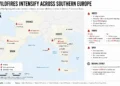
Editorial map showing major wildfire zones across southwestern Europe, including affected areas in France and Spain, evacuation regions, and extreme heat alerts.

France Expands Wildfire Evacuations as More Than 330,000 Displaced Across Southwest Europe

July 29, 2026
Map showing the extreme heat dome across the central and southern United States, highlighting heat warnings, severe storm risks, flash flood areas, and forecast temperatures.

Extreme Heat Grips Central and Southern U.S. as Millions Remain Under Weather Warnings

July 27, 2026
Map showing the dangerous heat dome covering the central United States, highlighting heat advisory areas, temperature anomalies, and affected regions.

Heat Dome Grips Central United States as Dangerous Temperatures Threaten Millions Through Next Week

July 26, 2026
Locator map showing major wildfire zones, evacuation areas, and affected communities across southwest France and central Spain.

Tens of Thousands Evacuated as Wildfires Sweep Southwest France and Central Spain

July 24, 2026

Researchers estimate that by century’s end, a weeklong southern European heat wave like the one in 2023 will be 70% more likely and 0.6°C (1.1°F) warmer than similar events a decade ago. If global emissions remain on their current trajectory, comparable heat waves could become 3°C (5.4°F) hotter by 2100.

In North America, a heat wave similar to the one that struck the southwestern United States and Mexico in 2024 could be 1.7°C (3.1°F) warmer under current trends.

Climate Inequality: Poorer Nations Hit Hardest

The report’s most striking finding is the imbalance between those most responsible for carbon emissions and those suffering the greatest effects. The 10 countries expected to endure the sharpest increase in superhot days are largely small, low-emitting island or coastal nations — including the Solomon Islands, Samoa, Panama, and Indonesia.

For example, Panama is projected to experience 149 additional superhot days each year, despite contributing just a fraction of global greenhouse gas emissions. Collectively, the top 10 hardest-hit nations produce only 1% of the world’s carbon emissions but will bear nearly 13% of the additional extreme heat days.

By contrast, the world’s top three emitters — the United States, China, and India — are expected to face only 23 to 30 extra superhot days annually, despite being responsible for 42% of the planet’s carbon dioxide emissions.

“This report quantifies what climate scientists have warned for decades,” said Andrew Weaver of the University of Victoria, who was not involved in the research. “The impacts of global warming will fall hardest on developing nations that contributed the least to the problem. This growing inequality will deepen geopolitical tensions.”

Regional Impacts Across the United States

Within the United States, Hawaii and Florida are projected to see the steepest increases in extreme heat days, while Idaho will experience the smallest rise. Even in wealthy nations, the burden will fall disproportionately on low-income and outdoor-working populations, particularly in southern states.

Kristie Ebi, a public health and climate expert at the University of Washington, said the data aligns with peer-reviewed research showing “hundreds of thousands of heat-related deaths in recent years,” much of it driven by human-caused climate change.

A Mixed Picture Before Global Climate Talks

The release of the study comes just weeks before nearly 200 nations gather in Brazil for the next round of United Nations climate negotiations. Scientists and policymakers are preparing to review progress since the Paris Agreement — and to assess whether new commitments can still prevent the worst climate outcomes.

While experts acknowledge that the world has avoided the most extreme warming scenario, they warn that current efforts remain insufficient. “The fact that we’re no longer on the 4-degree path is not a reason for comfort,” said Johan Rockström, director of the Potsdam Institute for Climate Impact Research. “Even 2.6 degrees of warming would mean a disastrous future for billions.”

Source: AP News – The world is heading to add 57 superhot days a year, but study indicates it could have been worse

Tags: #CarbonEmissions#ClimateAction#ClimateChange#ClimateCrisis#ClimateJustice#Environment#ExtremeHeat#GlobalInequality#GlobalWarming#Heatwaves#ParisAgreement#SuperhotDays
The Daily Desk

The Daily Desk

The Daily Desk is a contributor at JournosNews.com covering politics, media, governance, and the evolving dynamics of public discourse. Stories published under this byline are produced in accordance with JournosNews' editorial standards, with an emphasis on verified reporting, accuracy, context, and impartiality.

Related Posts

Locator map showing the Guadalajara wildfire in central Spain and extreme heat conditions affecting southern Europe across the Mediterranean region.

Spain Battles One of Its Largest Wildfires as Extreme Heat Grips the Mediterranean

July 23, 2026
Firefighters battle a deadly wildfire in Spain's Almeria province. - AP Photo/Gregorio Marrero

Deadly Wildfire Tears Through Expat Community in Southern Spain as Search Continues for Missing

July 11, 2026
Neil the elephant seal rests on a street in Tasmania. - Sam Volker Photography via AP

Australian Officials Urge Public to Give Viral Elephant Seal Neil More Space

July 3, 2026
Medical staff prepare hospital cooling measures during Europe's extreme heat wave - AP Photo/Christophe Ena

European Hospitals Strengthen Heat Wave Preparedness After Record Temperatures Expose System Gaps

July 1, 2026
Load More
Next Post
Trump Calls for Ukraine-Russia Ceasefire After Meeting with Zelenskyy - AP Photo/Alex Brandon

Trump Urges Ukraine and Russia to ‘Stop Where They Are’ and End the War After Zelenskyy Meeting

Trump Commutes George Santos Sentence and Calls for Ukraine-Russia Ceasefire - AP Photo/Mark Schiefelbein

Trump’s Week of Power Moves: Santos Commutation, Ukraine Peace Push, and Global Policy Shifts

JournosNews logo

Journos News delivers globally neutral, fact-based journalism that meets international media standards — clear, credible, and made for a connected world.

  • Categories
  • World News
  • Politics
  • Business & Markets
  • Technology
  • Health
  • Science
  • Sports
  • Arts & Culture
  • Resources
  • Editorial Standards
  • Submit a Story
  • Advertise with Us
  • Syndication & Partnerships
  • Site Map
  • Press & Media Kit
  • Editorial Team
  • Careers

Join thousands of readers receiving the latest updates, tips, and exclusive insights straight to their inbox. Never miss an important story again.

  • About Us
  • Editorial & Trust Center
  • Contact Us
  • Privacy Policy
  • Terms of Use & Copyright Notice

© JournosNews.com All rights reserved.

Welcome Back!

Login to your account below

Forgotten Password?

Retrieve your password

Please enter your username or email address to reset your password.

Log In
JournosNews

Independent Journalism.
Verified Facts.

You're about to read a professionally edited article from JournosNews.com.

Every article is produced in accordance with our editorial standards, emphasizing factual accuracy, transparent attribution, fairness, editorial independence, and meaningful context.

Editorial Standards
No Result
View All Result
  • Home
  • World
    • Africa
    • Americas
    • Asia
    • Europe
    • Middle East
    • Oceania
  • Politics
  • Business
  • Technology
  • Health
  • Science
  • Sports
  • Entertainment
  • Culture

© JournosNews.com All rights reserved.

This website uses cookies. By continuing to use this website you are giving consent to cookies being used. Visit our Privacy and Cookie Policy.