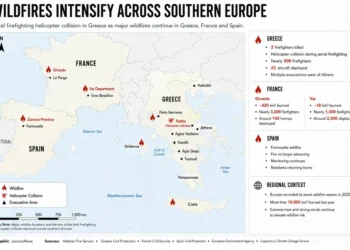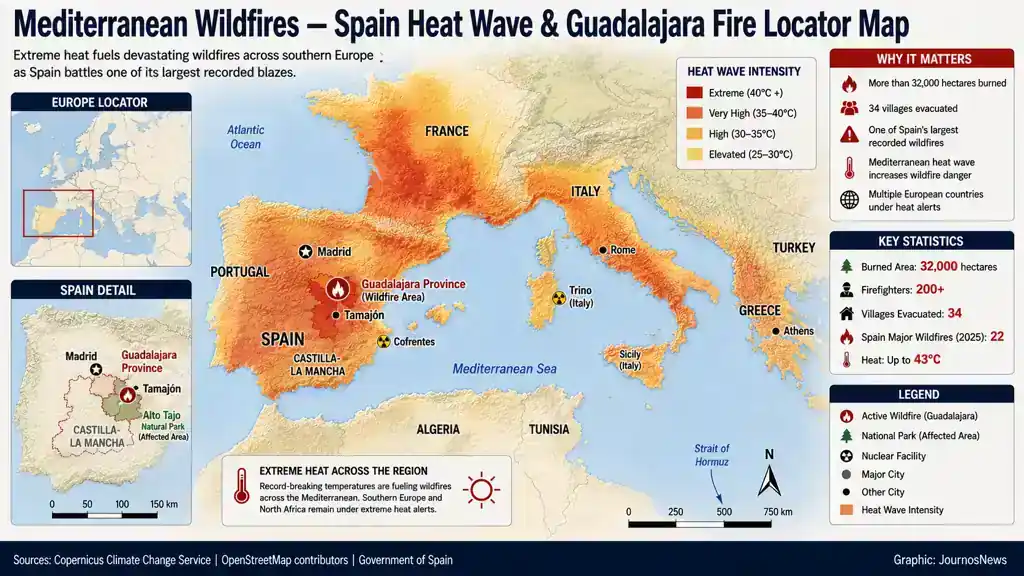
BARCELONA, Spain – Spain is battling one of the largest wildfires in its recorded history as firefighters work to contain a blaze that has burned more than 32,000 hectares (79,000 acres) in the central province of Guadalajara, while an intense Mediterranean heat wave threatens to worsen conditions across southern Europe.
More than 200 firefighters, supported by ground crews and water-dropping aircraft, continued battling the nearly week-old fire on Wednesday. Authorities said 34 villages have been evacuated, although no serious injuries or fatalities have been reported.
Historic Wildfire Stretches Emergency Response
Spanish officials described the Guadalajara wildfire as one of the country’s largest forest fires in recent decades.

Prime Minister Pedro Sánchez visited affected communities near the village of Tamajón, northeast of Madrid, on Wednesday. During the visit, he urged political leaders to unite in addressing climate change, arguing that increasingly destructive wildfires demonstrate its growing impact.
“Year after year we clearly see how climate change kills and destroys wealth in our communities,” Sánchez said. “This isn’t politics. It is science, it’s about facts.”
Spain’s Minister for Ecological Transition, Sara Aagesen, described the blaze as the largest wildfire ever recorded in the Castilla-La Mancha region and among the largest in the country’s recent history.
According to Spain’s Ministry for the Ecological Transition, the Guadalajara wildfire ranks as Spain’s second-largest on record, surpassed only by a fire that burned about 37,000 hectares (91,000 acres) in northwestern Spain last year, according to data cited by EFE.
Firefighters Protect Communities
Emergency crews have concentrated on preventing the fire from reaching populated areas while battling flames across mostly protected natural land.
Regional authorities said firefighters have successfully protected homes in all 40 villages within the affected zone, approximately 90% of which lies inside a national park.
■ Related News



Emiliano García-Page, president of the Castilla-La Mancha regional government, said officials hope to bring the wildfire under control by Friday.
Among the evacuated communities is Zarzuela de Jadraque, where all 100 residents left the village on Friday. Fourteen evacuees remain in temporary accommodation provided by the Red Cross.
Mayor Miguel Ángel Moreno praised firefighters for their efforts, saying they deserved recognition comparable to Spain’s World Cup-winning football players.
“The firefighters had to run from one side of the village to the other putting out fires,” Moreno told Spanish broadcaster TVE. “Besides the heroes who won the World Cup, we have other heroes who remain nameless.”
Spain Faces Another Severe Wildfire Season
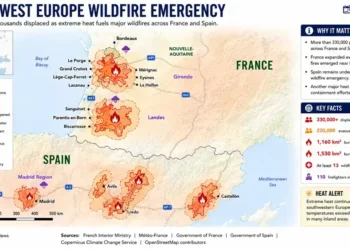
The Guadalajara fire comes less than two weeks after another deadly wildfire devastated a small expatriate community in southern Spain, killing 13 people, including several foreign nationals.
Spain has already recorded 22 major wildfires this year. Authorities classify a major wildfire as one that burns more than 500 hectares (1,235 acres).
Sánchez said more than 100,000 hectares (247,000 acres) have already burned during the first half of the year, matching Spain’s average annual total over the past decade.
Mediterranean Heat Wave Raises Fire Risk
Spain’s national weather agency warned that a heat wave beginning Tuesday was expected to peak on Wednesday and Thursday, with temperatures reaching around 40°C (104°F) across several inland regions and exceeding 42°C (108°F) in parts of Andalusia.
Guadalajara and large parts of Spain remained under heat alerts as high temperatures, strong winds and limited rainfall created conditions favorable for rapidly spreading wildfires.
The extreme weather extends well beyond Spain.
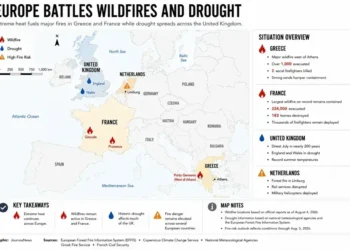
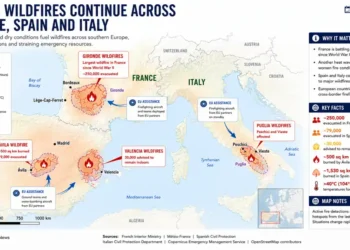
Firefighters in Sicily have responded to more than 1,000 emergency incidents since Saturday as multiple wildfires spread across the Italian island. Authorities evacuated about 100 people from homes and a healthcare facility in Agrigento while relocating 22 patients because of nearby fires and concerns over an oxygen storage facility.
Italy’s Civil Protection Department has maintained Sicily at its highest wildfire alert level as temperatures approached or exceeded 40°C.
Greece was forecast to experience temperatures above 42°C during what officials expected to be the final day of a four-day heat wave, with the Athens region and parts of southern and central Greece placed under the highest wildfire danger warning.
Cyprus also warned temperatures could reach 43°C (109°F).
In the United Kingdom, prolonged dry conditions prompted Thames Water to introduce a hosepipe ban affecting approximately 10 million customers across southern England beginning Thursday after more than a month without significant rainfall in some areas.
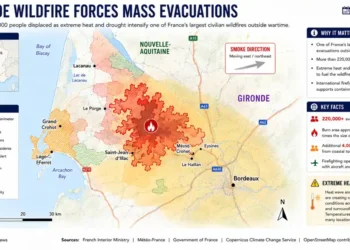
Meanwhile, France’s public health agency estimated that a record heat wave between June 17 and July 2 contributed to at least 5,700 excess deaths. The agency said 21,674 deaths from all causes were recorded during the period, compared with a modeled expectation of 15,910 under normal conditions.
Climate Concerns Remain in Focus
The wildfire emergency comes as Europe experiences increasingly frequent and intense periods of extreme heat.
According to the European Union’s Copernicus Climate Change Service, Europe is the world’s fastest-warming continent, with temperatures rising at roughly twice the global average since the 1980s.
Scientists say rising temperatures and prolonged drought are increasing the frequency and intensity of wildfires, particularly across southern Europe, leaving the region increasingly vulnerable to destructive fire seasons.
This report is based on reporting by The Associated Press.
Article Topics: Spain Wildfires | Guadalajara Fire | Mediterranean Heat Wave | Climate Change | Europe Weather | Emergency Response | Extreme Heat | Civil Protection