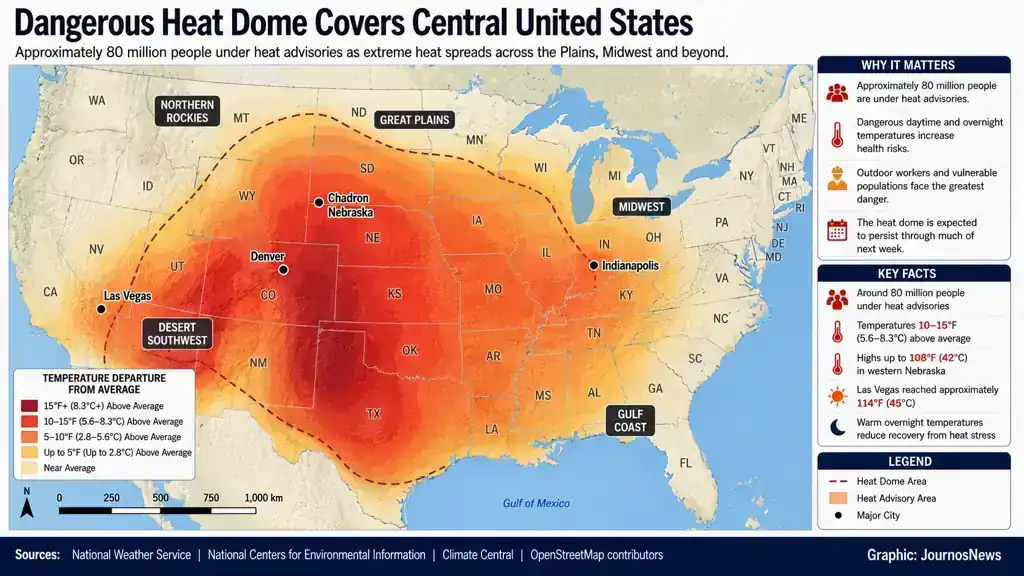
WASHINGTON – A powerful heat dome settled over the central United States on Saturday, bringing dangerous temperatures across a broad stretch of the country and placing an estimated 80 million people under heat advisories as forecasters warned the extreme conditions could persist into next week.
The prolonged heat is expected to affect communities from the Desert Southwest and Gulf Coast to the Midwest and Great Plains, increasing the risk of heat-related illnesses while placing added strain on public health services, outdoor workers and vulnerable populations. Meteorologists also warned that unusually warm overnight temperatures will provide little relief, allowing heat stress to build over several consecutive days.
Heat Dome Expected to Persist Through the Week
Meteorologists said the weather pattern responsible for the extreme heat is expected to remain largely stationary through much of the coming week.

Bob Oravec, a meteorologist with the National Weather Service, said the heat dome traps hot air beneath stable atmospheric conditions, producing prolonged high temperatures and elevated humidity that can make it feel significantly hotter than the actual air temperature.
Forecasts indicate temperatures will run between 10 and 15 degrees Fahrenheit (5.6 to 8.3 degrees Celsius) above seasonal averages across parts of the affected region.
Some communities near Denver could challenge daily temperature records, while western Nebraska remains under an extreme heat warning with highs expected to reach 108 degrees Fahrenheit (42 degrees Celsius) during the weekend.
Forecasters also expect unusually high temperatures to spread into areas that typically experience milder summers, including parts of Montana and Wyoming, where temperatures could exceed 100 degrees Fahrenheit (37 degrees Celsius).
Outdoor Workers Face Elevated Health Risks
The extended period of extreme heat is creating hazardous conditions for people whose jobs require prolonged outdoor activity.




In Las Vegas, where temperatures climbed to around 114 degrees Fahrenheit (45 degrees Celsius) on Saturday, HVAC technician Kristian “Flaco” Santos said repairing air conditioning systems often requires working on rooftops and inside attics, where temperatures can be substantially higher than outdoors.
Santos said he reduces the risk of heat-related illness by wearing protective clothing, drinking water with electrolytes and taking regular cooling breaks. He encouraged others working outdoors to adopt similar precautions during periods of extreme heat.
The weather has also affected tourism and local businesses.
At the Museum of the Fur Trade near Chadron, Nebraska, employee Hannah Lovelace said visitor numbers had declined during the heat wave, while lightweight historical clothing proved more popular than traditional fur garments among visitors attending frontier reenactments.
Communities Expand Public Health Measures
Health officials warned that children, older adults and people with underlying medical conditions remain most vulnerable to prolonged exposure to extreme heat.
Authorities urged residents to stay hydrated, seek air-conditioned spaces or public cooling centers, and avoid strenuous outdoor activities during the hottest hours of the day.
Several communities expanded heat-response measures.
Organizers of Sunday’s Brickyard 400 at the Indianapolis Motor Speedway planned additional water refill stations and cooling areas while allowing spectators to bring packed coolers into the venue.
In Denver, recreation centers prepared air-conditioned facilities for residents seeking relief from the heat.
Forecasters expect the most intense heat to shift toward Texas and parts of the Gulf Coast by the middle of next week. Some areas of the central United States may experience modest relief next weekend, although Oravec cautioned that any cooling trend could be temporary.
The Mid-Atlantic, Northeast and much of the Pacific Northwest are expected to avoid the most severe conditions.
Extreme Heat Reflects Broader Climate Trends
The latest heat wave follows several periods of unusually hot weather across the United States this summer.
Earlier episodes of extreme heat affected the eastern United States in early July and later spread across the Southwest and Great Plains.
Similar conditions have also affected other parts of the world. Europe experienced a severe heat wave in June, with French health authorities estimating that extreme temperatures contributed to thousands of excess deaths.
Andy Pershing, chief program officer at Climate Central, said rising global temperatures associated with greenhouse gas emissions have increased the likelihood that heat waves become more frequent and more intense. He noted, however, that attributing any single weather event directly to climate change requires additional scientific analysis.
According to the National Centers for Environmental Information, the continental United States recorded its second-hottest first half of the year on record in 2026, while June ranked as the nation’s 18th warmest June.
Officials continue to advise residents across affected states to monitor local weather forecasts, follow public health guidance and prepare for several more days of dangerous heat.
This report is based on reporting by The Associated Press.