WELLINGTON, New Zealand – Wildlife officials in Australia’s island state of Tasmania are urging residents and visitors to keep their distance from Neil, a young southern elephant seal whose growing online fame has attracted large crowds during his latest visit ashore. The Associated Press reported that authorities fear increasing public attention could lead to dangerous encounters for both people and the animal.
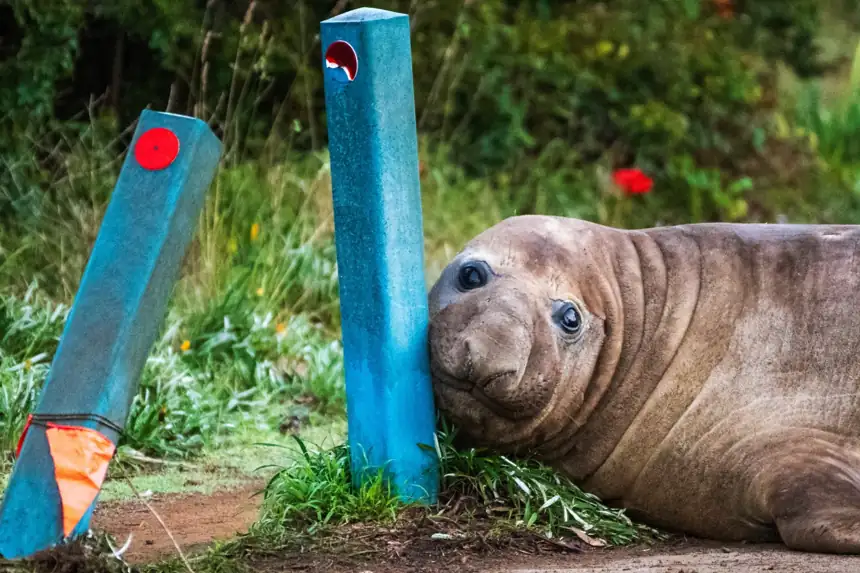
Neil, a five-year-old elephant seal weighing about 1,000 kilograms (2,200 pounds), returned to Tasmania’s coastline in June as part of his regular seasonal haul-out after months feeding at sea. During his latest visit, the massive marine mammal has wandered into beachside communities, damaging roadside infrastructure and repeatedly stopping traffic by resting in streets and public spaces.
Officials said their greatest concern is not the damaged property but the number of people approaching the wild animal to take photographs and videos.

Social Media Fame Raises Safety Concerns
Neil has amassed a TikTok following of about 1.4 million people, more than twice Tasmania’s population, with many viewers drawn to videos showing the seal pushing over traffic bollards, damaging fences and confronting parked vehicles.
According to the AP, wildlife authorities say those behaviors are typical for a juvenile male elephant seal rather than signs of aggression.
Sophia Volzke, an elephant seal researcher at the University of Tasmania, explained that young males naturally practice the dominance behaviors they will later use when competing with other males during breeding season.
Because Neil is currently the only known male elephant seal regularly coming ashore in Tasmania, Volzke said he has no other young seals with which to rehearse those interactions.
Authorities Ask Visitors to Keep Their Distance
Kris Carlyon of Tasmania’s Department of Natural Resources and Environment appealed to the public during a news conference in Hobart, warning that Neil’s popularity has become a mixed blessing.
■ Related News




He said officials have witnessed people bringing young children close to the seal in an effort to capture photographs for social media, behavior that increases the risk of injury to both visitors and the animal.
Authorities have also asked residents not to publicly disclose Neil’s exact location while he remains ashore, hoping to reduce the number of people traveling to see him.
According to Carlyon, if crowds become unmanageable or public safety is threatened, wildlife officers could be forced to relocate the seal—an operation officials would prefer to avoid.
He also referenced the case of Freya, a walrus in Norway that attracted large crowds before authorities euthanized the animal in 2023 after concluding it posed an increasing safety risk.
A Familiar Visitor With an Uncertain Future
Elephant seals routinely return to land twice each year to rest, molt and fast before heading back to sea. While female elephant seals have occasionally been recorded in Tasmania, Volzke said Neil is unusual because he is the only male regularly hauling out on the island in recent years.
She said Neil likely descends from breeding colonies on sub-Antarctic islands south of Tasmania and suggested the species may gradually be reoccupying parts of its historical range.
If Neil survives to adulthood, he could grow to approximately five meters (16 feet) in length and weigh roughly three times his current size. However, Volzke noted that about 90% of male elephant seals do not survive long enough to reach breeding age.
For now, Neil continues to rest wherever he chooses—including a favorite puddle beside flattened traffic bollards—while attracting amused locals and millions of online followers.
Local resident Dale Creamer summed up the community’s mixed feelings, telling the AP that despite the disruption, the famous visitor has become one of Tasmania’s best-known attractions.
Tags: Australia, Tasmania, Elephant Seal, Neil, Wildlife, Marine Mammals, Animal Conservation, Public Safety, Social Media, Hobart, Oceania, Environment