WASHINGTON, United States – President Donald Trump gave Chinese President Xi Jinping an unusually elaborate welcome at the White House as the two leaders sought to stabilize relations while leaving some of their most difficult disputes unresolved.
Xi’s state visit on Thursday included a formal arrival ceremony, military honors, a flyover and a state dinner, marking his first visit to Washington in more than a decade. The pageantry came as Washington and Beijing continued to negotiate over trade, technology, artificial intelligence, Taiwan and other strategic issues.
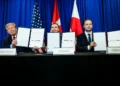
The meeting produced a limited economic outcome. U.S. Treasury Secretary Scott Bessent said the two sides agreed to extend their existing trade truce by two months, moving the immediate deadline into January. The extension gives negotiators additional time but leaves unresolved questions over tariffs, Chinese purchases of U.S. goods, rare-earth supplies and technology restrictions.

Trump described the meeting in warm personal terms, while Xi called for a relationship characterized by cooperation, controlled competition and management of differences.
The contrast between the ceremony and the substance of the talks illustrated the current state of the relationship: direct engagement has increased, but the strategic disagreements between the two governments remain.
A state visit built around ceremony
The White House prepared an extensive welcome for Xi.
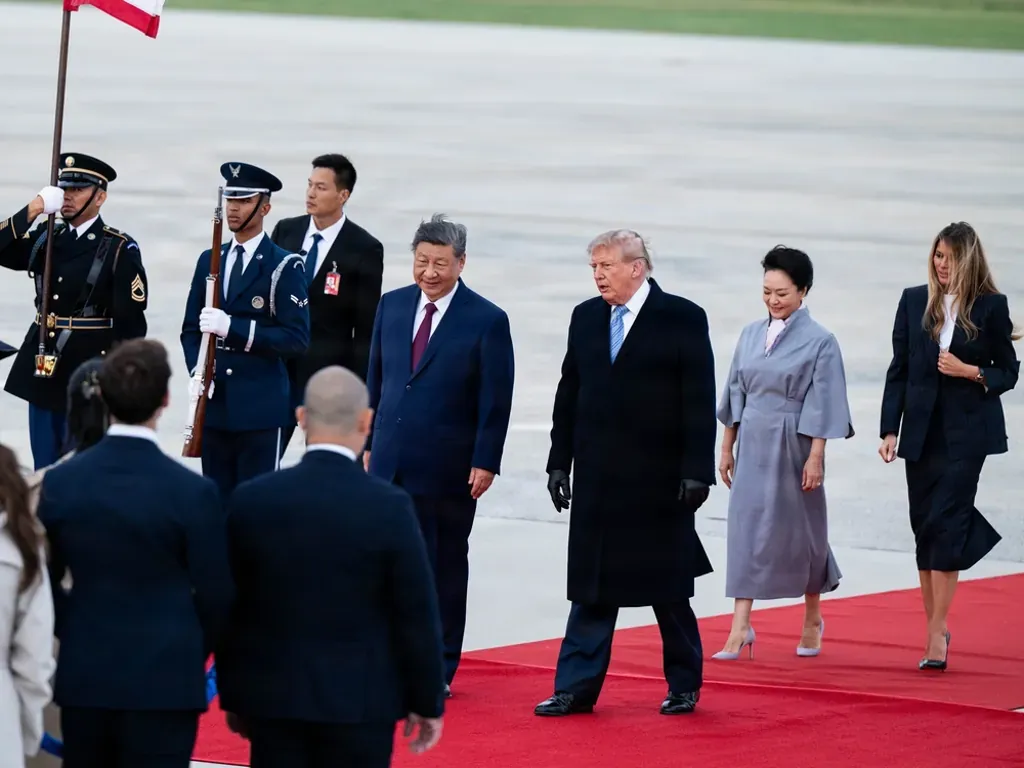
Trump and first lady Melania Trump greeted Xi and his wife, Peng Liyuan, at Joint Base Andrews on September 23. The following morning, the White House staged a formal arrival ceremony involving 479 military personnel from all branches of the U.S. armed forces. The program included military bands, a review and a flyover featuring a B-2 bomber and four F-22 fighter jets.
A state dinner followed that evening, bringing together government officials, the two delegations and business leaders.
■ Related News

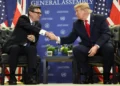
The White House said the dinner menu incorporated American ingredients with Chinese influences and included a toast referencing the 1972 meeting between President Richard Nixon and Chinese Premier Zhou Enlai.
The scale of the reception reflected the significance Washington attached to Xi’s visit.
It also carried a practical purpose. The leaders were meeting at a time when economic ties remained substantial but were increasingly shaped by tariffs, export controls and competition over advanced technology.
Trade truce extended, but not settled
Trade was among the most immediate issues facing the presidents.
The United States and China had previously reduced some of the tariffs imposed during their earlier confrontation and suspended additional measures under a temporary truce negotiated in Busan, South Korea.
That arrangement had been due to expire in November.
Bessent said after the Washington talks that the two sides had extended the truce for another two months. The move reduces the immediate risk of another tariff escalation but does not establish a permanent trade settlement.
The unresolved issues include the scale of Chinese purchases of U.S. agricultural products, access to rare-earth materials, tariffs and restrictions affecting advanced technologies.
The two governments have therefore moved from confrontation toward negotiation without removing the structural disputes that produced the confrontation in the first place.
Technology remains a central fault line
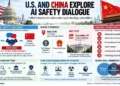
Artificial intelligence was another major subject.
Xi said the United States and China were both major AI powers and argued that competition should not prevent cooperation. China’s Foreign Ministry said Xi called for continued AI dialogue focused on both the technology’s risks and benefits and on preventing misuse.
Trump likewise said AI concerns warranted continued dialogue between the two countries.
The issue is complicated by Washington’s restrictions on China’s access to advanced semiconductor technology and Beijing’s efforts to build a domestic AI-chip ecosystem.
Those policies reflect competing national-security and economic objectives.
The United States has sought to restrict Chinese access to certain advanced computing and semiconductor technologies, while Chinese companies such as Huawei have accelerated development of domestic alternatives.
The summit did not resolve that broader technology competition.
Instead, the two sides agreed to continue talking about AI.
Taiwan remains a major disagreement
Taiwan was another issue where the two governments’ positions remain sharply different.
China considers Taiwan part of its territory and opposes what it calls “Taiwan independence.” The United States maintains unofficial relations with Taiwan and has continued providing defense equipment to the island.
During the summit, Xi urged Washington to oppose Taiwan independence and handle the Taiwan issue cautiously, according to China’s Foreign Ministry and Chinese state media.
The White House did not immediately release a detailed public readout of the private discussion on Taiwan.
The issue remains one of the most sensitive areas in the bilateral relationship because disagreements over Taiwan involve both political commitments and military planning.
The Washington meeting did not produce a public agreement that changed either side’s underlying position.
Xi also pressed for a broader relationship framework
China’s Foreign Ministry said Xi told Trump that the two countries should develop what their governments have described as a “constructive strategic stability” relationship.
Beijing said the two presidents had agreed in May to work toward that framework.
Xi argued that cooperation could produce mutual economic benefits while competition should be managed and disagreements controlled.
Trump also emphasized his relationship with Xi.
According to the Chinese Foreign Ministry’s account, Trump called Xi a friend and said the two countries could improve their relationship under their leadership.
The personal tone was notably different from the rhetoric surrounding the tariff escalation between the countries in 2025.
But warmer presidential language does not automatically resolve disputes embedded in trade, technology, national security and foreign policy.
Iran adds another layer to the relationship
The summit also took place against the backdrop of the Iran war.
Washington and Beijing have different positions on the conflict, while the war has affected energy markets and China’s access to oil from the Middle East.
Xi and Trump discussed the conflict as part of a wider exchange on international and regional issues. China’s position has emphasized negotiations and respect for sovereignty, while the Trump administration has pursued military pressure against Iran.
The two leaders also discussed Ukraine and the Korean Peninsula, according to China’s Foreign Ministry.
Those issues demonstrate how difficult it is to separate the bilateral relationship from wider geopolitical competition.
Washington and Beijing increasingly encounter each other not only through trade and technology but also through conflicts and diplomatic disputes elsewhere.
The relationship remains competitive despite the diplomacy
The state visit created a new opportunity for direct presidential engagement.
It did not eliminate the strategic competition that has defined U.S.-China relations in recent years.
The two countries remain economically interconnected, but their governments are also competing over advanced technology, supply chains, military influence and the future rules governing strategically important industries.
The short extension of the trade truce illustrates the situation.
It keeps negotiations moving and reduces the immediate prospect of another tariff confrontation. But because the extension is temporary, the underlying questions have simply been moved to a later date.
The same pattern is visible in AI.
Both governments have an interest in preventing uncontrolled risks from advanced AI, while each is simultaneously seeking technological advantages over the other.
And on Taiwan, the central disagreement remains.
A carefully managed thaw, not a settled relationship
Trump’s reception of Xi demonstrated the importance both governments place on keeping direct communication open.
For Beijing, the visit provided an opportunity to engage directly with the U.S. president while pressing its positions on trade, technology and Taiwan.
For Washington, the meeting created space to negotiate economic issues without abandoning broader technology and security policies.
The result was neither a return to the confrontational atmosphere of the earlier tariff war nor a comprehensive reset.
The two governments extended their trade truce, agreed to continue dialogue on AI and maintained direct communication on major international issues.
At the same time, tariffs, technology restrictions, rare-earth supplies, Taiwan and broader strategic competition remain active areas of disagreement.
The red carpet therefore marked a diplomatic opening, not the end of the rivalry.
Reporting Credit: The White House — state-visit arrangements, arrival ceremony and official program; U.S. Treasury — trade-truce negotiations and economic discussions; Chinese Ministry of Foreign Affairs — Xi Jinping’s account of the summit, Chinese positions on trade, AI, Taiwan and international issues; U.S. and Chinese negotiating teams — bilateral economic consultations.